




Introduction
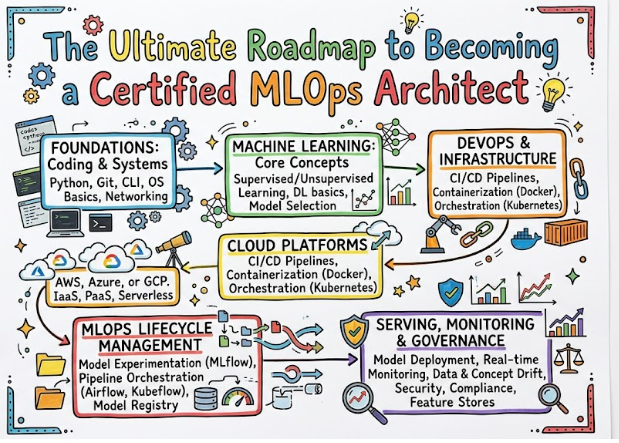
The Certified MLOps Architect program is a specialized curriculum designed to bridge the gap between machine learning development and large-scale production operations. This guide is crafted for engineers and technical leaders who recognize that building a model is only a small fraction of the effort required to maintain a functional system. As organizations shift toward data-driven decision-making, the demand for professionals who can automate, scale, and monitor these complex environments has reached an all-time high.
For those navigating careers in DevOps, cloud-native engineering, or platform management, understanding the nuances of machine learning operations is no longer optional. This guide, hosted by AIOps School, provides a clear roadmap to help you navigate this transition. By the end of this article, you will understand how this certification aligns with modern industry standards and how it can serve as a catalyst for your professional growth in a competitive global market.
What is the Certified MLOps Architect?
The Certified MLOps Architect is a professional designation that signifies a deep understanding of the intersection between data science, software engineering, and operations. It exists because traditional DevOps practices often fail to account for the unique challenges of machine learning, such as data drift, model versioning, and hardware-specific scaling. This program shifts the focus from purely theoretical knowledge to the practical application of building robust pipelines that ensure models remain reliable in production.
In modern enterprise workflows, an architect must ensure that code, data, and models are all treated as first-class citizens in a CI/CD pipeline. This certification validates your ability to design systems that handle automated retraining, performance monitoring, and secure deployment of models at scale. It aligns perfectly with the current industry move toward “Continuous Delivery for Machine Learning” (CD4ML), making it a cornerstone for teams aiming for operational excellence.
Who Should Pursue Certified MLOps Architect?
This program is primarily intended for software engineers and DevOps professionals who want to pivot into the specialized field of artificial intelligence operations. Systems Reliability Engineers (SREs) and cloud architects will find the curriculum particularly useful as it addresses the infrastructure requirements specific to ML, such as GPU partitioning and high-concurrency inference. It is also highly relevant for data engineers who want to extend their expertise beyond pipeline construction into the realm of model lifecycle management.
For technical managers and engineering leads, pursuing this certification provides the necessary context to build and lead high-performing MLOps teams. It helps them understand the resource allocation and risk management strategies unique to ML projects. Whether you are a beginner looking to enter the field or an experienced professional in India or the global market, this certification offers a structured way to prove your competency to potential employers and stakeholders.
Why Certified MLOps Architect is Valuable Beyond Today
The demand for MLOps expertise is driven by the rapid enterprise adoption of predictive analytics and generative models. As companies realize that manual model deployment is unsustainable, they are seeking architects who can implement standardized frameworks. This certification ensures you stay relevant by focusing on architectural principles that persist even as specific tools and libraries evolve over time. It provides a level of future-proofing that is essential in a rapidly changing technical landscape.
Investing your time in this certification offers a high return on effort because it addresses the “last mile” problem in machine learning—getting models out of the lab and into the hands of users. Enterprises are increasingly prioritizing reliability and reproducibility in their ML efforts to comply with internal audits and external regulations. By becoming a certified architect, you position yourself as a key asset capable of reducing the time-to-market for intelligent features while maintaining high standards of system stability.
Certified MLOps Architect Certification Overview
The program is delivered via the official curriculum at Certified MLOps Architect and is hosted on the AIOps School platform. The certification follows a structured assessment approach that prioritizes hands-on competence over rote memorization. It is designed to evaluate a candidate’s ability to design, implement, and manage the entire machine learning lifecycle in a cloud-native or hybrid environment.
The ownership of the program lies with industry practitioners who have faced the challenges of scaling models in real-world scenarios. The structure is practical, divided into manageable modules that cover everything from data ingestion and experiment tracking to deployment strategies and observability. This comprehensive approach ensures that once certified, you possess a holistic view of the MLOps ecosystem and can contribute to any stage of the production pipeline.
Certified MLOps Architect Certification Tracks & Levels
The certification is organized into three distinct levels to accommodate different stages of professional growth. The Foundation level focuses on core concepts and terminology, ensuring that everyone on a team speaks the same language. It is the starting point for those new to the intersection of ML and Ops, providing a baseline of knowledge regarding version control for data and basic model deployment.
The Professional and Advanced levels dive deeper into complex scenarios, such as multi-cloud orchestration and advanced security protocols for ML systems. These tracks allow professionals to specialize in areas like SRE for ML or FinOps for high-performance computing. As you progress through these levels, you demonstrate an increasing ability to handle larger, more complex systems, mirroring the natural progression from a junior engineer to a principal architect.
Complete Certified MLOps Architect Certification Table
| Track | Level | Who it’s for | Prerequisites | Skills Covered | Recommended Order |
| Core Architecture | Foundation | Beginners, Managers | Basic Linux & Python | GitOps, ML Lifecycles, CI/CD Basics | 1st |
| Implementation | Professional | DevOps Engineers, SREs | 2+ years Cloud experience | Kubernetes, Model Registry, Feature Stores | 2nd |
| Strategic Design | Advanced | Principal Engineers, Architects | 5+ years Systems Design | Distributed Training, ML Observability, Governance | 3rd |
Detailed Guide for Each Certified MLOps Architect Certification
Certified MLOps Architect – Foundation
What it is
This entry-level certification validates a candidate’s understanding of the fundamental principles of MLOps. It ensures that the professional can identify the different stages of the ML lifecycle and understands the basic infrastructure required to support them.
Who should take it
It is suitable for junior developers, data scientists wanting to learn operations, and technical recruiters or managers who need to understand the technical requirements of the field. No deep prior experience in operations is required.
Skills you’ll gain
- Understanding of ML lifecycle management and the role of an architect.
- Basic knowledge of versioning for both code and datasets.
- Familiarity with containerization and its importance in ML.
- Awareness of standard CI/CD tools used in automated model testing.
Real-world projects you should be able to do
- Set up a simple automated pipeline to retrain a model based on new data.
- Containerize a pre-trained model for consistent deployment across environments.
- Document the architectural flow of a basic machine learning application.
Preparation plan
- 7-14 Days: Focus on core terminology and the high-level differences between DevOps and MLOps.
- 30 Days: Complete the online modules and experiment with basic GitOps workflows for ML.
- 60 Days: Not typically required for this level, but useful for those entirely new to cloud computing.
Common mistakes
- Overcomplicating the infrastructure for simple model deployments.
- Ignoring the data versioning aspect and focusing only on the code.
- Not understanding the difference between model training and model inference.
Best next certification after this
- Same-track option: Certified MLOps Architect – Professional.
- Cross-track option: Certified DataOps Associate.
- Leadership option: Technical Product Manager for AI.
Certified MLOps Architect – Professional
What it is
This certification is designed to prove that an engineer can implement and manage production-grade MLOps environments. It focuses on the integration of various tools to create a seamless, automated workflow for model development and deployment.
Who should take it
This is intended for working DevOps engineers, SREs, and data engineers with at least two years of experience. Candidates should be comfortable with cloud platforms and container orchestration.
Skills you’ll gain
- Mastery of Kubernetes for scaling ML workloads and handling inference.
- Implementation of feature stores for centralized data management.
- Setting up automated model monitoring and alerting for drift detection.
- Integrating security best practices into the ML pipeline (DevSecOps for ML).
Real-world projects you should be able to do
- Deploy a highly available model inference service on a Kubernetes cluster.
- Build an automated pipeline that triggers retraining when model performance drops.
- Implement a centralized model registry for versioning and auditing purposes.
Preparation plan
- 7-14 Days: Review advanced Kubernetes concepts and ML-specific CRDs.
- 30 Days: Build a full end-to-end pipeline using an open-source framework like Kubeflow or MLflow.
- 60 Days: Deep dive into security, compliance, and multi-tenant infrastructure setups.
Common mistakes
- Failing to account for resource limits and quotas in shared clusters.
- Neglecting to implement proper logging and observability for models in production.
- Building “snowflake” environments that cannot be easily replicated.
Best next certification after this
- Same-track option: Certified MLOps Architect – Advanced.
- Cross-track option: Certified SRE Professional.
- Leadership option: Engineering Manager for Data Platforms.
Certified MLOps Architect – Advanced
What it is
The Advanced level is the pinnacle of the program, certifying that the individual can design complex, distributed, and highly secure MLOps strategies for global enterprises. It focuses on high-level architecture and strategic technical decision-making.
Who should take it
This is for principal engineers, lead architects, and senior technical leaders with extensive experience in systems design. It requires a deep understanding of both business goals and technical constraints.
Skills you’ll gain
- Design of distributed training systems across multiple cloud providers or data centers.
- Implementation of enterprise-wide governance and compliance frameworks for AI.
- Advanced cost optimization and FinOps strategies for large-scale ML clusters.
- Leadership in establishing MLOps culture and best practices across large organizations.
Real-world projects you should be able to do
- Architect a global model deployment strategy with low-latency inference at the edge.
- Design a disaster recovery and high-availability plan for critical ML infrastructure.
- Create an automated cost-attribution model for ML resources across different business units.
Preparation plan
- 7-14 Days: Focus on case studies of large-scale ML failures and architectural solutions.
- 30 Days: Design and document a complex multi-cloud architecture for a hypothetical enterprise.
- 60 Days: Engage in peer reviews and deep-dive sessions into the latest research in ML infrastructure.
Common mistakes
- Focusing too much on specific tools rather than architectural patterns.
- Underestimating the cultural shift required to implement MLOps at scale.
- Designing overly complex systems that are difficult for smaller teams to maintain.
Best next certification after this
- Same-track option: None (this is the highest level).
- Cross-track option: Certified FinOps Cloud Architect.
- Leadership option: Chief Technology Officer (CTO) track.
Choose Your Learning Path
DevOps Path
This path is for those who already have a strong foundation in traditional software delivery. You will focus on how to adapt existing CI/CD pipelines to accommodate the non-deterministic nature of machine learning. The goal is to treat ML models as another type of software artifact while respecting their unique requirements.
DevSecOps Path
The security path emphasizes the protection of the entire ML supply chain. You will learn how to scan datasets for poisoning, secure model weights, and ensure that inference endpoints are protected from adversarial attacks. This is critical for professionals working in regulated industries like finance or healthcare.
SRE Path
The Reliability path focuses on the uptime and performance of ML systems. You will learn how to apply SRE principles—like error budgets and service level objectives (SLOs)—to model performance. This path is essential for ensuring that ML-powered features do not become a bottleneck for the entire application.
AIOps Path
In the AIOps path, you focus on using machine learning to improve IT operations themselves. You will learn how to build systems that automatically detect anomalies in infrastructure and predict potential outages before they happen. This is a “meta” approach where you use the tools of ML to manage the tools of operations.
MLOps Path
The pure MLOps path is dedicated to the lifecycle of the model itself. You will spend your time mastering the transition from experimental notebooks to production-ready services. This path is ideal for those who want to be the primary link between the data science team and the engineering department.
DataOps Path
The DataOps path focuses on the “fuel” of the ML system: data. You will learn how to build resilient data pipelines that provide high-quality, versioned data to the MLOps pipeline. This path ensures that the foundation of the ML system is solid, reliable, and reproducible.
FinOps Path
The FinOps path addresses the massive costs associated with training and running large-scale machine learning models. You will learn how to optimize cloud spend, select the right instance types, and implement auto-scaling to ensure that the AI initiative remains financially viable for the organization.
Role → Recommended Certified MLOps Architect Certifications
| Role | Recommended Certifications |
| DevOps Engineer | Certified MLOps Architect (Foundation + Professional) |
| SRE | Certified MLOps Architect (Professional) |
| Platform Engineer | Certified MLOps Architect (Advanced) |
| Cloud Engineer | Certified MLOps Architect (Professional) |
| Security Engineer | Certified MLOps Architect (Professional + Security Specialization) |
| Data Engineer | Certified MLOps Architect (Foundation) |
| FinOps Practitioner | Certified MLOps Architect (Advanced) |
| Engineering Manager | Certified MLOps Architect (Foundation) |
Next Certifications to Take After Certified MLOps Architect
Same Track Progression
Once you have mastered the Certified MLOps Architect levels, the next step is to go deeper into specialized niches. This might include certifications in specific cloud platforms or advanced deep learning infrastructure. The goal is to become the go-to expert for the most difficult architectural challenges in the field.
Cross-Track Expansion
Broadening your skills into SRE or DataOps can make you a more versatile professional. By understanding how data flows through a pipeline and how systems are kept reliable, you can design MLOps strategies that are more integrated with the rest of the technology stack. This cross-pollination is highly valued in senior leadership roles.
Leadership & Management Track
For those looking to move into management, the next logical step is to pursue certifications focused on technical leadership and product management. Understanding the business value of AI and how to manage the lifecycle of a technical product will prepare you for roles like Director of Engineering or VP of AI Platforms.
Training & Certification Support Providers for Certified MLOps Architect
DevOpsSchool
DevOpsSchool has established itself as a major player in the technical training space, offering a vast array of resources for modern engineers. Their approach is heavily focused on community learning and providing hands-on labs that simulate real-world production issues. They provide a supportive environment for those looking to transition from traditional IT roles into DevOps and MLOps. Their curriculum is often updated to reflect the latest tools and trends in the industry, making them a reliable choice for ongoing professional development. They emphasize the importance of mastering the cultural aspects of engineering along with the technical skills required for success.
Cotocus
Cotocus specializes in high-end technical consulting and training, with a strong focus on cloud-native technologies and container orchestration. They are known for their deep-dive workshops that go beyond basic certification requirements to address complex enterprise challenges. Their instructors are often active practitioners who bring current industry insights into the classroom. Cotocus is particularly well-suited for organizations looking to upskill entire teams on specific technologies like Kubernetes, Terraform, and advanced CI/CD. Their training style is intense and practical, ensuring that participants can immediately apply what they have learned to their current projects and production environments.
Scmgalaxy
Scmgalaxy is a comprehensive community portal and training provider that has been serving the DevOps community for over a decade. They offer a wealth of free resources, tutorials, and structured courses that cover every aspect of the software development lifecycle. Their focus is on empowering engineers through knowledge sharing and collaborative learning. Scmgalaxy is an excellent starting point for those who prefer a self-paced learning approach before committing to formal certifications. They have a strong reputation for breaking down complex topics into digestible guides, making them a favorite among both beginners and experienced professionals looking to refresh their knowledge.
BestDevOps
BestDevOps focuses on delivering high-quality, curated content specifically designed for professionals who want to excel in modern operations. Their training programs are built around the concept of “quality over quantity,” ensuring that every module provides tangible value. They focus on the core principles of automation, monitoring, and collaborative engineering. BestDevOps is ideal for individuals who want a streamlined learning path without the noise often found in larger platforms. Their commitment to technical excellence and professional growth makes them a trusted partner for many engineers seeking to elevate their careers in a competitive job market.
DevSecOpsSchool
DevSecOpsSchool addresses the critical need for security integration within the modern delivery pipeline. As security becomes a shared responsibility across the entire engineering team, their courses provide the necessary tools and mindsets to implement “security as code.” They cover everything from automated vulnerability scanning to secrets management and compliance auditing. For an MLOps architect, understanding these security principles is vital for protecting sensitive data and model IP. DevSecOpsSchool provides a clear path for engineers to become security-conscious practitioners, ensuring that speed of delivery does not come at the cost of system integrity or data privacy.
SRESchool
SRESchool is dedicated to the art and science of Site Reliability Engineering, providing deep technical training on how to build and maintain ultra-reliable systems. Their curriculum is heavily influenced by the principles popularized by major tech companies, focusing on observability, incident management, and scalability. In the context of MLOps, SRE skills are essential for managing the unpredictable nature of ML workloads. SRESchool teaches engineers how to set meaningful performance metrics and how to build self-healing infrastructure. Their training is highly technical and aimed at those who enjoy solving complex stability problems in high-pressure production environments.
AIOpsSchool
AIOpsSchool is a specialized training provider focused on the intersection of artificial intelligence and operations. They provide the most direct support for the Certified MLOps Architect program, offering detailed modules on how to implement AI-driven automation. Their curriculum is designed to help engineers move beyond manual intervention by leveraging machine learning to optimize infrastructure performance. AIOpsSchool is the primary resource for anyone looking to master the use of AI within the DevOps lifecycle. They provide a unique blend of data science concepts and operational practices, making them a leader in this emerging and highly impactful technical domain.
DataOpsSchool
DataOpsSchool focuses on the fundamental component of any AI system: the data. Their training programs are designed to teach engineers how to manage the data lifecycle with the same rigor and automation applied to software code. They cover data quality, orchestration, and versioning, which are all critical prerequisites for successful MLOps. By focusing on the reliability of the data pipeline, DataOpsSchool ensures that the models being built are grounded in high-quality information. Their courses are essential for data engineers and architects who want to ensure their ML initiatives are built on a solid and scalable data foundation.
FinOpsSchool
FinOpsSchool addresses the often-overlooked aspect of cloud engineering: cost management. As ML training and inference costs can quickly spiral out of control, understanding the financial implications of architectural decisions is vital. FinOpsSchool provides the frameworks and tools needed to track, manage, and optimize cloud spend across the enterprise. Their training is crucial for architects who need to prove the ROI of their technical projects to business stakeholders. By mastering FinOps, an MLOps architect can ensure that their AI initiatives are not only technically successful but also financially sustainable in the long term.
Frequently Asked Questions (General)
- How difficult is the Certified MLOps Architect exam?
The difficulty depends on your level. Foundation is accessible to beginners, while Professional and Advanced require significant hands-on experience with cloud and Kubernetes. - How long does it take to get certified?
A dedicated professional can complete the Foundation level in a month, but reaching the Advanced level typically takes six months to a year of study and practice. - What are the prerequisites for the program?
Basic knowledge of Python, Linux, and Git is recommended for the starting level. Professional levels require experience with Docker and Kubernetes. - Is this certification recognized globally?
Yes, the program is designed to meet international standards and is recognized by major technology firms and enterprises across the globe. - What is the return on investment (ROI) for this certification?
Certified architects often see significant salary increases and have access to more senior roles in AI-driven companies. - Should I learn DevOps before MLOps?
While not strictly required, a strong understanding of DevOps principles makes the transition to MLOps much smoother. - Do I need to be a data scientist to take this course?
No, this is an architecture and operations course. While you will learn ML concepts, the focus is on the infrastructure and automation side. - Is the assessment hands-on or multiple choice?
The program uses a combination of both, with a heavy emphasis on practical lab exercises at the Professional and Advanced levels. - Can I take the exam online?
Yes, the certification is delivered and assessed through the official website platform for global accessibility. - How often do I need to renew my certification?
Certifications are generally valid for two years, after which you can renew by passing an updated exam or demonstrating ongoing professional work. - Does the program cover specific tools like AWS or Azure?
The program focuses on platform-agnostic principles but provides guidance on how to implement them on all major cloud providers. - Is there community support available?
Yes, students gain access to forums and groups where they can interact with instructors and peers.
FAQs on Certified MLOps Architect
- What makes a Certified MLOps Architect different from a Data Engineer?
While Data Engineers focus on the flow of data, the MLOps Architect focuses on the entire model lifecycle, including training and deployment. - Does this certification cover Generative AI and LLMs?
Yes, the modern curriculum includes the specific operational challenges of managing large language models and generative AI pipelines. - How does this program handle the “Data Drift” concept?
The certification teaches you how to architect automated monitoring systems that detect changes in data patterns and trigger alerts. - Will I learn about GPU orchestration?
Yes, the Professional and Advanced levels cover the complexities of managing hardware accelerators for ML workloads. - Is GitOps a part of the MLOps curriculum?
Absolutely, GitOps is a core component for managing the state of ML infrastructure and model versions. - How much coding is involved in the certification?
You will need a working knowledge of Python and YAML for configuration, though you won’t be writing complex algorithms. - What role does Kubernetes play in the certification?
Kubernetes is treated as the primary orchestration engine for scaling and managing ML services in production. - Can I skip the Foundation level?
It is recommended to start with Foundation to ensure you have a solid grasp of the terminology, but experienced professionals may challenge the Professional level directly.
Final Thoughts: Is Certified MLOps Architect Worth It?
From the perspective of a mentor who has watched the industry evolve for two decades, the shift toward MLOps is one of the most significant changes in our field. Companies are no longer satisfied with models that only work on a data scientist’s laptop. They need systems that are robust, secure, and scalable. The Certified MLOps Architect program is a direct answer to this need. It provides a structured, rigorous way to gain the skills that are currently in the highest demand.
Is it worth it? If you are looking to stay at the forefront of technical innovation and want to move into a role that is both challenging and highly rewarded, the answer is a clear yes. This isn’t about chasing a trend; it’s about mastering the infrastructure that will power the next generation of software. My advice is to approach this as a marathon, not a sprint. Take the time to truly understand the architectural principles, and you will find yourself in a very strong position for years to come.