




Introduction
In the current landscape of cloud computing, the focus has shifted from simple migration to sophisticated cost management and value realization. The Certified FinOps Architect is a professional designation designed to bridge the gap between engineering execution and financial accountability. This guide is crafted for professionals who recognize that cloud efficiency is no longer just a finance problem but a core engineering discipline. Whether you are navigating the complexities of multi-cloud environments or managing large-scale kubernetes clusters, understanding the architectural implications of cost is vital.
Platform engineering and DevOps teams are increasingly measured by their ability to deliver high-performing systems that remain economically viable. This guide aims to help engineers and technical leaders understand how the finopsschool curriculum prepares them for high-level decision-making. By moving beyond basic cost-tracking to architectural optimization, professionals can ensure their career trajectory aligns with the needs of modern, cloud-native enterprises. We will explore the technical depth, strategic value, and practical career impact of achieving this certification.
What is the Certified FinOps Architect?
The Certified FinOps Architect represents a specialized intersection of cloud architecture, financial management, and operational excellence. It exists because traditional cloud management often fails to account for the dynamic, elastic nature of modern infrastructure, leading to massive budget overruns. This certification focuses on teaching engineers how to build systems that are “cost-aware” by design, rather than trying to fix expensive mistakes after the fact.
Unlike entry-level certifications that focus on terminology, this program emphasizes real-world, production-focused learning. It covers the technical nuances of resource tagging, automated scaling policies, and the selection of cost-effective compute instances. It aligns perfectly with modern engineering workflows by integrating financial metrics into the CI/CD pipeline, ensuring that every deployment is evaluated for its economic impact alongside its performance.
Who Should Pursue Certified FinOps Architect?
This certification is primarily designed for senior engineering roles including SREs, DevOps Engineers, and Platform Architects who oversee large cloud footprints. Cloud professionals who are responsible for infrastructure design will find the curriculum essential for justifying architectural choices to stakeholders. It is also highly beneficial for security and data professionals who manage resource-intensive workloads and need to understand the financial guardrails of their environments.
The program caters to both seasoned engineers looking to pivot into leadership roles and technical managers who need a deeper understanding of cloud unit economics. In the global market, and particularly within the rapidly expanding Indian tech sector, there is a massive demand for professionals who can prove they know how to optimize cloud spend. Companies are moving away from “growth at all costs” and are actively seeking architects who can deliver “growth with fiscal responsibility.”
Why Certified FinOps Architect is Valuable and Beyond
The demand for FinOps expertise is tied directly to the continued adoption of cloud-native technologies and the increasing complexity of enterprise cloud bills. As organizations scale, the “visibility gap” between what is spent and what is delivered grows, making the Architect role indispensable for maintaining profitability. This certification offers longevity because it teaches principles of cloud economics that remain relevant even as specific cloud provider tools and services evolve.
Professionals who hold this certification demonstrate a unique ability to bridge the communication gap between the engineering floor and the C-suite. It helps you stay relevant by positioning you as a strategic partner to the business rather than just a technical implementer. The return on career investment is significant, as architects capable of saving an organization millions in cloud waste often command higher salaries and more influential roles within engineering leadership.
Certified FinOps Architect Certification Overview
The program is delivered via the official course page and is hosted on the primary platform of the provider. It is structured as a comprehensive learning journey that moves from foundational concepts to advanced architectural patterns. The assessment approach is practical, often requiring candidates to solve real-world scenarios rather than just memorizing facts.
Ownership of the FinOps lifecycle—Inform, Optimize, and Operate—is central to the curriculum. The structure is designed to be modular, allowing professionals to build their skills incrementally while focusing on the specific challenges of their enterprise environments. By focusing on practical application, the program ensures that candidates are ready to implement governance and automation strategies immediately upon completion.
Certified FinOps Architect Certification Tracks & Levels
The certification is typically categorized into three main tiers: Foundation, Professional, and Advanced. The Foundation level introduces the core vocabulary and the lifecycle of cloud financial management, making it ideal for those new to the discipline. The Professional level dives deeper into data analysis, forecasting, and cross-team collaboration, targeting active practitioners.
The Advanced or Architect level focuses on the technical implementation of FinOps principles within the infrastructure itself. This includes building automated remediation tools, designing for multi-tenancy, and implementing complex showback or chargeback models. These levels align with career progression from a standard engineer to a specialized FinOps lead or a Principal Architect responsible for organizational cloud strategy.
Complete Certified FinOps Architect Certification Table
| Track | Level | Who it’s for | Prerequisites | Skills Covered | Recommended Order |
| Core FinOps | Foundation | Junior Engineers, Finance Ops | Basic Cloud Awareness | Terminology, Lifecycle, Tools | 1st |
| FinOps Engineering | Professional | SRE, DevOps, Platform Eng | 2+ Years Cloud Exp | Tagging, Automation, Rightsizing | 2nd |
| FinOps Architecture | Advanced | Principal Architects, Tech Leads | Professional Cert | Unit Economics, Governance, Scaling | 3rd |
| Leadership | Executive | CTOs, VPs of Engineering | Management Experience | Strategy, Culture, Policy | Optional |
Detailed Guide for Each Certified FinOps Architect Certification
Certified FinOps Architect – Foundation Level
What it is
This entry-level certification validates a professional’s understanding of the basic principles of FinOps. It ensures the candidate speaks the same language as finance and engineering teams regarding cloud costs.
Who should take it
It is suitable for junior cloud engineers, project managers, and finance professionals who need to collaborate with technical teams on cloud budgets.
Skills you’ll gain
- Understanding the FinOps Lifecycle (Inform, Optimize, Operate).
- Knowledge of cloud billing structures and common terminology.
- Ability to identify areas of cloud waste in simple environments.
Real-world projects you should be able to do
- Create a basic cloud cost report using native cloud provider tools.
- Implement a simple tagging policy across a development environment.
Preparation plan
- 7-14 Days: Focus on the official glossary and basic cloud pricing models.
- 30 Days: Practice using cost explorer tools in a sandbox environment.
- 60 Days: Not required for this level unless the candidate is entirely new to tech.
Common mistakes
- Overcomplicating the financial terms and ignoring the operational aspect.
- Failing to understand the difference between Capex and Opex.
Best next certification after this
- Same-track option: Certified FinOps Practitioner.
- Cross-track option: Cloud Provider Developer Associate.
- Leadership option: Technical Project Management.
Certified FinOps Architect – Practitioner Level
What it is
The Practitioner level validates the ability to apply FinOps principles to solve everyday operational challenges. It focuses on the data-driven decision-making required to optimize active workloads.
Who should take it
Mid-level DevOps engineers, SREs, and cloud analysts who are actively managing production workloads and cloud budgets.
Skills you’ll gain
- Advanced data analysis for cloud spending trends.
- Implementation of anomaly detection for cloud billing.
- Managing commitment-based discounts (RIs and Savings Plans).
Real-world projects you should be able to do
- Design and execute a rightsizing project for a large compute cluster.
- Build a dashboard that tracks unit costs for a specific microservice.
Preparation plan
- 7-14 Days: Review advanced billing concepts and data analysis techniques.
- 30 Days: Work through case studies on rightsizing and reservation management.
- 60 Days: Deep dive into SQL or business intelligence tools for custom reporting.
Common mistakes
- Relying too heavily on automated recommendations without manual verification.
- Neglecting the cultural change required to get engineering buy-in.
Best next certification after this
- Same-track option: Certified FinOps Architect.
- Cross-track option: Certified Kubernetes Administrator (CKA).
- Leadership option: Engineering Manager training.
Certified FinOps Architect – Architect Level
What it is
This is the pinnacle of the track, validating an engineer’s ability to design cost-optimized architectures. It focuses on engineering-led FinOps rather than just reporting.
Who should take it
Senior Architects, Principal Engineers, and Platform Leads who define the technical standards for an entire organization.
Skills you’ll gain
- Designing serverless and auto-scaling architectures for maximum efficiency.
- Implementing “Policy as Code” for financial guardrails.
- Advanced Kubernetes cost management and multi-tenant allocation.
Real-world projects you should be able to do
- Architect a multi-region system that automatically shifts workloads based on cost/performance.
- Develop an automated remediation engine to shut down unapproved resources.
Preparation plan
- 7-14 Days: Intensive review of complex architectural patterns and governance.
- 30 Days: Hands-on labs focusing on automation and Policy as Code.
- 60 Days: Full immersion in enterprise-scale cloud financial management scenarios.
Common mistakes
- Focusing only on cost and sacrificing system performance or reliability.
- Underestimating the complexity of shared resource allocation in containers.
Best next certification after this
- Same-track option: Advanced FinOps Strategy.
- Cross-track option: Security Architect certification.
- Leadership option: Chief Cloud Officer (CCO) path.
Choose Your Learning Path
DevOps Path
The DevOps path focuses on integrating FinOps into the existing delivery pipeline. Engineers learn how to provide immediate cost feedback to developers during the deployment phase. This involves setting up automated alerts within CI/CD tools and ensuring that infrastructure-as-code scripts include financial guardrails. The goal is to make cost a first-class citizen in the development lifecycle, similar to how security and performance are handled.
DevSecOps Path
In this path, the focus is on the intersection of security, compliance, and cost. Professionals learn how security configurations, such as high-availability requirements across multiple zones, impact the cloud bill. This path teaches how to balance the need for robust security with the mandate for cost efficiency. It also covers the financial implications of data retention policies and the cost of security logging and monitoring at scale.
SRE Path
The SRE path views FinOps through the lens of reliability and efficiency. SREs learn to treat “cost” as another metric to be monitored alongside latency and error rates. This path focuses on building automated systems that can scale down resources during low demand without impacting the user experience. Engineers explore how to use error budgets and financial budgets in tandem to maintain a healthy and sustainable production environment.
AIOps Path
The AIOps path leverages artificial intelligence to manage complex cloud environments. In this track, professionals learn to use machine learning models to predict future cloud spend and identify complex patterns of waste that human analysis might miss. The focus is on automating the “Inform” and “Optimize” phases of FinOps using intelligent algorithms that can adapt to changing usage patterns in real-time.
MLOps Path
The MLOps path is specifically tailored to the unique cost challenges of machine learning workloads. Training large models often involves high GPU costs and massive data movement fees. This path teaches engineers how to architect ML pipelines that are cost-effective, including the use of spot instances for training and the optimization of inference endpoints. It is essential for teams looking to scale AI capabilities without incurring exponential costs.
DataOps Path
DataOps focuses on the financial management of data pipelines, storage, and big data processing. Data professionals learn how to manage the costs associated with data lakes, warehouses, and real-time streaming services. This path covers strategies for data lifecycle management, tiered storage, and optimizing query performance to reduce processing fees. It ensures that the value extracted from data is always higher than the cost of storing and processing it.
FinOps Path
The pure FinOps path is for those who want to become specialists in the discipline itself. This involves a deep dive into the cultural and organizational aspects of cloud financial management. Professionals learn how to build a FinOps center of excellence, drive cross-departmental collaboration, and establish a culture of accountability. The focus is on the holistic view of the cloud business, including procurement, finance, and engineering alignment.
Role → Recommended Certified FinOps Architect Certifications
| Role | Recommended Certifications |
| DevOps Engineer | FinOps Foundation, FinOps Practitioner |
| SRE | FinOps Practitioner, FinOps Architect |
| Platform Engineer | FinOps Architect |
| Cloud Engineer | FinOps Foundation, FinOps Practitioner |
| Security Engineer | FinOps Foundation, DevSecOps Specialist |
| Data Engineer | FinOps Practitioner, DataOps Specialist |
| FinOps Practitioner | FinOps Foundation, Practitioner, Architect |
| Engineering Manager | FinOps Foundation, Leadership Track |
Next Certifications to Take After Certified FinOps Architect
Same Track Progression
For those who have reached the Architect level, the next step is often a deeper specialization in specific cloud providers or advanced strategy. This might include becoming a subject matter expert in Kubernetes FinOps or focusing on multi-cloud governance. Deepening your expertise ensures you remain the go-to person for the most complex financial and technical challenges within the cloud ecosystem.
Cross-Track Expansion
Broadening your skills into related areas like Security or Site Reliability Engineering provides a more well-rounded profile. A FinOps Architect who also understands the intricacies of cloud security is a massive asset to any enterprise. This cross-pollination of skills allows you to design systems that are not only cost-effective but also secure, resilient, and highly performant.
Leadership & Management Track
Moving into leadership requires a shift from technical implementation to strategic planning and people management. Certifications in ITIL, PMP, or dedicated leadership programs help in this transition. For a FinOps expert, the ultimate goal might be a role like Director of Cloud Operations or Chief Information Officer, where you manage the entire organizational technology budget and strategy.
Training & Certification Support Providers for Certified FinOps Architect
DevOpsSchool
DevOpsSchool provides a robust platform for engineering professionals looking to master modern infrastructure tools. Their curriculum is known for its heavy emphasis on hands-on labs and real-world project scenarios. They offer comprehensive support for various cloud-native certifications, ensuring that students understand the practical application of the theories they learn. With a focus on the entire DevOps lifecycle, they help bridge the gap between development and operations. Their instructors are typically industry veterans who bring a wealth of practical knowledge to the classroom environment.
Cotocus
Cotocus focuses on providing specialized training solutions for enterprise teams and individual professionals. They are known for their tailored approach to learning, often customizing their training modules to meet the specific needs of a corporate environment. Their courses cover a wide range of cloud and automation technologies, with a particular focus on helping candidates pass rigorous certification exams. They provide a supportive learning environment with access to various resources and mentorship. Their goal is to empower engineers with the skills needed to navigate the complexities of modern cloud architectures effectively.
Scmgalaxy
Scmgalaxy is a prominent community and training hub for software configuration management and DevOps professionals. They offer a vast repository of tutorials, guides, and certification preparation materials that are highly valued by the engineering community. Their training programs are designed to be practical and industry-aligned, focusing on the tools and practices that are in high demand. They foster a strong community of learners and experts, providing a platform for knowledge sharing and career growth. Their contribution to the DevOps space has made them a reliable source for technical skill development.
BestDevOps
BestDevOps offers a streamlined approach to technical training, focusing on the most relevant and high-impact skills in the market today. Their courses are structured to be efficient and effective, catering to busy professionals who need to upskill quickly. They provide clear, concise learning materials and practical exercises that reinforce core concepts. Their focus on the “best practices” of the industry ensures that their students are learning the most modern and efficient ways to manage cloud infrastructure. They are a popular choice for those looking for a direct and results-oriented learning path.
devsecopsschool.com
DevSecOpsSchool is a specialized training provider that focuses on the integration of security into the DevOps process. They offer deep-dives into the tools and methodologies required to build secure, automated pipelines. Their curriculum covers everything from automated security testing to compliance as code. They are essential for professionals who want to ensure that their speed of delivery does not come at the cost of security. Their training programs help engineers become security-conscious practitioners who can defend modern cloud-native environments against evolving threats.
sreschool.com
SRESchool focuses on the discipline of Site Reliability Engineering, teaching the principles of scale, reliability, and automation. Their courses are designed to help engineers build systems that are both highly available and efficient. They cover essential SRE topics such as error budgets, toil reduction, and incident management. Their training is highly technical and aimed at those who manage production environments at scale. By focusing on the operational aspects of software engineering, they prepare candidates for one of the most critical roles in the modern tech industry.
aiopsschool.com
AIOpsSchool is at the forefront of the shift toward intelligent operations. They provide training on how to use artificial intelligence and machine learning to automate and enhance IT operations. Their curriculum includes data science basics for engineers and the practical application of AI tools in monitoring and incident response. They help professionals prepare for a future where manual operations are replaced by intelligent, self-healing systems. Their courses are ideal for those looking to stay ahead of the curve in a rapidly changing technological landscape.
dataopsschool.com
DataOpsSchool addresses the growing need for efficient and reliable data management. They focus on the lifecycle of data, from ingestion to analysis, and how to automate the pipelines that support it. Their training covers data governance, quality, and the financial aspects of managing large-scale data environments. They help data engineers and architects build systems that are scalable and cost-effective. Their goal is to treat data with the same operational rigor that DevOps brings to software development, ensuring high-quality data delivery.
finopsschool.com
FinOpsSchool is the primary destination for professionals dedicated to the discipline of cloud financial management. They provide a comprehensive suite of certifications and training programs designed to help organizations maximize the value of their cloud spend. Their curriculum is the industry standard for FinOps education, covering the cultural, financial, and technical aspects of the field. They provide a clear path from foundational knowledge to advanced architectural expertise. Their focus is on creating a community of practitioners who can drive real financial impact within their organizations.
Frequently Asked Questions (General)
- How difficult is the Certified FinOps Architect exam?
The exam is considered moderately difficult as it requires a blend of financial understanding and deep technical cloud knowledge. It is not just about theory; you must know how to implement solutions. - How much time does it take to prepare for this certification?
For someone with a cloud background, 30 to 60 days of focused study is usually sufficient. Beginners may need three to six months to grasp the prerequisite cloud concepts first. - What are the prerequisites for the Architect level?
Ideally, you should have at least one professional-level cloud provider certification and a solid understanding of infrastructure-as-code and container orchestration. - What is the typical ROI for this certification?
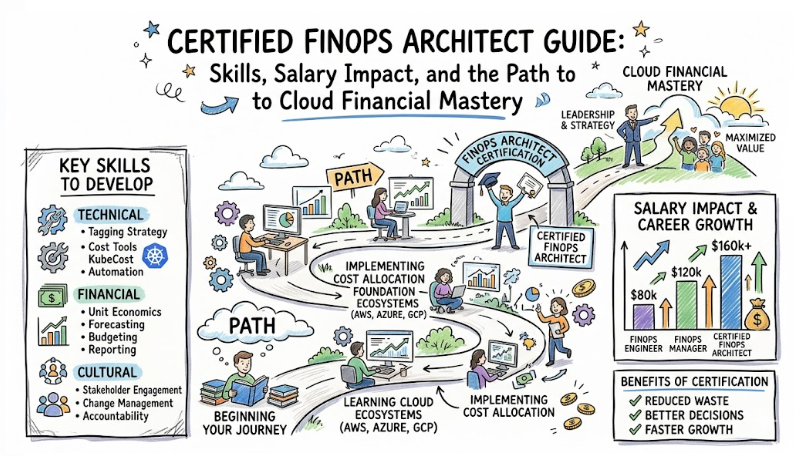
Professionals often see immediate career benefits, including eligibility for senior leadership roles and an average salary increase of 15-25% depending on the region and experience. - Is this certification recognized globally?
Yes, FinOps is a global movement, and this certification is recognized by major enterprises and cloud service providers worldwide. - Do I need a finance degree to take this course?
No, a finance degree is not required. The course teaches you the specific financial concepts you need to know within the context of cloud engineering. - How does this differ from a standard Cloud Architect certification?
A standard Cloud Architect cert focuses on how to build systems for performance and reliability; this cert focuses on how to build them for cost-efficiency and value. - Can I skip the Foundation level?
While possible if you have extensive experience, it is generally recommended to start with the Foundation to ensure you are aligned with the official terminology and framework. - How often do I need to recertify?
Most certifications in this space require recertification every two to three years to ensure your skills stay current with evolving cloud billing practices. - Are there any hands-on labs in the training?
Yes, the Architect and Practitioner levels heavily emphasize hands-on labs where you practice rightsizing and building cost dashboards. - Does this certification help with career transitions?
Absolutely. It is an excellent way for traditional IT managers or finance professionals to pivot into high-demand cloud operations roles. - Is FinOps just about cutting costs?
No, FinOps is about maximizing value. Sometimes that means spending more on the cloud to drive even higher business revenue, but doing so intentionally.
FAQs on Certified FinOps Architect
- What specific cloud providers are covered in the Certified FinOps Architect program?
The program is cloud-agnostic, meaning it teaches principles that apply to AWS, Azure, and Google Cloud equally. - How does the Architect level handle Kubernetes costs?
It dives deep into container cost allocation, teaching you how to use tools to see spend at the namespace, pod, and label level. - Does the certification cover third-party FinOps tools?
While it mentions them, the focus is on the underlying principles and native cloud tools to ensure your skills are transferable. - Is there an emphasis on automation?
Yes, the Architect level focuses heavily on using code and automation to enforce financial policies and remediate waste. - What is “Unit Economics” in the context of this certification?
It refers to calculating the cloud cost per business metric, such as cost per customer transaction or cost per user. - How does this program address multi-cloud environments?
It teaches strategies for consistent tagging and reporting across different cloud providers to give a single pane of glass view. - Are there case studies included in the curriculum?
Yes, real-world enterprise scenarios are used to teach how to navigate complex organizational hurdles and technical debt. - Will I learn about commitment-based discounts like Savings Plans?
Yes, advanced strategies for managing and optimizing commitment-based discounts are a core part of the professional and architect levels.
Final Thoughts: Is Certified FinOps Architect Worth It?
If you are looking for a way to differentiate yourself in a crowded field of cloud engineers, the Certified FinOps Architect is a powerful choice. It marks you as a professional who understands that the ultimate goal of technology is to drive business value, not just to run code. In an era where cloud budgets are under intense scrutiny, being the person who can architect for efficiency is a highly secure and lucrative position.
The most important advice I can give is to treat FinOps as a core engineering skill, not an administrative burden. When you start seeing your infrastructure through the lens of unit economics, your architectural decisions become much sharper and more impactful. This certification is more than just a credential; it is a shift in mindset that will serve you throughout your career in the cloud-native ecosystem. Stick to the practical applications, engage with the community, and focus on delivering measurable value.