




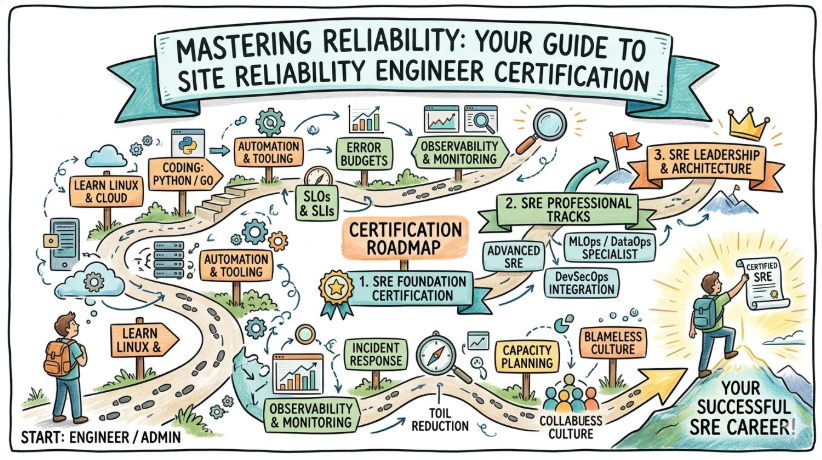
The Certified Site Reliability Engineer program is a professional credential designed to bridge the gap between software development and IT operations through the lens of Google’s SRE principles. This guide is written for engineers and technical leaders who want to master the art of building scalable, reliable, and efficient distributed systems in a cloud-native world. As the industry moves toward platform engineering and automated operations, understanding these core tenets is no longer optional for high-growth careers. By reading this guide, you will gain a clear roadmap on how to validate your technical expertise and make informed decisions about your professional development.
What is the Certified Site Reliability Engineer?
The Certified Site Reliability Engineer represents a standard of excellence for professionals who manage production systems using software engineering mindsets. It exists to provide a structured learning path that prioritizes real-world application, such as error budgets and service level objectives, over purely theoretical concepts. This certification focuses on the practical implementation of automation, monitoring, and incident response within modern engineering workflows. It ensures that practitioners can handle the complexities of enterprise-scale infrastructure while maintaining high availability and performance.
Who Should Pursue Certified Site Reliability Engineer?
This certification is highly beneficial for DevOps engineers, systems administrators, and software developers who are transitioning into reliability-focused roles. Cloud professionals and security engineers will find value in the systemic approach to risk management and infrastructure stability provided by the curriculum. Even engineering managers and technical leads can benefit from this track to better understand how to balance feature velocity with system stability. Whether you are a beginner in India or an experienced professional in a global tech hub, this credential aligns your skills with international industry standards.
Why Certified Site Reliability Engineer is Valuable and Beyond
The demand for SRE professionals continues to outpace supply as organizations migrate more services to complex microservices architectures. This certification provides longevity to a career because it teaches fundamental principles of reliability that remain constant even as specific tools and cloud providers evolve. Organizations are increasingly adopting SRE practices to reduce downtime and improve customer satisfaction, making certified professionals highly sought after for their specialized knowledge. Investing time in this certification offers a high return by positioning you as a high-value asset capable of managing mission-critical production environments.
Certified Site Reliability Engineer Certification Overview
The program is delivered via the official course page at Site Reliability Engineer Certification and is hosted on the sreschool.com platform. It is structured to provide a comprehensive assessment of an individual’s ability to apply SRE principles to modern IT challenges through various levels of testing. The certification ownership ensures that the curriculum stays updated with the latest industry trends and best practices in the SRE domain. Candidates undergo a rigorous process that validates their competency in automation, monitoring, and the cultural aspects of site reliability.
Certified Site Reliability Engineer Certification Tracks & Levels
The certification is organized into foundation, professional, and advanced levels to cater to different stages of an engineer’s career. The foundation level introduces core concepts, while the professional and advanced tracks dive deep into specialized areas like advanced automation, architecture, and observability. There are also specific specialization tracks that allow professionals to align their SRE skills with other domains such as FinOps or DevSecOps. This tiered approach allows for a logical progression, ensuring that learners build a solid base before tackling complex, high-level system designs.
Complete Certified Site Reliability Engineer Certification Table
| Track | Level | Who it’s for | Prerequisites | Skills Covered | Recommended Order |
| SRE Core | Foundation | Aspiring SREs | Basic Linux & Networking | SLOs, SLIs, Error Budgets | 1 |
| SRE Core | Professional | Experienced SREs | Foundation Level | Automation, Incident Response | 2 |
| SRE Core | Advanced | Lead Engineers | Professional Level | Capacity Planning, Architecture | 3 |
| SRE + DevOps | Professional | DevOps Engineers | Foundation Level | CI/CD Integration, IaC | 2 |
| SRE + FinOps | Professional | Cloud Architects | Foundation Level | Cost Optimization, Resource Scaling | 2 |
Detailed Guide for Each Certified Site Reliability Engineer Certification
Certified Site Reliability Engineer
What it is This certification validates a foundational understanding of SRE principles, terminology, and the core practices required to maintain service reliability. It serves as the entry point for anyone looking to formalize their knowledge of modern production operations.
Who should take it It is suitable for junior engineers, developers, and traditional operations staff who want to understand the SRE framework. It is also ideal for managers who need a high-level overview of how SRE teams function and add value.
Skills you’ll gain
- Understanding the difference between DevOps and SRE.
- Defining and measuring Service Level Objectives (SLOs) and Service Level Indicators (SLIs).
- Managing Error Budgets to balance innovation and stability.
- Implementing basic monitoring and alerting strategies.
- Understanding the importance of automation in reducing toil.
Real-world projects you should be able to do
- Create a basic dashboard for tracking service health and SLIs.
- Draft an Error Budget policy for a sample application.
- Automate a repetitive operational task using scripting.
- Conduct a basic post-mortem for a simulated system failure.
Preparation plan
- 7-14 Days: Focused study for individuals with strong prior background in Linux and cloud operations.
- 30 Days: Recommended for working professionals who can dedicate a few hours a week to review modules and take practice tests.
- 60 Days: Ideal for beginners who need to learn the underlying infrastructure concepts alongside SRE principles.
Common mistakes
- Focusing too much on specific tools rather than the underlying SRE principles and philosophy.
- Underestimating the importance of cultural aspects like psychological safety and blamelessness.
- Ignoring the mathematical logic behind calculating availability and error budgets.
Best next certification after this
- Same-track option: Certified Site Reliability Engineer – Professional.
- Cross-track option: Certified DevSecOps Professional.
- Leadership option: Engineering Management Foundation.
Choose Your Learning Path
DevOps Path
The DevOps path focuses on the integration of development and operations through continuous delivery and automated infrastructure. It emphasizes the speed of delivery while ensuring that the transition from code to production is seamless and repeatable. Engineers in this path learn to build robust CI/CD pipelines and manage infrastructure as code to support rapid deployment cycles. This is the ideal route for those who enjoy optimizing the software delivery lifecycle and working closely with development teams.
DevSecOps Path
The DevSecOps path integrates security practices directly into the DevOps and SRE workflows rather than treating it as an afterthought. It covers automated security testing, vulnerability management, and compliance as code within the delivery pipeline. Professionals following this path focus on creating secure-by-default systems and ensuring that reliability does not come at the cost of security. This is a critical path for organizations handling sensitive data and operating in highly regulated industries.
SRE Path
The SRE path is deeply focused on the stability, performance, and scalability of systems once they are in production. It prioritizes software engineering solutions to operational problems, such as building automated self-healing systems and advanced observability platforms. SREs work to minimize toil and ensure that the system meets its reliability targets through data-driven decision-making. This path is perfect for engineers who are passionate about complex system architecture and high-scale production management.
AIOps Path
The AIOps path explores the application of artificial intelligence and machine learning to IT operations. It involves using data science techniques to analyze massive amounts of log and metric data to predict and prevent system failures before they occur. Professionals in this track learn how to implement automated root cause analysis and anomaly detection to enhance traditional monitoring. This is a forward-looking path for engineers interested in the intersection of data science and system reliability.
MLOps Path
The MLOps path focuses on the operationalization of machine learning models, ensuring they are deployed, monitored, and retrained reliably. It addresses the unique challenges of managing data pipelines and model drift in production environments. This track bridges the gap between data science and traditional SRE, ensuring that AI-driven features are as stable as standard software services. It is essential for teams looking to scale their machine learning capabilities in a production-ready manner.
DataOps Path
The DataOps path applies SRE and DevOps principles to data management and data engineering pipelines. It focuses on improving data quality, reducing the cycle time of data analytics, and ensuring the reliability of data delivery. By implementing automated testing and monitoring for data, professionals in this track help organizations make more reliable data-driven decisions. This path is designed for data engineers and architects who want to bring operational excellence to their data platforms.
FinOps Path
The FinOps path centers on the financial management of cloud resources, ensuring that organizations get the most value out of their cloud spend. It involves tracking costs, optimizing resource utilization, and fostering a culture of financial accountability among engineering teams. By combining SRE principles with financial discipline, professionals can ensure that systems are not only reliable but also cost-effective. This path is vital for companies looking to control their cloud budgets while maintaining high performance.
Role → Recommended Certified Site Reliability Engineer Certifications
| Role | Recommended Certifications |
| DevOps Engineer | Certified Site Reliability Engineer – Foundation |
| SRE | Certified Site Reliability Engineer – Professional |
| Platform Engineer | Certified Site Reliability Engineer – Advanced |
| Cloud Engineer | Certified Site Reliability Engineer – Foundation |
| Security Engineer | Certified Site Reliability Engineer – Foundation |
| Data Engineer | Certified Site Reliability Engineer – Foundation |
| FinOps Practitioner | Certified Site Reliability Engineer – Foundation |
| Engineering Manager | Certified Site Reliability Engineer – Foundation |
Next Certifications to Take After Certified Site Reliability Engineer
Same Track Progression
After completing the foundation level, the natural progression is to move toward the professional and advanced levels within the SRE track. This allows for a deeper dive into complex topics like distributed system design, advanced automation, and building internal developer platforms. Deep specialization in SRE makes you a subject matter expert capable of leading large-scale reliability initiatives within global enterprises. It ensures you have the technical depth to solve the most challenging production issues.
Cross-Track Expansion
For those looking to broaden their skill set, moving into DevSecOps or AIOps is a strategic choice after mastering SRE basics. Expanding into security ensures that the reliable systems you build are also protected against modern threats. Alternatively, moving into AIOps allows you to leverage machine learning to automate the reliability tasks you have mastered manually. This cross-pollination of skills makes you a versatile engineer capable of handling multiple facets of modern infrastructure.
Leadership & Management Track
If your goal is to transition into leadership, following up your SRE certification with management-focused credentials is recommended. Understanding the technicalities of SRE provides a strong foundation for managing high-performing engineering teams and making data-driven business decisions. Leadership in the SRE space involves setting organizational goals for reliability and advocating for the necessary resources and cultural changes. This track prepares you for roles like Site Reliability Manager or Director of Platform Engineering.
Training & Certification Support Providers for Certified Site Reliability Engineer
DevOpsSchool is a leading provider that offers comprehensive training programs tailored to the SRE curriculum, providing hands-on labs and expert-led sessions. Their approach focuses on bridging the gap between theoretical knowledge and the practical skills required in the industry today. They have a strong reputation for helping professionals in India and abroad achieve their certification goals through structured learning paths.
Cotocus provides specialized coaching and mentorship for engineers looking to master site reliability and cloud-native technologies. Their training modules are designed to be interactive, ensuring that students can apply what they learn to real-world production scenarios immediately. They offer flexible learning options that cater to the schedules of busy working professionals seeking career advancement.
Scmgalaxy is a well-known community and training hub that focuses on configuration management, CI/CD, and the broader SRE ecosystem. They provide a wealth of resources, including tutorials and practice exams, to help candidates prepare thoroughly for their certification journeys. Their focus on open-source tools and industry best practices makes them a valuable partner for any aspiring SRE.
BestDevOps offers high-quality training materials and bootcamps specifically designed for the SRE and DevOps community. Their curriculum is updated frequently to reflect the changing landscape of cloud operations and automated system management. They emphasize the importance of hands-on experience, providing students with environments to practice complex troubleshooting and automation tasks.
devsecopsschool.com focuses on the critical intersection of security and operations, providing training that complements the SRE mindset. Their programs teach engineers how to build reliability and security into the core of their delivery pipelines. This provider is ideal for those who want a holistic view of modern engineering that includes robust security protocols.
sreschool.com is the primary platform for SRE-specific certifications and learning resources, offering a direct path to becoming a certified professional. It serves as a centralized hub for the latest SRE methodologies, case studies, and official certification exams. The platform is designed to support learners at every stage of their SRE journey, from foundation to advanced levels.
aiopsschool.com provides cutting-edge training for engineers who want to integrate artificial intelligence into their operational workflows. Their courses cover the tools and techniques needed to move from reactive to predictive maintenance using data science. This is the go-to provider for SREs looking to stay ahead of the curve with AI-driven automation.
dataopsschool.com offers specialized training for managing data pipelines with the same rigour and reliability as software applications. Their curriculum focuses on the unique challenges of data reliability, quality, and scalability in large-scale environments. They help data professionals adopt SRE principles to ensure consistent and accurate data delivery.
finopsschool.com focuses on the essential skill of cloud financial management, teaching engineers how to balance performance with cost. Their training programs provide the tools needed to implement cost-visibility and optimization strategies within SRE teams. This provider is essential for anyone looking to manage the business side of cloud infrastructure effectively.
Frequently Asked Questions (General)
- How difficult is the Certified Site Reliability Engineer exam? The difficulty depends on your level of experience with production systems and Linux environments. The foundation exam is manageable with dedicated study, while professional levels require hands-on experience.
- How long does it take to prepare for the certification? Most professionals spend between 4 to 8 weeks preparing, depending on their existing knowledge and the amount of time they can dedicate each week.
- Are there any prerequisites for the foundation level? There are no formal prerequisites, but a basic understanding of computer networking, Linux command line, and software development cycles is highly recommended.
- What is the return on investment for this certification? Certified SREs often see significant salary increases and have access to higher-level job opportunities in top-tier tech companies globally.
- Is this certification recognized globally? Yes, the principles taught are based on industry-standard SRE practices used by major tech organizations worldwide, making it highly portable across borders.
- Can I take the exam online? Yes, the certification exams are typically offered through online proctored platforms, allowing you to take them from the comfort of your home or office.
- How does SRE differ from traditional DevOps? While DevOps is a cultural philosophy, SRE is a specific implementation of that philosophy using software engineering practices to solve operations problems.
- Do I need to know how to code to become a Certified SRE? Yes, a basic to intermediate level of coding (usually in Python, Go, or Shell) is necessary as SRE relies heavily on automation and building software tools.
- What tools should I be familiar with? While the certification is principle-based, familiarity with Docker, Kubernetes, Prometheus, Terraform, and cloud platforms like AWS or GCP is very helpful.
- Is there a renewal process for the certification? Most certifications in this domain require renewal or continuing education every two to three years to ensure your skills stay current with the fast-moving industry.
- Does the certification include hands-on labs? Most reputable training providers associated with this certification include lab environments to practice the implementation of SLOs and monitoring stacks.
- Which level should I start with if I have 5 years of experience? Even with experience, starting with the foundation level is recommended to ensure you have the correct terminology and philosophical alignment before moving to advanced topics.
FAQs on Certified Site Reliability Engineer
- What is the core focus of the Certified Site Reliability Engineer – Foundation? The focus is on the essential SRE principles like SLIs, SLOs, and Error Budgets. It ensures you understand how to quantify reliability and use it to drive operational decisions within a team.
- How does this certification help with incident management? It teaches you the structured approach to incident response, including the roles of an incident commander and the process of conducting blameless post-mortems to prevent future failures.
- Will this certification help me in a Platform Engineering role? Absolutely, as Platform Engineering often involves building the very tools and infrastructures that SREs use to maintain reliability across an entire organization.
- What is the importance of toil reduction in the curriculum? The certification emphasizes identifying and automating “toil”—manual, repetitive work—so that engineers can focus on high-value projects that improve system long-term.
- How are Error Budgets explained in the exam? You will be tested on your ability to calculate error budgets and understand how they act as a negotiation tool between development and operations teams.
- Does the course cover cloud-specific SRE practices? The core principles are cloud-agnostic, but the practical applications often use examples from major cloud providers like AWS, Azure, and Google Cloud Platform.
- Is the culture of SRE addressed in the certification? Yes, a significant portion of the curriculum is dedicated to the cultural shifts required, such as fostering a blameless culture and shared responsibility.
- What kind of questions can I expect regarding monitoring? Questions typically focus on the “Four Golden Signals” (latency, traffic, errors, and saturation) and how to set meaningful alerts that don’t cause fatigue.
Final Thoughts: Is Certified Site Reliability Engineer Worth It?
If you are looking to advance your career in the modern infrastructure space, becoming a Certified Site Reliability Engineer is a practical and strategic move. It moves you beyond being a “tool operator” and transforms you into a system architect who understands the balance between speed and stability. The certification provides a structured way to validate your skills to employers and gives you a common language to speak with top-tier engineering teams. While tools will change, the fundamental ability to manage complex systems reliably is a skill that will remain in high demand for the foreseeable future. My advice is to focus on the principles, do the hands-on work, and use this credential as a springboard to more challenging and rewarding roles.