




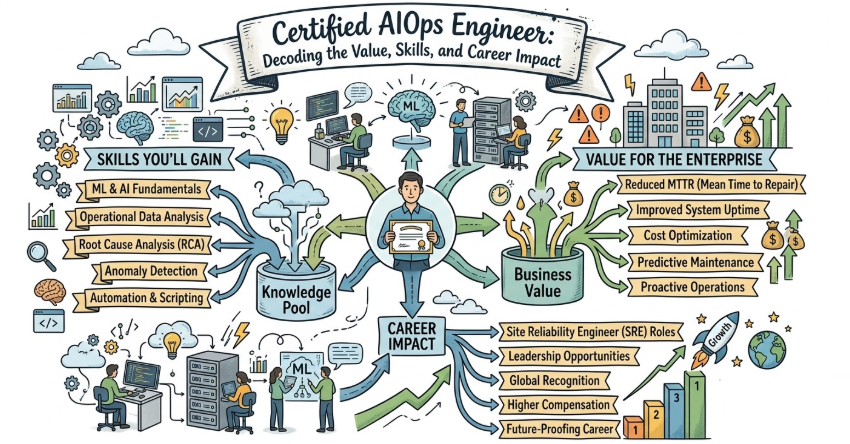
The landscape of infrastructure management is shifting from manual intervention to automated intelligence. As systems grow in complexity, the Certified AIOps Engineer program has emerged as a critical benchmark for professionals looking to master artificial intelligence for IT operations. This guide is designed for software engineers and technical leaders who need to understand how algorithmic decision-making integrates with standard DevOps and SRE workflows. At AIOps School, the focus is on bridging the gap between traditional monitoring and proactive, data-driven observability. By following this path, you can transition from reactive firefighting to building self-healing systems that scale with business needs.
What is the Certified AIOps Engineer?
The Certified AIOps Engineer designation represents a specialized mastery of applying machine learning and big data analytics to IT operations. It exists to solve the “alert fatigue” problem that plagues modern distributed systems, moving beyond simple threshold-based monitoring. This certification emphasizes production-focused learning, ensuring that engineers can handle massive telemetry streams and derive actionable insights in real-time. It aligns perfectly with enterprise practices where reliability is no longer just a goal but a competitive necessity driven by intelligent automation.
Unlike theoretical AI courses, this program is grounded in the reality of the data center and the cloud. It focuses on how to implement noise reduction, root cause analysis, and predictive maintenance within existing CI/CD and production environments. For the modern engineer, this represents a shift toward becoming a system architect who manages intelligence rather than just managing scripts. The framework provided here is designed to integrate seamlessly with modern engineering workflows, ensuring that automation is both safe and effective at scale.
Who Should Pursue Certified AIOps Engineer?
This certification is primarily built for Site Reliability Engineers (SREs), DevOps practitioners, and Cloud Architects who are managing high-scale environments. It is also highly beneficial for Security Operations (SecOps) professionals who need to identify anomalous patterns in network traffic and Data Engineers who want to pivot into operational roles. While beginners with a strong foundation in Linux and Python can enter the program, it is most effective for those who have seen the limitations of manual monitoring in a production setting.
In the global market, particularly in India’s massive IT services and product landscape, there is a growing demand for engineers who can reduce operational overhead through automation. Managers and technical leaders should also consider this track to better understand the ROI of AI investments and how to lead teams through the cultural shift of AIOps adoption. Whether you are an individual contributor looking for a salary bump or a lead engineer designing the next generation of a platform, this certification provides the technical vocabulary and skill set needed to succeed.
Why Certified AIOps Engineer is Valuable Today and Beyond
The demand for AIOps expertise is driven by the sheer volume of data generated by microservices and containerized environments. As enterprises move toward hybrid and multi-cloud architectures, the complexity exceeds human cognitive limits, making algorithmic assistance mandatory for survival. This certification ensures longevity in your career by teaching you how to build systems that adapt to tool changes and evolving infrastructure trends. It is an investment in your ability to remain relevant as manual tasks are increasingly replaced by automated logic.
From an enterprise perspective, the adoption of AIOps leads to a significant reduction in Mean Time to Repair (MTTR) and a drastic improvement in system availability. Professionals who hold this certification demonstrate that they can provide a tangible return on time by preventing outages before they happen. This career investment positions you at the intersection of data science and systems engineering, a niche that is currently underserved and highly compensated. As we move further into the era of autonomous systems, the skills learned here will form the bedrock of all infrastructure roles.
Certified AIOps Engineer Certification Overview
The Certified AIOps Engineer program is delivered via the official AIOps School portal and is hosted on the AIOps School platform. This program utilizes a multi-tiered assessment approach, combining rigorous theoretical exams with hands-on laboratory challenges that simulate real-world production incidents. The certification is owned and governed by industry experts who ensure the curriculum stays updated with the latest advancements in neural networks and anomaly detection. In practical terms, the structure is designed to be modular, allowing engineers to balance their learning with full-time professional responsibilities.
The assessment methodology focuses on the ability to interpret telemetry data and configure automated responses rather than just memorizing definitions. Candidates are required to demonstrate proficiency in handling logs, metrics, and traces within a unified data lake. Ownership of the certification by a dedicated school ensures that the learning path is cohesive and directly applicable to the challenges faced by modern SRE teams. The program’s structure encourages a deep dive into both the “why” and the “how” of intelligent operations, making it a comprehensive professional development tool.
Certified AIOps Engineer Certification Tracks & Levels
The certification is organized into three distinct levels: Foundation, Professional, and Advanced. The Foundation level introduces the core concepts of data ingestion, noise reduction, and the basic principles of machine learning for IT. The Professional level dives deeper into specific specialization tracks such as SRE-driven AIOps, FinOps for AI, and automated incident response. Finally, the Advanced level is reserved for architects who are designing enterprise-wide observability platforms and managing the governance of autonomous systems.
Each level is designed to align with a specific stage of career progression, from junior engineers to principal architects. Specialization tracks allow professionals to tailor their learning to their specific job functions, whether that is focusing on security, cost optimization, or pure system reliability. This tiered approach ensures that learners do not get overwhelmed by complex algorithms before they understand the fundamental data structures involved. It also provides a clear roadmap for long-term skill acquisition and professional growth within the engineering domain.
Complete Certified AIOps Engineer Certification Table
| Track | Level | Who it’s for | Prerequisites | Skills Covered | Recommended Order |
| Core AIOps | Foundation | Junior Engineers, Managers | Basic Cloud & Linux | Data Ingestion, Alerting | 1 |
| SRE & Ops | Professional | SREs, DevOps Engineers | 2+ Years Experience | Anomaly Detection, RCA | 2 |
| Data & ML | Professional | Data Engineers, ML Ops | Python & SQL Basics | Model Training, Data Ops | 2 |
| Advanced Arch | Advanced | Principal Engineers, Leads | Professional Level Cert | Scaling AI, Governance | 3 |
| FinOps AI | Specialist | FinOps Practitioners | Basic Cloud Billing | Cost Prediction, Optimization | 2 |
Detailed Guide for Each Certified AIOps Engineer Certification
Certified AIOps Engineer – Foundation
What it is
This certification validates a foundational understanding of how AI and ML principles apply to modern IT infrastructure and monitoring ecosystems. It serves as an entry point for professionals looking to understand the core terminology and architecture of an AIOps platform.
Who should take it
This is suitable for junior DevOps engineers, IT managers, and traditional system administrators who need to understand the future of operations. It is also ideal for students and freshers aiming for a career in cloud-native engineering.
Skills you’ll gain
- Understanding the four stages of AIOps: Data selection, Pattern discovery, Inference, and Collaboration.
- Ability to identify different types of operational data (Logs, Metrics, Traces).
- Basic knowledge of noise reduction techniques in monitoring tools.
- Familiarity with the AIOps toolchain and integration points.
Real-world projects you should be able to do
- Setting up a basic data ingestion pipeline for server metrics.
- Configuring a centralized dashboard to visualize heterogeneous data sources.
- Implementing simple threshold-based alerting that transitions into basic anomaly detection.
Preparation plan
- 7–14 days: Review official documentation and understand the AIOps glossary and core architecture.
- 30 days: Complete a foundational training course and set up a home lab using open-source monitoring tools.
- 60 days: Engage in community forums, take practice exams, and implement a small-scale data ingestion project.
Common mistakes
- Focusing too much on complex ML math instead of operational use cases.
- Ignoring the importance of data quality before applying AI models.
Best next certification after this
- Same-track option: Certified AIOps Engineer – Professional
- Cross-track option: DevOps Foundation
- Leadership option: ITIL 4 Foundation
Certified AIOps Engineer – Professional
What it is
The Professional level validates the ability to implement and manage AIOps solutions in a production environment. It focuses on incident correlation, root cause analysis, and the automation of remediation workflows.
Who should take it
Mid-level SREs, Cloud Engineers, and DevOps professionals with a few years of experience should take this. It is for those who are actively responsible for the uptime and performance of distributed systems.
Skills you’ll gain
- Advanced correlation techniques to group related alerts into actionable incidents.
- Implementation of automated root cause analysis using machine learning models.
- Building and managing self-healing scripts and runbooks.
- Managing the lifecycle of ML models used in production operations.
Real-world projects you should be able to do
- Deploying an incident correlation engine that reduces alert volume by 70%.
- Creating an automated remediation workflow that restarts services based on predictive signals.
- Building a predictive capacity planning model for a Kubernetes cluster.
Preparation plan
- 7–14 days: Deep dive into the specific ML algorithms used for time-series forecasting and clustering.
- 30 days: Hands-on implementation of ELK or Prometheus-based AIOps integrations in a staging environment.
- 60 days: Perform full-scale incident simulations and refine automated response scripts for production readiness.
Common mistakes
- Over-automating without sufficient guardrails, leading to cascading failures.
- Failing to account for “model drift” in operational environments.
Best next certification after this
- Same-track option: Certified AIOps Engineer – Advanced
- Cross-track option: Certified DevSecOps Professional
- Leadership option: Digital Transformation Officer
Choose Your Learning Path
DevOps Path
The DevOps learning path focuses on integrating intelligence directly into the continuous delivery pipeline. It starts with automating testing and deployment gates using predictive analytics to ensure that only healthy code reaches production. Engineers on this path prioritize feedback loops where operational data informs the development cycle. By the end of this journey, a DevOps engineer is capable of building a “NoOps” environment where the pipeline itself is self-correcting. This path is ideal for those who want to eliminate the friction between development and operations through smart automation.
DevSecOps Path
In the DevSecOps path, the primary focus is using AIOps to enhance the security posture of the organization. This involves using machine learning to detect zero-day vulnerabilities and anomalous user behavior that traditional signature-based tools might miss. Engineers learn to automate security audits and implement real-time threat hunting within the production environment. This path bridges the gap between high-speed delivery and rigorous security requirements. It is best suited for security professionals who want to leverage AI for proactive defense rather than just reactive patching.
SRE Path
The SRE path is deeply rooted in reliability and the management of Service Level Objectives (SLOs). Professionals here use AIOps to manage error budgets more effectively by predicting potential breaches before they occur. The focus is on building “toil-free” operations where the system handles the majority of low-level incidents autonomously. This path emphasizes the creation of complex observability frameworks that can scale with massive global traffic. It is the gold standard for engineers dedicated to the science of keeping large-scale systems running under any condition.
AIOps Path
The dedicated AIOps path is for those who want to become specialists in the underlying technology of intelligent operations. It focuses on the data science aspect of IT, including the management of huge data lakes and the training of custom operational models. Professionals on this path often work on building the platforms that other engineering teams use to monitor their services. They are responsible for the accuracy of the insights generated and the scalability of the monitoring infrastructure. This is perfect for those who enjoy the intersection of big data, machine learning, and infrastructure.
MLOps Path
The MLOps path is distinct in its focus on the lifecycle of machine learning models themselves. It addresses the unique challenges of deploying, monitoring, and updating AI models in production, ensuring they don’t become a bottleneck for the business. Engineers learn how to implement version control for data, manage computational resources for training, and automate the retraining of models. This path is essential for organizations that rely on AI for their core business products. It provides the operational discipline needed to turn experimental AI into a reliable, production-grade service.
DataOps Path
DataOps focuses on the reliability and quality of the data pipelines that feed both business intelligence and operational tools. This path teaches engineers how to apply DevOps principles to data management, ensuring that data is always available, accurate, and secure. It involves automating data testing, orchestrating complex data workflows, and monitoring the health of data platforms. For an AIOps strategy to succeed, the underlying DataOps must be flawless. This path is designed for data engineers who want to specialize in the operational excellence of data-driven enterprises.
FinOps Path
The FinOps path uses AIOps to bring financial accountability to the variable spend of cloud computing. It focuses on using predictive analytics to forecast cloud costs and identify waste in real-time. Professionals learn how to automate the rightsizing of resources and the selection of cost-effective pricing models across multi-cloud environments. This path aligns engineering activities with business value, ensuring that performance does not come at an unsustainable cost. It is an increasingly vital role for organizations looking to maximize their return on cloud investment without sacrificing agility.
Role → Recommended Certified AIOps Engineer Certifications
| Role | Recommended Certifications |
| DevOps Engineer | Foundation, Professional (SRE Track) |
| SRE | Professional, Advanced Architect |
| Platform Engineer | Foundation, Professional (Data & ML Track) |
| Cloud Engineer | Foundation, Specialist (FinOps) |
| Security Engineer | Professional (DevSecOps Track) |
| Data Engineer | Professional (Data & ML Track) |
| FinOps Practitioner | Specialist (FinOps AI) |
| Engineering Manager | Foundation, Leadership Track |
Next Certifications to Take After Certified AIOps Engineer
Same Track Progression
Once you have mastered the professional level, moving toward the Advanced Architect level is the natural progression. This involves taking on the responsibility of designing the entire observability strategy for an organization. You will move from implementing tools to defining the governance and ethical use of AI in operations. This deep specialization makes you a subject matter expert who can consult on the most complex infrastructure challenges in the world. It is about moving from a practitioner to a visionary leader in the space.
Cross-Track Expansion
If you want to broaden your skill set, expanding into DevSecOps or FinOps is a highly strategic move. An AIOps engineer who understands how to secure the data pipeline or optimize the cost of the AI platform is incredibly valuable to any enterprise. Cross-training allows you to see the “big picture” of how technology, security, and finance intersect in a modern business. This versatility makes you indispensable, as you can speak the language of multiple departments and solve problems that span different technical domains.
Leadership & Management Track
For those looking to move into management, the next step involves certifications focused on digital transformation and technical leadership. You will transition from writing scripts to managing people, budgets, and high-level technical roadmaps. Understanding AIOps gives you a unique advantage as a manager, as you can lead your team toward data-driven decision-making. You will be responsible for fostering a culture of automation and reliability across the entire organization. This track is for those who want to shape the future of engineering teams rather than just the systems they build.
Training & Certification Support Providers for Certified AIOps Engineer
DevOpsSchool
DevOpsSchool is a leading provider of technical training, specializing in the entire DevOps and AIOps ecosystem. They offer comprehensive courses that cover everything from basic automation to advanced site reliability engineering. Their curriculum is known for being hands-on, providing students with access to real-world environments and tools. They focus on bridging the skills gap for working professionals, ensuring that the knowledge gained is immediately applicable to their current roles. With a strong presence in India and globally, they have helped thousands of engineers transition into more advanced technical positions through structured learning and expert-led mentorship.
Cotocus
Cotocus focuses on delivering high-impact technical consulting and training services for modern enterprises. They specialize in cloud-native technologies, helping organizations adopt Kubernetes, AIOps, and DevSecOps at scale. Their approach is unique because they combine training with real-world implementation experience, ensuring that students learn from active practitioners. Cotocus provides a range of certification prep programs designed to help engineers master complex topics in a short amount of time. Their focus on practical outcomes makes them a preferred partner for companies looking to upskill their internal engineering teams for the challenges of digital transformation.
Scmgalaxy
Scmgalaxy is a vast community and resource hub for professionals in the software configuration management and DevOps space. They provide an extensive library of tutorials, blog posts, and training videos that cover the latest trends in the industry. Beyond content, they offer specialized training programs that focus on the tools and methodologies required for modern software delivery. Their community-driven approach ensures that the content is always relevant and addresses the actual pain points of working engineers. Scmgalaxy is an excellent resource for those looking to stay updated on tool advancements and best practices in a rapidly changing field.
BestDevOps
BestDevOps is dedicated to providing premium training content for engineers who want to reach the top tier of their profession. They offer specialized courses in AIOps, SRE, and cloud architecture, with a focus on deep technical mastery. Their programs are designed to be intensive, pushing students to understand the underlying mechanics of the systems they manage. By focusing on quality over quantity, BestDevOps ensures that their graduates are among the most capable in the job market. They are a great choice for professionals who are looking for a rigorous and rewarding learning experience that goes beyond the basics.
devsecopsschool.com
This platform is the go-to resource for engineers who want to specialize in the intersection of security and operations. They provide detailed training on how to integrate security into every stage of the development lifecycle using AI and automation. Their courses cover a wide range of topics, including container security, automated compliance, and threat intelligence. The mission of devsecopsschool.com is to empower engineers to build systems that are not only fast and reliable but also inherently secure. Their specialized focus makes them a leader in the growing field of DevSecOps education.
sreschool.com
Sreschool.com is dedicated specifically to the discipline of Site Reliability Engineering. They offer a comprehensive curriculum that covers SLOs, error budgets, incident management, and the application of AIOps for system reliability. Their training is designed for engineers who are responsible for the uptime of mission-critical services. By focusing on the principles pioneered by major tech giants, sreschool.com provides students with the framework needed to manage complexity at scale. Their courses are highly practical, emphasizing the use of observability and automation to reduce toil and improve system performance across the board.
aiopsschool.com
As the primary host for the Certified AIOps Engineer program, aiopsschool.com is the authoritative source for intelligent operations education. They provide a dedicated learning environment that focuses exclusively on the application of AI and machine learning to IT infrastructure. Their curriculum is developed by industry experts who are at the forefront of the AIOps movement. The platform offers a range of levels and specializations, ensuring that there is a path for every professional, regardless of their starting point. It is the central hub for anyone looking to master the future of automated IT management.
dataopsschool.com
Dataopsschool.com addresses the growing need for operational excellence in the data engineering domain. They provide training on how to apply DevOps principles to data pipelines, ensuring data quality, reliability, and speed. Their courses are essential for organizations that are building data-driven products and need to manage their data infrastructure with the same rigor as their software services. By focusing on the lifecycle of data, from ingestion to consumption, dataopsschool.com helps engineers build the foundation for successful AI and analytics initiatives. It is a vital resource for the modern data professional.
finopsschool.com
Finopsschool.com is focused on the emerging field of cloud financial management. They provide training on how to manage the costs of cloud computing using data-driven insights and automated optimization. Their curriculum covers the cultural, technical, and financial aspects of FinOps, ensuring that students can drive value for their organizations. With the rise of AIOps, finopsschool.com also covers how to use machine learning to predict and control cloud spend. Their courses are ideal for anyone looking to align engineering performance with business profitability in the cloud-first era.
Frequently Asked Questions (General)
- How difficult is the Certified AIOps Engineer exam?
The difficulty is moderate to high, as it requires both theoretical knowledge of ML and practical experience with infrastructure tools. It is designed to challenge even experienced engineers. - How long does it take to get certified?
Most professionals complete the certification within 2 to 4 months, depending on their prior experience and the amount of time they can dedicate to study. - Are there any prerequisites for the Foundation level?
There are no formal prerequisites, but a basic understanding of Linux, networking, and at least one cloud platform is highly recommended for success. - What is the ROI of this certification?
Holders often see a significant increase in salary and job opportunities, as the demand for AIOps skills far outweighs the current supply of qualified professionals. - Is the exam proctored online?
Yes, the certification exams are typically proctored online, allowing you to take them from anywhere in the world while maintaining the integrity of the process. - Do I need to be a data scientist to pass?
No, you do not need to be a data scientist. The focus is on the application of AI models to IT problems rather than the creation of new algorithms. - How long is the certification valid?
The certification is typically valid for two years, after which you may need to complete a recertification process to ensure your skills are up to date. - Can I skip the Foundation level?
While not recommended, professionals with significant documented experience in AIOps may be eligible to jump directly to the Professional level after a review. - Does this certification help with SRE roles?
Absolutely. AIOps is a core component of modern SRE practices, and this certification directly validates the skills needed for high-level reliability engineering. - What tools are covered in the training?
The training covers a mix of open-source and enterprise tools, including Prometheus, ELK stack, various cloud-native monitoring services, and specialized AIOps platforms. - Is there a community for certified professionals?
Yes, AIOps School provides access to an exclusive community where you can network with other certified professionals and share best practices. - Are there practice exams available?
Yes, the program includes several practice exams that mirror the format and difficulty of the actual certification test to help you prepare effectively.
FAQs on Certified AIOps Engineer
- What specific AI models will I learn about?
You will focus on time-series forecasting, clustering for alert grouping, and regression models for capacity planning, all tailored for operational telemetry data. - How does this certification handle multi-cloud environments?
The curriculum is cloud-agnostic, teaching you principles that apply across AWS, Azure, and Google Cloud, focusing on the data rather than a specific provider’s tool. - Is coding required for the Professional level?
Yes, a working knowledge of Python or a similar scripting language is required to build automation and manage data ingestion pipelines. - Will I learn about automated incident response?
Yes, a major portion of the Professional and Advanced levels is dedicated to building and governing self-healing systems and automated runbooks. - Does the program cover ethical AI?
Yes, especially at the Advanced level, where we discuss the implications of automated decision-making and how to ensure transparency in AI-driven operations. - How is the hands-on lab portion structured?
You are given access to a sandbox environment with a simulated production failure and must use AIOps techniques to identify and resolve the issue. - Is this certification recognized by major tech companies?
Yes, the curriculum is aligned with the standards used by global enterprises and is recognized as a valid benchmark for advanced operations roles. - What is the focus on data quality?
The program emphasizes that AI is only as good as the data it receives, teaching you how to clean, normalize, and validate telemetry before processing.
Final Thoughts: Is Certified AIOps Engineer Worth It?
If you are an engineer who feels overwhelmed by the increasing noise and complexity of modern systems, the Certified AIOps Engineer program is a career-changing investment. It provides the structured path needed to move from being a generalist to a specialist in the most important trend in infrastructure today. The transition to intelligent operations is not a matter of “if” but “when,” and being an early adopter gives you a massive advantage in the job market.
My advice as a mentor is to look past the marketing hype and focus on the practical ability to solve problems with data. This certification isn’t just about a badge on your profile; it’s about gaining the confidence to lead your organization through a major technological shift. If you are willing to put in the work to master the intersection of data science and systems engineering, you will find yourself in a very strong position for the next decade of your career.