




Introduction
In the rapidly evolving landscape of software engineering, the speed at which a company can deliver value is a primary competitive advantage. Historically, development teams focused on building new features, while operations teams prioritized stability and uptime. This divide created rigid silos, leading to friction, delayed deployments, and significant communication gaps.
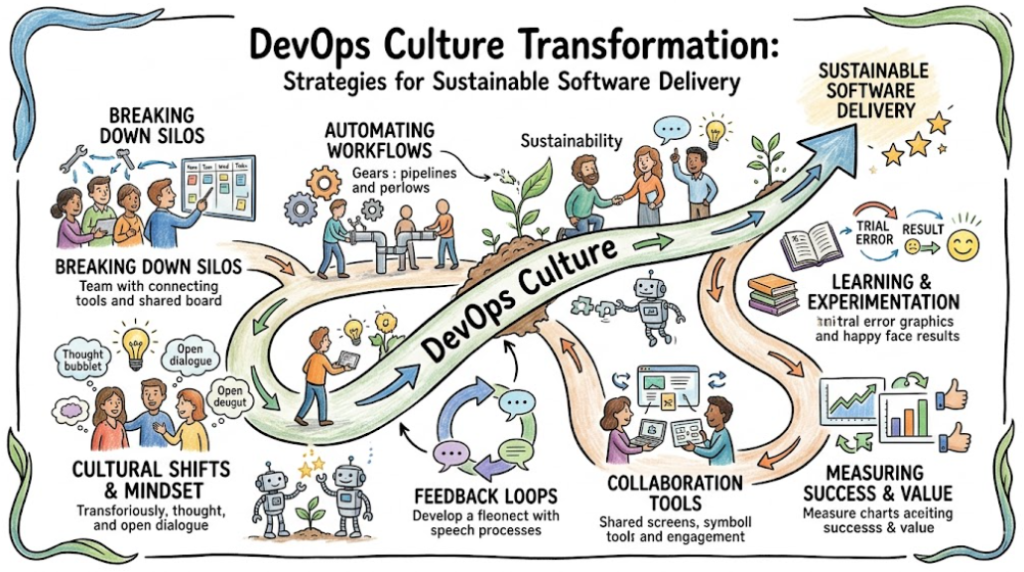
The emergence of modern software delivery models has fundamentally changed how engineering teams operate. Today, the focus has shifted from managing isolated handoffs to fostering a unified, agile environment. the heartbeat of a successful technical organization. By prioritizing collaboration, automation, and a shared vision, organizations can move faster while maintaining higher levels of quality.
At DevOpsSchool, we have observed how this cultural shift enables both small startups and global enterprises to streamline their workflows and build more resilient systems. This article explores the depth of this transformation, providing the insights necessary to foster a culture that empowers your entire engineering department.
What Is DevOps Culture?
DevOps culture is not a software product, a specific plugin, or a rigid set of compliance rules. It is a philosophy rooted in the belief that software delivery is a collaborative, continuous process rather than a linear series of departmental handoffs.
At its core, this culture demands a radical shift in mindset. Instead of viewing development and operations as competing interests, it integrates them into a single lifecycle. Teams share the responsibility for the entire application—from the initial commit of code to the final delivery and maintenance in the production environment. It emphasizes radical transparency, the removal of artificial barriers, and a relentless commitment to continuous improvement.
Why DevOps Culture Matters
Modern business demands innovation that keeps pace with user expectations. A siloed organization often struggles with long deployment cycles, frequent production failures, and a blame-heavy internal environment. DevOps culture matters because it creates a pathway to bypass these hurdles.
- Faster Time-to-Market: By automating repetitive processes, teams can ship features daily rather than monthly.
- Reduced Friction: When communication channels are open, developers and operations engineers solve problems together instead of passing tickets back and forth.
- Increased Reliability: Shared responsibility means the team that writes the code also understands how it performs in production, leading to more robust software design.
- Cultural Satisfaction: Environments that prioritize learning and transparency tend to retain top engineering talent significantly longer than those stuck in legacy, conflict-ridden workflows.
Traditional IT Culture vs DevOps Culture
Understanding the transformation requires identifying where the industry is coming from versus where it is heading.
| Feature | Traditional IT Culture | DevOps Culture |
| Team Collaboration | Departmental Silos | Cross-functional Teams |
| Release Cycles | Quarterly or Monthly | Daily or On-demand |
| Responsibility | Developers build, Ops fixes | Shared ownership of the service |
| Automation | Manual execution | Automated pipelines |
| Communication | Ticket-based, formal | Real-time, transparent |
| Incident Handling | Blame-oriented | Blameless post-mortems |
| Deployment Speed | Slow, risky | Fast, repeatable, low-risk |
| Feedback Loops | Delayed, disconnected | Continuous and immediate |
Core Principles of DevOps Culture
Collaboration
Teams must break down the walls between departments. When developers participate in operational discussions and operations engineers contribute to the design phase, the resulting software is inherently more maintainable.
Shared Responsibility
The “it works on my machine” excuse disappears in a true DevOps environment. Everyone on the team owns the quality and the uptime of the product.
Automation
Automation is the vehicle for cultural change. By automating testing, infrastructure provisioning (Infrastructure as Code), and deployments, the team removes human error and frees up time for higher-level innovation.
Continuous Improvement
Often called “Kaizen,” this principle encourages small, incremental changes rather than massive, risky updates. It focuses on learning from every release, whether successful or not.
Fast Feedback Loops
Incentivizing fast feedback—via automated monitoring and alerting—ensures that engineers are aware of issues as they happen, allowing for rapid remediation.
Role of Communication in DevOps Culture
Communication is the lubricant that keeps the engine running. In a successful culture, communication is moved out of private email threads and into shared, transparent spaces. By utilizing chat-ops and collaborative documentation, teams stay aligned on goals. This prevents the “knowledge silo” effect, ensuring that the departure of one engineer does not cripple the operation of an entire service.
Automation and DevOps Culture
Automation is the foundation of scale. Without it, scaling an application would require a linear increase in staff. By adopting a CI/CD (Continuous Integration/Continuous Deployment) model, teams ensure that code changes are automatically tested and validated. This removes the fear of deployment and builds confidence throughout the engineering organization.
DevOps Culture in Agile & Cloud-Native Environments
Agile development methodologies and cloud-native technologies like Kubernetes rely heavily on the DevOps mindset. As applications transition to microservices, the complexity of managing infrastructure increases. A DevOps culture allows engineers to treat infrastructure as a programmable service, facilitating scalability that is impossible to achieve in legacy, monolithic environments.
Real-World DevOps Culture Examples
- SaaS Companies: High-growth startups use automated deployments to push new features to users multiple times a day without impacting availability.
- Banking: Financial institutions implement strict compliance through automated testing, ensuring security policies are enforced in the pipeline while maintaining speed.
- E-Commerce: During peak traffic events (like Black Friday), these teams rely on automated scaling and rigorous observability to prevent downtime.
Benefits of DevOps Culture
- Improved Agility: Rapid response to market changes.
- High Reliability: Systems designed for failure recover faster.
- Operational Efficiency: Lower costs through automated resource management.
- Enhanced Security: Integrating security early in the process (DevSecOps).
Challenges in Building DevOps Culture
- Resistance to Change: Existing teams often feel threatened by new ways of working. Address this through mentorship and showing “quick wins.”
- Legacy Systems: Old architecture can be difficult to automate. Start by isolating components and modernizing them piece by piece.
- Skill Gaps: Invest in training and professional development to ensure your team has the skills to manage new technologies.
Leadership’s Role in DevOps Culture
Leadership must lead by example. They must foster a “blameless” culture where failures are treated as opportunities to learn rather than reasons for punishment. By prioritizing psychological safety and providing the necessary budget for automation tools, leaders enable their teams to succeed.
DevOps Culture and SRE
Site Reliability Engineering (SRE) is the practical application of DevOps culture. While DevOps is the philosophy, SRE provides the specific practices for managing large-scale, reliable systems. SREs prioritize automation and data-driven decision-making to maintain service level objectives (SLOs).
Metrics Used in DevOps Culture
| Metric | Purpose | Goal |
| Deployment Frequency | Measures how often code is shipped. | High frequency |
| MTTR (Mean Time to Recovery) | How long to fix a failure. | Low time |
| Change Failure Rate | Percentage of changes that cause issues. | Minimal percentage |
| Lead Time for Changes | Time from commit to production. | Short duration |
DevOps Team Structure & Collaboration Models
Modern organizations often use a “Platform Engineering” model, where a central team builds the self-service tools that feature teams use to manage their own deployments. This empowers developers while maintaining operational standards.
Common Mistakes Organizations Make
- The “DevOps Team” Fallacy: Thinking that having a department called “DevOps” solves the culture problem.
- Over-reliance on Tools: Buying expensive software without changing the team’s communication habits.
- Ignoring Feedback: Creating pipelines that provide data, but failing to act on the insights.
Best Practices for Building DevOps Culture
- Start small with a single team or project.
- Document everything.
- Host regular cross-team knowledge-sharing sessions.
- Automate everything that is done more than once.
- Prioritize observability—you cannot fix what you cannot measure.
Future of DevOps Culture
The future lies in the integration of AI-assisted operations (AIOps), which will further reduce the cognitive load on engineers. As we move toward more autonomous systems, the human element—collaboration and strategic thinking—will become even more critical to success.
DevOps Culture Career Impact
Professionals who embody this culture are among the most sought-after in the industry. Whether you are a developer, an SRE, or an Engineering Manager, mastering these principles positions you as a strategic thinker capable of leading organizations through complex transformations.
DevOps Certifications & Learning Paths
Continuous learning is mandatory in this field. Engaging with structured training helps bridge the gap between theory and execution.
| Certification | Level | Best For | Focus Area |
| Foundation DevOps | Beginner | Students/Juniors | Core concepts and lifecycle |
| Cloud Professional | Intermediate | Cloud Engineers | AWS/Azure/GCP scaling |
| Advanced SRE | Expert | SREs/Leads | Observability and reliability |
Explore comprehensive programs through the DevOpsSchool learning ecosystem to build your practical skillset.
FAQs
- What is DevOps culture in simple words?It is the practice of getting developers and operations teams to work together as one, using automation to reduce manual work and improve quality.
- Why is DevOps culture important?It prevents “us vs. them” mentalities that slow down delivery and cause system instability.
- Is DevOps only about automation?No, automation is just the tool. Culture is about the mindset, communication, and shared goals.
- How does DevOps improve teamwork?By aligning everyone on the goal of high-quality software delivery and removing silos.
- What role does leadership play?Leaders define the environment where experimentation is safe and collaboration is incentivized.
- Can small companies adopt it?Yes, they have the advantage of being able to pivot quickly and adopt these practices early.
- Is it difficult to implement?It requires discipline and time. It is a marathon, not a sprint.
- What skills are important?Communication, scripting, cloud platforms, and a deep understanding of CI/CD concepts.
- Do I need a DevOps title to practice it?No, DevOps is a practice anyone in engineering can adopt regardless of title.
- How do I start?Start by identifying the biggest pain point in your delivery process and automating that single step.
- What is a blameless post-mortem?An analysis of an outage that focuses on the process failure, not the human error.
- Is DevOps only for Cloud?It is most effective in cloud environments but can be applied to on-premise systems as well.
- How does it affect security?It improves security by moving it earlier in the development process (DevSecOps).
- How long does transformation take?It varies, but culture change is usually an ongoing journey.
- Where can I find more resources?DevOpsSchool provides extensive tutorials and training paths for all skill levels.
Final Thoughts
DevOps culture is not a destination; it is an ongoing journey of improvement. By moving away from silos and embracing a model of shared responsibility, organizations create environments where engineers thrive and products excel. Remember that the technology will change, but the focus on collaboration and customer-centricity will always remain the defining factor of high-performing teams. Focus on the people, refine your processes, and the tools will naturally fall into place.