




Introduction
Imagine waking up in a country where the air is crisp, the career opportunities are endless, and your family’s future is secure. For millions of skilled professionals, students, and dreamers, moving to countries like Canada, Australia, or New Zealand is the ultimate goal. But between you and that dream lies a complex, often intimidating hurdle: The PR Points System.
If you’ve started researching, you’ve likely heard terms like “CRS Score,” “65 points,” or “Invitation to Apply (ITA).” At the heart of these terms is the PR Points Calculator.
Think of a PR Points Calculator as a digital “pre-assessment.” It is a tool designed to help you understand where you stand in the eyes of a foreign government. Why do countries use these? Because they want the “best of the best”—people whose age, education, and skills will contribute to their economy.
Checking your eligibility before you spend thousands of dollars on English tests and application fees is the smartest move you can make. This guide is designed to take the mystery out of the process. Whether you are a software engineer in Bangalore, a nurse in Manila, or a student in London, this ultimate guide will show you exactly how to calculate your points and, more importantly, how to increase them.
What Is a PR Points Calculator?
In simple terms, a PR Points Calculator is a points-based assessment tool used by immigration authorities to rank candidates.
The Definition
A points-based system (PBS) is a meritocratic way of managing immigration. Instead of a first-come, first-served basis, countries like Canada and Australia assign numerical values to different aspects of your profile.
The Purpose
The primary goal is to identify “High Human Capital” individuals. Governments want to ensure that the people moving to their country can find jobs quickly and integrate into society.
Eligibility Score vs. Invitation Score
This is where most beginners get confused.
- Eligibility Score: This is the minimum score required to even enter the “pool” or be considered for a visa. (e.g., 67 points for Canada’s FSWP).
- Invitation Score: This is the “cutoff.” Just because you are eligible doesn’t mean you will be invited. You are competing against others in the pool, and only the highest scores receive an invitation.
Example: Think of it like a university entrance exam. Scoring 50% might make you eligible to apply, but only those who score 90% actually get a seat in the classroom.
How PR Points Systems Work: The Core Factors
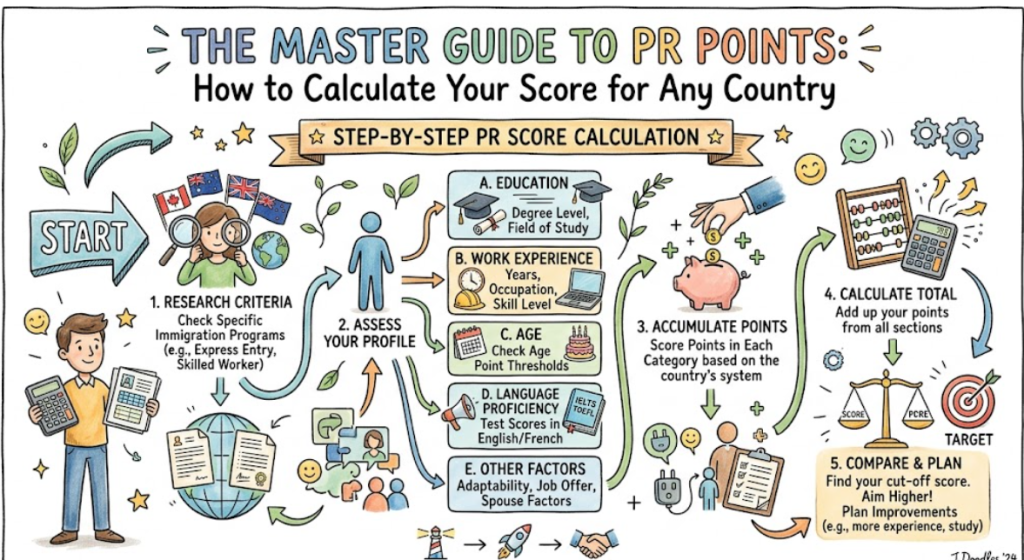
While every country has its own unique formula, most PR points calculators focus on these seven core pillars:
A. Age Points
Most systems favor younger applicants (usually between 20 and 34). As you get older, your points begin to decline because governments prioritize workers who will contribute to the pension system for a longer duration.
B. Education Points
The higher your degree, the higher your score.
- PhD/Doctorate: Maximum points.
- Master’s Degree: High points.
- Two or more certificates: Good points.
- Bachelor’s Degree: Standard points.
C. Language Proficiency
This is the most critical “controllable” factor. Most countries require tests like IELTS, CELPIP (for Canada), or PTE (for Australia/NZ). Scoring a “CLB 9” or higher in Canada or “Superior English” in Australia can add a massive boost to your score.
D. Work Experience
Points are awarded based on the number of years of full-time, skilled work experience you have. Usually, 3+ years of overseas experience or 1+ year of local experience (in the target country) yields the best results.
E. Job Offers
Having a valid job offer from a local employer can sometimes act as a “golden ticket,” adding significant points or making you exempt from certain high-score requirements.
F. Provincial/State Nominations
In Canada and Australia, specific regions have their own needs. If a province (like Ontario) or a state (like New South Wales) nominates you, you essentially receive enough points to guarantee an invitation.
G. Spouse/Adaptability Factors
If you are moving with a partner, their education and language skills can also add points to your profile.
| Factor | Influence Level | Can you improve it? |
| Age | High | No (it decreases over time) |
| Education | High | Yes (by completing more studies) |
| Language | Very High | Yes (by Retaking tests) |
| Work Exp. | Medium | Yes (by gaining more years) |
| Job Offer | Massive | Yes (through networking) |
Canada PR Points Calculator (Express Entry)
Canada is the pioneer of the points-based system. Their main system is called Express Entry, and it uses the Comprehensive Ranking System (CRS).
The Express Entry System
To enter the pool, you must first qualify under one of three programs:
- Federal Skilled Worker Program (FSWP): Requires a minimum of 67/100 points.
- Federal Skilled Trades Program (FSTP).
- Canadian Experience Class (CEC): For those who have already worked in Canada.
The CRS Score Breakdown
Once in the pool, you are ranked out of 1,200 points.
| Category | Points (Single) | Points (With Spouse) |
| Core Human Capital (Age, Edu, Lang, Exp) | 500 | 460 |
| Spouse Factors | 0 | 40 |
| Skill Transferability | 100 | 100 |
| Additional (PNP, Job Offer, French, Siblings) | 600 | 600 |
Real-World Example: “The Tech Professional”
- Candidate: Rohan, 29 years old.
- Education: Master’s Degree.
- Language: IELTS 8.0 (CLB 9).
- Work Exp: 3 years.
- Estimated CRS: ~470–480.
- Outcome: Highly competitive for Category-Based draws (like STEM draws).
Tips to Improve Your CRS Score
- Get a PNP: A Provincial Nomination adds 600 points instantly.
- Learn French: Even basic French can add up to 50 points.
- The “Max Out” Strategy: Don’t settle for a 7.5 in IELTS. Aim for the “8777” (8 in Listening, 7 in others) to unlock Skill Transferability points.
Australia PR Points Calculator (SkillSelect)
Australia’s system is slightly different. You use the SkillSelect platform to submit an Expression of Interest (EOI).
The Points Threshold
The minimum to apply is 65 points, but for popular occupations (like IT or Engineering), you often need 85–95 points to get an invite.
Main Visa Subclasses
- Subclass 189: Skilled Independent (No sponsor needed).
- Subclass 190: Skilled Nominated (Requires State Nomination).
- Subclass 491: Skilled Work Regional (Provisional visa for 5 years).
Australia Points Table (Simplified)
- Age (25–32): 30 points.
- English (Superior): 20 points.
- Work Exp (8+ years outside Aus): 15 points.
- Education (Bachelor/Master): 15 points.
- Professional Year (in Aus): 5 points.
- NAATI CCL (Language test): 5 points.
Profile Calculation Example
A 30-year-old Accountant with 5 years of experience and “Proficient English” (IELTS 7) would likely hit 75 points. To be competitive, they would need to take the PTE again for “Superior English” to reach 85.
New Zealand PR Points Calculator
New Zealand recently overhauled its Skilled Migrant Category (SMC). They moved to a “6-point system” to simplify the process.
The 6-Point System
You need a total of 6 points to apply. These can come from:
- Professional Registration: (e.g., Doctors/Nurses get 6 points immediately).
- Education: (PhD gets 6 points, Master’s gets 5).
- Income: (Earning 1.5x to 3x the median wage).
Crucial Note: You also need a skilled job offer from an Accredited Employer in New Zealand to qualify, regardless of your points.
PR Systems in Other Countries
Points-based systems are becoming the global standard. Here is how other top destinations compare:
Japan Highly Skilled Professional (HSP) Visa
Japan uses a points system focusing heavily on salary and academic credentials. 70 points gets you a fast-track to PR in 3 years; 80 points gets it in just 1 year.
Germany Opportunity Card (Chancenkarte)
Launched in 2024, this allows job seekers to stay in Germany to find work. Points are given for German/English skills, age, and ties to Germany.
UK Skilled Worker Pathway
While not a traditional “PR points calculator” for the general public, the UK requires you to meet a salary threshold and English requirements to get a visa that eventually leads to Indefinite Leave to Remain (ILR).
Quick Comparison Table
| Country | Min. Points | Hardest Factor | Best For |
| Canada | 67 (FSWP) | Language Scores | Tech & Healthcare |
| Australia | 65 | Occupation Lists | Engineers & Trades |
| New Zealand | 6 | Job Offer Requirement | Specialty Roles |
| Germany | 6 | Language (German) | European Exposure |
Benefits of Using a PR Points Calculator
Why should you use an online calculator like the one found at DesiNRI?
- Reality Check: It stops you from dreaming about a country where you might not meet the basic age or education criteria.
- Strategic Planning: You can “toggle” your scores. What happens if I get a Master’s? What if I score higher on my English test?
- Saves Money: Don’t pay an immigration consultant $3,000 just to tell you that you don’t have enough points. Do the math yourself first.
- Country Comparison: You might find that while you are ineligible for Canada, you are a perfect fit for Australia’s Subclass 491.
Step-by-Step Guide to Calculate Your PR Points
Don’t just guess. Follow this professional workflow:
Step 1: Gather Your Documents
You can’t calculate points accurately without knowing your exact graduation date, your job titles, and your dates of employment.
Step 2: Take a Mock Language Test
Don’t assume you are “fluent.” Take a free online IELTS or PTE mock test. Use that score for your initial calculation.
Step 3: Evaluate Your Education (ECA)
For Canada, your degree must be assessed (usually by WES). A 3-year degree from one country might only count as a 2-year diploma in another.
Step 4: Calculate Skilled Work Experience
Only count “Skilled” work (Managerial, Professional, or Technical). Unskilled part-time jobs usually count for zero points.
Step 5: Factor in Your Spouse
If your spouse has a degree and good English, they are an asset. If not, you might actually score higher by applying as a “Single” applicant (on paper) for the initial calculation.
Step 6: The Final Tally
Input all data into a reliable PR Points Calculator.
How to Increase Your PR Score (Expert Strategies)
If your score is currently below the cutoff, don’t panic. Thousands of people “build” their profiles over 12–24 months.
- Master the Language Test: Moving from IELTS 7.0 to 8.0 can sometimes add 20–50 points to a CRS score. This is the fastest way to improve.
- Gain “Local” Experience: If you can get a Study Permit or a Work Permit, 12 months of working inside the country you want to move to is often worth more than 5 years of experience outside.
- The Second Language Bonus: For Canada, learning French is a superpower. For Australia, the NAATI CCL test in your native language (Hindi, Punjabi, etc.) is an easy 5 points.
- Provincial Nomination (PNP): Research provinces that need your specific job. If you are a healthcare worker, Nova Scotia or Saskatchewan might give you a nomination even with a lower base score.
Common Mistakes to Avoid
- Overestimating Work Exp: You cannot count internship years or “unskilled” work.
- Using Expired English Tests: Most tests are only valid for 2 years.
- Miscalculating Age: Points often drop on your birthday. If you turn 30 next month, calculate your points as a 30-year-old.
- Ignoring the NOC/ANZSCO Codes: If you select the wrong job category, your points are invalid. Ensure your job duties match the official government description.
- Assuming “Eligible” = “Invited”: Never quit your current job just because you hit the minimum 65 or 67 points. Wait for the actual Invitation to Apply (ITA).
Real-Life Case Studies
Case Study 1: The Young Software Engineer
- Profile: Arjun, 26, Bachelor’s in CS, 2 years exp.
- Initial Score: 435 (Too low for general Canada draws).
- Strategy: Arjun took French classes for 6 months and retook IELTS to get CLB 10.
- Final Result: Score jumped to 495. Received ITA in a STEM-targeted draw.
Case Study 2: The Married Couple (Australia)
- Profile: Sarah (Marketing) and David (Civil Engineer).
- Initial Score: David was the lead, but they were at 75 points.
- Strategy: Sarah took the PTE and got “Proficient” scores. David took the NAATI CCL test.
- Final Result: Added 10 points (5 for spouse, 5 for NAATI). Total 85. Received 190 State Nomination for Victoria.
Case Study 3: The Healthcare Worker (New Zealand)
- Profile: Maria, Registered Nurse, 10 years exp.
- Initial Score: 3 points (for her Bachelor’s).
- Weakness: No job offer.
- Strategy: Maria applied for NZ Nursing Registration first. This gave her 6 points immediately under the new system.
- Final Result: Once registered, she found an employer on the “Green List.” PR was processed in months.
Frequently Asked Questions (FAQs)
1. What is a PR points calculator?
It’s a tool that converts your personal and professional profile into a numerical score to determine your eligibility for permanent residency.
2. What is a “good” CRS score for Canada in 2024?
For general draws, 520+ is strong. For category-based draws (Healthcare, STEM, Trades), 450–480 is often sufficient.
3. Does age really matter that much?
Yes. In Australia, you get 0 points for age after 45. In Canada, you lose points every year after age 30.
4. Which country is the easiest for PR?
There is no “easy” country, but Canada is currently the most transparent, while Germany is becoming the most accessible for job seekers.
5. Can I apply for PR without a job offer?
Yes, both Canada (Express Entry) and Australia (Subclass 189) allow you to apply without a job offer if your points are high enough.
6. How accurate are online PR points calculators?
They are very accurate if you provide honest data. However, they are for guidance only. The final score is determined by the government after they verify your documents.
7. Should I apply as a single person or with my spouse?
Sometimes a spouse with low English scores can “drag down” the average. Many people apply as “Single” and later sponsor their spouse, though this takes longer.
8. Do I need an immigration lawyer to calculate points?
No. You can use free tools. However, a lawyer is helpful for complex cases (e.g., medical issues or criminal records).
9. What is the “67 points” rule for Canada?
This is the entry requirement for the Federal Skilled Worker Program. If you don’t hit 67/100, you cannot even enter the Express Entry pool.
10. How long does the PR process take?
After getting an invitation, it usually takes 6–12 months for Canada and 12–24 months for Australia.
11. Can I improve my score after submitting my profile?
Yes! You can update your profile anytime with new test scores, a new degree, or more work experience.
12. Is IELTS the only test I can take?
No. Canada also accepts CELPIP and PTE Core. Australia accepts PTE Academic, TOEFL, and OET (for healthcare).
Conclusion:
The path to permanent residency is not a sprint; it’s a marathon. While the points system might seem cold and mathematical, it is actually your best friend. It provides a clear roadmap. If your score is low today, you know exactly what you need to do: study for that English test, gain one more year of experience, or look into a provincial nomination.
Don’t let the numbers discourage you. Thousands of people who once had “low scores” are now citizens of Canada, Australia, and New Zealand. They succeeded because they used a PR Points Calculator to identify their weaknesses and worked systematically to improve them.
Your immigration dream is valid. Start by knowing your numbers, and the rest will follow.
Call To Action
Ready to see where you stand? Don’t leave your future to guesswork.
- Try the Calculator: Head over to the PR Points Calculator and get your baseline score today.
- Compare Programs: Check if you’re a better fit for Canada, Australia, or New Zealand.
- Book Your Tests: If your language score is the only thing holding you back, register for your IELTS or PTE today.
- Stay Updated: Immigration rules change fast. Follow official government blogs and trusted sources like DesiNRI for the latest draw updates.
Your new life is waiting. Calculate your points and take the first step today!