




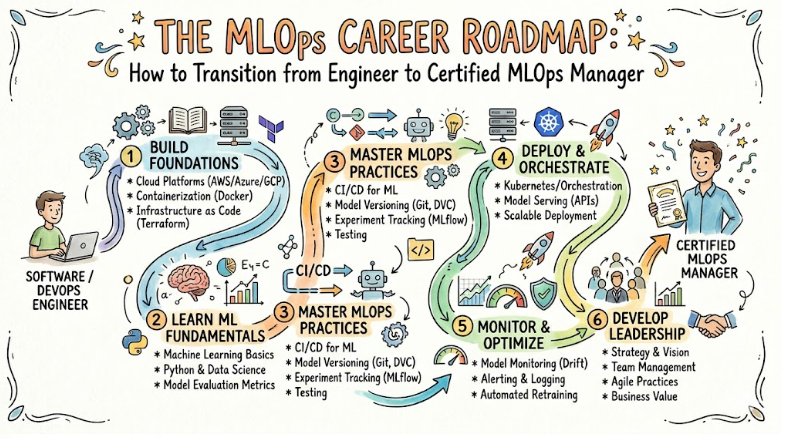
Introduction
The Certified MLOps Manager designation represents a critical evolution in the intersection of artificial intelligence and operational excellence. This guide is designed for professionals who recognize that the bottleneck in modern AI is no longer the algorithm, but the ability to deploy and manage it at scale. As organizations move from experimental data science to production-grade machine learning, the need for structured management has never been higher. By exploring this roadmap provided by AIOps School, you will understand how to bridge the gap between model development and sustainable business value. This comprehensive breakdown serves as a strategic resource for engineers and leaders looking to solidify their authority in the high-stakes world of production AI.
What is the Certified MLOps Manager?
The Certified MLOps Manager is a professional accreditation that focuses on the governance, orchestration, and lifecycle management of machine learning models. Unlike purely technical certifications that focus only on coding, this program emphasizes the “Ops” and “Management” aspects of the ecosystem. It exists to solve the “hidden technical debt” in machine learning systems by teaching professionals how to build resilient pipelines that are reproducible and observable. The curriculum aligns with enterprise needs, focusing on how to integrate ML workflows into existing DevOps and platform engineering frameworks.
Who Should Pursue Certified MLOps Manager?
This certification is ideal for senior DevOps engineers, Site Reliability Engineers, and Cloud Architects who are increasingly tasked with supporting data science teams. It is also highly relevant for Engineering Managers and Technical Leads who need to oversee the budget, security, and operational stability of AI initiatives. In the Indian market, where service and product companies are rapidly pivoting to AI-first strategies, this credential provides a competitive edge. Beginners with a strong foundation in cloud computing will find it a structured way to enter the specialized field of machine learning operations.
Why Certified MLOps Manager is Valuable in and Beyond
As enterprises move beyond the “proof of concept” phase of AI, they require professionals who can ensure that models remain accurate and cost-effective over time. The Certified MLOps Manager certification is valuable because it focuses on platform-agnostic principles that survive the rapid churn of specific tools and libraries. It addresses the global shortage of talent capable of handling model decay, data drift, and security vulnerabilities in AI pipelines. Investing in this certification ensures that your career remains relevant as traditional software engineering increasingly merges with intelligent automation.
Certified MLOps Manager Certification Overview
The program is delivered via the official portal and hosted on the specialized training site. It offers a structured approach to learning that balances theoretical understanding with the practical demands of a production environment. The assessment methodology is designed to test not just your knowledge of terminology, but your ability to make architectural decisions under pressure. Ownership of the certification lies with an institution dedicated to operational excellence, ensuring the content is updated to reflect current industry shifts and cloud-native practices.
Certified MLOps Manager Certification Tracks & Levels
The certification is structured to accommodate different stages of a professional’s career, starting with a foundation level that covers core terminology and basic automation. As candidates progress to the professional level, the focus shifts toward complex orchestration, multi-cloud deployments, and advanced monitoring strategies. The advanced or manager level focuses on the strategic side, including team leadership, financial management of ML resources, and legal compliance. These levels allow professionals to gradually specialize in areas like FinOps for AI or DevSecOps for machine learning.
Complete Certified MLOps Manager Certification Table
| Track | Level | Who it’s for | Prerequisites | Skills Covered | Recommended Order |
| Operations | Foundation | Junior Engineers | Cloud Basics | CI/CD for ML, Versioning | 1 |
| Engineering | Professional | SREs / DevOps | Docker/K8s | Orchestration, Drift Detection | 2 |
| Leadership | Manager | Leads / Managers | Team Lead Exp | Governance, ROI, Strategy | 3 |
| Security | Specialist | Security Pros | InfoSec Basics | Model Security, Privacy | 4 |
| Finance | Specialist | FinOps / Ops | Basic Finance | Cost Optimization for AI | 5 |
Detailed Guide for Each Certified MLOps Manager Certification
Certified MLOps Manager – Foundation Level
What it is
This level validates a candidate’s understanding of the basic MLOps terminology and the fundamental differences between standard DevOps and ML-specific operations. It ensures that the learner can contribute effectively to a data science team by managing basic infrastructure needs.
Who should take it
Aspiring MLOps engineers, junior cloud practitioners, and project managers who need to understand the technical vocabulary of their teams. It is suitable for those with 0-2 years of experience in technical roles.
Skills you’ll gain
- Understanding the ML lifecycle from data ingestion to deployment.
- Version control for both code and large datasets.
- Basic containerization of machine learning models.
- Setting up simple automated pipelines for model training.
Real-world projects you should be able to do
- Automate a basic retraining pipeline for a linear regression model.
- Implement a Git-based workflow for tracking model experiments.
Preparation plan
- 7-14 Days: Focus on core terminology and the MLOps manifesto.
- 30 Days: Practice basic Docker and Git commands relevant to data science.
- 60 Days: Complete mock exams and build a simple end-to-end local pipeline.
Common mistakes
- Ignoring the data versioning aspect and focusing only on code.
- Underestimating the importance of reproducible environments.
Best next certification after this
- Same-track option: Professional MLOps Engineer.
- Cross-track option: DataOps Associate.
- Leadership option: Technical Team Lead Certification.
Certified MLOps Manager – Professional Level
What it is
The Professional Level validates the ability to design and implement scalable, high-availability machine learning platforms. It focuses on the “Day 2” operations of ML, including monitoring, scaling, and handling production failures.
Who should take it
Senior DevOps engineers, Platform engineers, and SREs who have at least 3 years of industry experience. It is for those responsible for the actual uptime and performance of AI models in the cloud.
Skills you’ll gain
- Advanced Kubernetes orchestration for high-performance ML workloads.
- Implementation of feature stores and model registries.
- Designing automated drift detection and alerting systems.
- Managing GPU resources and distributed training clusters.
Real-world projects you should be able to do
- Deploy a microservices-based ML application on a managed Kubernetes cluster.
- Set up an automated monitoring dashboard that detects model performance degradation.
Preparation plan
- 7-14 Days: Deep dive into Kubernetes and specialized operators for ML.
- 30 Days: Hands-on labs with feature stores and model monitoring tools.
- 60 Days: Case study analysis of large-scale ML failures and mitigation.
Common mistakes
- Over-engineering the solution for small-scale datasets.
- Failing to account for the cost implications of high-frequency model monitoring.
Best next certification after this
- Same-track option: Certified MLOps Manager (Leadership).
- Cross-track option: Cloud Security Professional.
- Leadership option: Engineering Manager Foundations.
Certified MLOps Manager – Managerial Level
What it is
This level is the pinnacle of the track, focusing on the strategic and organizational aspects of MLOps. It validates that a professional can lead a department, manage budgets, and align AI initiatives with corporate goals.
Who should take it
Existing engineering managers, Directors of AI, or senior architects transitioning into executive leadership. It requires a deep understanding of both technology and business operations.
Skills you’ll gain
- Strategic planning for enterprise-wide AI platform adoption.
- Financial modeling for ML infrastructure and cloud consumption.
- Ethics, compliance, and risk management for automated systems.
- Building and leading cross-functional teams of data scientists and engineers.
Real-world projects you should be able to do
- Develop a three-year roadmap for an organization’s MLOps maturity.
- Perform a cost-benefit analysis of building vs. buying an ML platform.
Preparation plan
- 7-14 Days: Review industry case studies on AI organizational structures.
- 30 Days: Focus on FinOps principles and compliance frameworks (like GDPR/AI Act).
- 60 Days: Refine leadership communication skills and strategic planning exercises.
Common mistakes
- Losing touch with the technical constraints of the engineering team.
- Focusing too much on tool selection rather than cultural and process changes.
Best next certification after this
- Same-track option: Executive Leadership Program.
- Cross-track option: FinOps Practitioner.
- Leadership option: CTO Mentorship Program.
Choose Your Learning Path
DevOps Path
Engineers following this path focus on integrating machine learning into existing CI/CD workflows. They prioritize automation and the “shift-left” philosophy, ensuring that models are tested for quality and performance before reaching production. This path is perfect for those who want to treat ML models exactly like any other software artifact.
DevSecOps Path
In this specialized path, the focus is on the security of the ML supply chain. Professionals learn to scan models for vulnerabilities, secure data pipelines from injection attacks, and ensure the privacy of the training data. This is a critical path for those working in regulated industries like finance or healthcare.
SRE Path
The Site Reliability Engineering path focuses on the availability and latency of ML services. These professionals apply SRE principles like error budgets and SLIs/SLOs to machine learning models. They are the experts in ensuring that an AI-powered application remains responsive even under extreme traffic loads.
AIOps Path
This path focuses on using artificial intelligence to improve traditional IT operations. Professionals learn how to implement automated incident response and predictive maintenance for server infrastructure. It is distinct from MLOps as it applies ML to the “Ops” side of the business rather than the “Product” side.
MLOps Path
The pure MLOps path is dedicated to the lifecycle of the machine learning model itself. It covers everything from data ingestion and feature engineering to model deployment and monitoring. This is the most direct path for those wanting to become specialists in the intersection of data science and engineering.
DataOps Path
DataOps focuses on the quality and reliability of the data that feeds into machine learning models. Professionals on this path work on data pipelines, warehouse management, and data orchestration. They ensure that the “fuel” for the ML engine is clean, timely, and compliant with all regulations.
FinOps Path
The FinOps path is becoming increasingly important as the cost of cloud-based AI training and inference continues to rise. These professionals focus on cloud cost optimization and financial accountability. They work to ensure that the organization is getting a high return on investment for every dollar spent on GPUs and data storage.
Role → Recommended Certified MLOps Manager Certifications
| Role | Recommended Certifications |
| DevOps Engineer | Certified MLOps Manager – Foundation |
| SRE | Certified MLOps Manager – Professional |
| Platform Engineer | Certified MLOps Manager – Professional |
| Cloud Engineer | Certified MLOps Manager – Foundation |
| Security Engineer | Certified MLOps Manager – Security Track |
| Data Engineer | Certified MLOps Manager – DataOps Track |
| FinOps Practitioner | Certified MLOps Manager – FinOps Track |
| Engineering Manager | Certified MLOps Manager – Managerial Level |
Next Certifications to Take After Certified MLOps Manager
Same Track Progression
Once you have mastered the management aspect of MLOps, you should look toward deep technical specialization. This could involve certifications in specific cloud platforms or advanced orchestration tools. Staying on the same track means becoming the ultimate subject matter expert in how machine learning systems are built and sustained over several years.
Cross-Track Expansion
Broadening your skills into areas like FinOps or DevSecOps is a strategic move for those who want to be indispensable. Understanding how security affects model deployment or how costs impact the viability of an AI project makes you a well-rounded professional. This horizontal growth is often the key to reaching senior staff engineer or architect roles.
Leadership & Management Track
Transitioning into leadership requires a shift from “how” to “why” and “when.” After completing the managerial level of the MLOps certification, you should seek out broader leadership training. This includes people management, strategic communication, and executive presence, which are essential for those aiming for VP or CTO positions in tech-driven companies.
Training & Certification Support Providers for Certified MLOps Manager
DevOpsSchool
This provider is a veteran in the field of technical education, offering a wide array of programs focused on automation and modern engineering practices. Their approach to MLOps training is grounded in years of experience teaching traditional DevOps, making the transition easier for seasoned engineers. They provide extensive lab environments and real-world scenarios that mimic the challenges faced by large-scale enterprises. DevOpsSchool has built a reputation for its deep curriculum and its ability to keep pace with the rapidly evolving tech landscape. Their instructors are typically industry veterans who bring a wealth of practical knowledge to every session, ensuring that students learn more than just theory.
Cotocus
Cotocus stands out by offering specialized consulting and training services that focus on high-end technology implementations. Their training modules for MLOps are often integrated with their consulting insights, providing a unique perspective on what actually works in production environments. They emphasize hands-on learning and architectural best practices, helping students understand the “why” behind the “how.” For professionals looking to understand the nuances of cloud-native MLOps, Cotocus provides a structured and intellectually rigorous environment. Their focus on emerging technologies ensures that candidates are always learning the most relevant skills for the current market, making them a preferred choice for many corporate teams.
Scmgalaxy
Scmgalaxy has long been a community-driven powerhouse for software configuration management and DevOps knowledge. Their extension into MLOps certification support leverages a massive library of resources, tutorials, and community forums. They offer a practical, no-nonsense approach to learning that is highly valued by working professionals who need to gain skills quickly. Scmgalaxy is particularly known for its focus on open-source tools and its ability to break down complex topics into manageable learning paths. By providing a mix of free resources and structured training, they cater to a wide range of learners from different financial and professional backgrounds.
BestDevOps
As the name suggests, this organization focuses on providing top-tier education in the realm of operations and automation. Their MLOps program is designed to be comprehensive, covering every stage of the lifecycle with a focus on efficiency and reliability. BestDevOps utilizes a modern teaching methodology that includes interactive sessions and project-based assessments. This ensures that candidates are not just ready to pass an exam, but are prepared to handle real-world deployments on day one. Their curriculum is often cited for its clarity and its focus on the most popular tools currently used in the tech industry.
devsecopsschool.com
This platform is the go-to resource for anyone looking to integrate security into their operations and machine learning workflows. They recognize that security is often an afterthought in AI projects and work to change that mindset through their specialized training. Their courses provide a deep dive into model security, data privacy, and secure pipeline construction. By focusing on the intersection of security and MLOps, they fill a critical gap in the market. Students learn how to build “secure by design” systems that can withstand the unique threats posed by machine learning vulnerabilities and adversarial attacks.
sreschool.com
Site Reliability Engineering is at the heart of any successful production system, and this school focuses on applying those principles to the world of AI. Their training covers everything from error budgets to automated incident response for machine learning models. They teach students how to measure the reliability of non-deterministic systems, which is one of the hardest challenges in MLOps. The curriculum is highly technical and aimed at those who want to ensure the highest levels of uptime and performance. Graduates from this program are well-equipped to manage the complex, distributed systems that power modern artificial intelligence.
aiopsschool.com
As the primary host for the Certified MLOps Manager program, this site is dedicated entirely to the convergence of AI and operations. They provide a holistic view of the field, offering tracks that cover both the use of AI for IT operations and the operationalization of machine learning models. Their content is curated by experts who are actively working on some of the world’s most advanced AI platforms. The platform offers a seamless learning experience, with integrated labs, assessments, and community support. It is the definitive starting point for anyone serious about a career in MLOps or AIOps.
dataopsschool.com
Data is the foundation of all machine learning, and this school ensures that the foundation is solid. Their programs focus on the engineering and management of data pipelines, ensuring quality, reliability, and speed. They bridge the gap between traditional data warehousing and modern, real-time data streaming for AI. By teaching the principles of DataOps, they help professionals ensure that their models are always fed with high-quality data. This is an essential skill set for any MLOps manager who needs to oversee the entire pipeline from raw data to a deployed model.
finopsschool.com
With the rising costs of cloud computing, particularly for GPU-heavy AI workloads, FinOps has become a mandatory skill set. This school teaches professionals how to manage and optimize the costs associated with machine learning and cloud infrastructure. They provide frameworks for financial accountability, cost allocation, and resource optimization. Students learn how to communicate the value of AI initiatives to stakeholders in financial terms. In a world where cloud bills can spiral out of control, the skills taught here are essential for the long-term sustainability of any organization’s AI strategy.
Frequently Asked Questions (General)
- How long does it take to complete the certification?
Most professionals complete the foundation level in 4-6 weeks, while the full manager track may take 6 months of dedicated study and practice. - Are there any prerequisites for the foundation level?
While no formal certifications are required, a basic understanding of cloud computing and Linux command lines is highly recommended. - Is the exam based on multiple-choice questions?
The exam is a combination of theoretical multiple-choice questions and practical, scenario-based challenges that test decision-making. - Does this certification cover specific tools like AWS or Azure?
The core certification is platform-agnostic, focusing on principles that apply to all major cloud providers and on-premise environments. - What is the passing score for the exams?
Generally, a score of 70% or higher is required to demonstrate a professional level of competency in the subject matter. - Can I skip the foundation level if I have experience?
It is highly recommended to follow the sequence, as the foundation sets the terminology used in more advanced levels, but waivers are available for high-experience candidates. - How often is the curriculum updated?
The content is reviewed every six months to ensure it reflects the latest trends in the machine learning and operations industries. - Is there a community for certified professionals?
Yes, successful candidates gain access to an exclusive alumni network where they can share insights and job opportunities. - Do I need to know how to build ML models to be an MLOps Manager?
You don’t need to be a data scientist, but you must understand how models are built and the specific constraints they place on infrastructure. - Does the certification expire?
To ensure professionals stay current, the certification typically requires renewal or proof of continuing education every two to three years. - Is the exam proctored?
Yes, all professional and managerial level exams are conducted in a secure, proctored online environment to maintain the integrity of the credential. - Can my company sponsor my certification?
Most major enterprises have professional development budgets that cover these types of industry-recognized technical certifications.
FAQs on Certified MLOps Manager
- What is the primary focus of the Certified MLOps Manager program?
It focuses on the governance, lifecycle management, and operational scaling of machine learning models within an enterprise environment. - How does this differ from a standard DevOps certification?
Standard DevOps focuses on code and binary artifacts, while MLOps adds the complexities of data versioning, model drift, and non-deterministic outputs. - What is the ROI of getting this certification?
Professionals often see a significant increase in salary and are eligible for specialized roles that are currently in high demand globally. - Are labs included in the training?
Yes, the program includes hands-on lab environments where you can practice deploying models and setting up monitoring pipelines. - Who is the ideal candidate for the Managerial level?
Technical leads or engineering managers who are responsible for the delivery and stability of AI-powered products. - Does the program cover ethical AI and compliance?
Yes, the managerial level specifically addresses the legal and ethical frameworks surrounding automated decision-making. - Can I move from Data Engineering to MLOps using this guide?
Absolutely; the DataOps track provides a perfect bridge for data specialists to move into broader operational management roles. - Is this certification recognized in India?
Yes, it is highly valued by major IT service providers and product startups in India’s booming AI and tech sector.
Final Thoughts: Is Certified MLOps Manager Worth It?
After two decades in the trenches of DevOps and SRE, I can tell you that the complexity of modern systems is only increasing. Machine learning is no longer a niche project; it is the core engine of the modern enterprise. However, an engine is useless without a transmission, a fuel system, and a driver who knows how to maintain it. That is exactly what the Certified MLOps Manager program provides—the blueprints for the infrastructure that makes AI work.
If you are looking for a “get rich quick” scheme or a simple badge to post on social media, this isn’t it. This certification requires a genuine commitment to understanding the messy, difficult parts of production technology. But if you want to be the person who can walk into a room of confused stakeholders and explain exactly how to make their AI initiatives stable and profitable, then this path is for you. It is an investment in your ability to lead in the next decade of engineering. Be practical, stay curious, and focus on the fundamentals of operational excellence.