




Introduction
The landscape of software delivery has undergone a seismic shift over the last decade. Gone are the days of manual server provisioning, long-cycle releases, and the deep-seated friction between developers who wanted to ship code and operations teams who prioritized system stability. Today, the rise of cloud-native systems has made speed and reliability not just competitive advantages, but baseline requirements for survival in the tech industry.
To navigate this complexity, engineers must move beyond tool proficiency and understand the underlying philosophies that drive modern infrastructure. This is where DevOps principles come into play. They represent the cultural and technical shift required to align engineering output with business goals. Whether you are a developer looking to understand the production environment or an SRE aiming to optimize deployment cycles, these principles serve as the blueprint for building high-performing teams. For those seeking structured guidance in navigating this transition, DevOpsSchool provides resources to help engineers master these critical skills. By integrating these foundational concepts, organizations can move faster, reduce burnout, and create more robust software ecosystems.
What Are DevOps Principles?
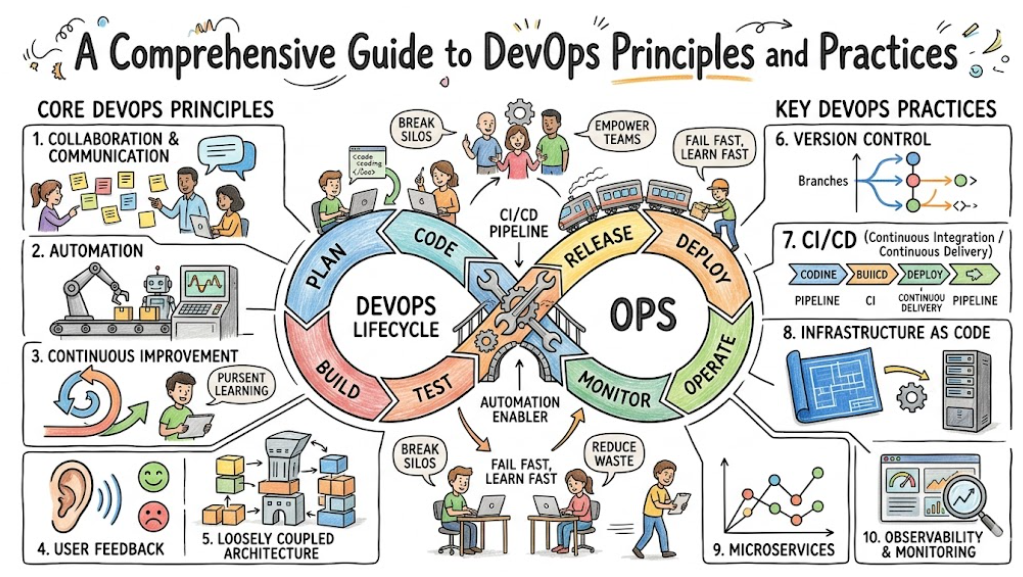
At its core, DevOps is not a specific piece of software or a job title; it is a philosophy that integrates development (Dev) and operations (Ops) teams to shorten the systems development life cycle. DevOps principles are the guiding tenets that facilitate this integration.
These principles emphasize breaking down organizational silos, adopting an automation-first mindset, and fostering a culture of shared ownership. Instead of treating code as something that is “thrown over the wall” to an operations team, DevOps encourages continuous collaboration throughout the entire lifecycle—from design and development to production support. It is about creating a feedback loop where engineers are empowered to take responsibility for the stability of their applications, while operations teams are empowered to influence how code is written for better performance.
Why DevOps Principles Matter for Engineers
For an engineer, mastering these principles is about more than just efficiency; it is about reclaiming control over the software lifecycle.
- Faster Software Delivery: By automating repetitive tasks, teams can push features to production in hours rather than weeks.
- Reduced Operational Risk: Automated testing and infrastructure provisioning ensure that the environment where code is tested is identical to the one in production.
- Improved Reliability: Observability and monitoring allow engineers to detect issues before they impact the end user.
- Faster Incident Resolution: When the team that writes the code also understands the infrastructure, mean time to recovery (MTTR) drops significantly.
- Better Scalability: Cloud-native principles ensure that applications can handle sudden spikes in traffic without manual intervention.
Evolution of DevOps Principles
Software delivery was historically defined by Waterfall methodology, where phases were strictly sequential. Developers would finish their work, pass it to QA, and then pass it to Operations. If a bug was found in production, the process of finding the root cause often involved “finger-pointing” across departments.
As businesses demanded faster iteration, Agile methodologies emerged, focusing on speed but often leaving operations behind. DevOps evolved as the natural successor to Agile, recognizing that you cannot have true agility if the infrastructure cannot keep pace with development. The rise of containerization and cloud platforms transformed these theoretical concepts into actionable engineering practices, allowing teams to treat infrastructure as code and deployments as automated, low-risk events.
Core DevOps Principles Overview
| Principle | Purpose | Technical Impact | Business Impact |
| Collaboration | Break silos | Better cross-team communication | Faster time-to-market |
| Automation | Remove manual tasks | Fewer human errors | Increased output |
| CI/CD | Streamline delivery | Consistent build quality | Rapid feature releases |
| Observability | Gain system insight | Faster troubleshooting | Higher uptime |
| IaC | Standardize infra | Consistent environments | Lower infrastructure costs |
| Feedback | Learn and adapt | Continuous improvement | Better user satisfaction |
Principle 1: Collaboration and Communication
The biggest bottleneck in many organizations is not technical—it is cultural. Collaboration means moving away from “my code” or “your server” toward “our product.” When developers and operators work in the same loop, they share the burden of incidents and the joy of successful releases. This alignment reduces the ambiguity that typically leads to deployment failures.
Principle 2: Automation Everywhere
Automation is the engine of the DevOps philosophy. If a task is performed more than twice, it should be automated. This applies to unit testing, environment provisioning, security scanning, and deployment. By automating these processes, engineers free up their time to focus on complex problem-solving rather than mundane configuration management.
Principle 3: Continuous Integration (CI)
Continuous Integration is the practice of merging all developers’ working copies to a shared mainline several times a day. Every merge triggers an automated build and test sequence. The goal is to detect integration errors as early as possible. If the build fails, the team knows immediately, preventing the “merge hell” that occurs when developers work in isolation for too long.
Principle 4: Continuous Delivery & Continuous Deployment
These terms are often used interchangeably but have distinct meanings in the engineering workflow.
| Feature | Continuous Delivery | Continuous Deployment |
| Definition | Code is always in a deployable state | Code is automatically deployed to production |
| Approval | Manual trigger required | Fully automated |
| Risk Level | Lower (human oversight) | Higher (requires robust testing) |
Principle 5: Infrastructure as Code (IaC)
Infrastructure as Code (IaC) allows engineers to manage infrastructure using configuration files rather than manual hardware configuration or interactive tools. By version-controlling infrastructure, teams can ensure that production, staging, and development environments are identical. Tools like Terraform and Ansible allow for declarative infrastructure management, making cloud environments reproducible and scalable.
Principle 6: Monitoring and Observability
Monitoring tells you when something is wrong; observability tells you why. In a distributed system, you cannot rely on simple up/down checks. Engineers must implement logging, metrics, and tracing to understand the health of their applications. Tools like Prometheus and Grafana are essential for visualizing the performance of cloud-native infrastructure.
Principle 7: Continuous Feedback Loops
DevOps is an iterative process. Feedback loops—ranging from automated alerts when a production service fails, to customer usage analytics—provide the data needed for the next development cycle. Without these loops, teams are essentially flying blind, unable to verify if their improvements are actually benefiting the user.
Principle 8: Shared Responsibility
Shared responsibility is the hallmark of a mature DevOps culture. When developers are involved in on-call rotations and production support, they naturally write more stable code. This shared burden ensures that reliability is considered during the design phase, rather than treated as an afterthought.
Principle 9: Customer-Centric Thinking
All technical decisions should be viewed through the lens of the customer. Does this automation improve performance for the user? Does this deployment strategy reduce downtime for them? By prioritizing the customer experience, engineering teams align their technical roadmap with real-world business value.
Principle 10: Continuous Learning and Improvement
The technology landscape moves fast. DevOps encourages a culture where failure is viewed as a learning opportunity—often documented through blameless post-mortems—rather than a reason for punishment. Regular knowledge sharing and experimentation keep teams at the cutting edge of modern engineering.
DevOps Principles in Cloud-Native Environments
Cloud-native environments rely heavily on Kubernetes, containers, and microservices. In this paradigm, infrastructure is ephemeral. DevOps principles become even more critical here, as the complexity of managing hundreds of microservices manually is impossible. Platform engineering has emerged as an evolution of these principles, where specialized teams build internal platforms that abstract away the complexity of Kubernetes for the rest of the development team.
DevOps Principles and CI/CD Pipelines
A CI/CD pipeline is the physical manifestation of DevOps principles. A well-designed pipeline starts with a code commit and ends with a production deployment, with automated gates for testing, security scanning, and quality assurance in between. By integrating these steps, engineers ensure that every piece of code undergoes the same rigorous quality standards.
Popular Tools Supporting DevOps Principles
| Tool | Purpose | DevOps Principle Supported | Difficulty |
| Jenkins / GitLab CI | CI/CD | Continuous Integration | Medium |
| Terraform | IaC | Infrastructure as Code | High |
| Prometheus | Monitoring | Observability | Medium |
| Docker / Kubernetes | Containers | Cloud-Native Scaling | High |
| Jira / Slack | Collaboration | Communication | Low |
Real-World DevOps Workflow Example
- Code Commit: Developer pushes code to a Git repository.
- CI Pipeline: An automated pipeline triggers a build and runs unit tests.
- Artifact Creation: The code is packaged into a container image.
- IaC Execution: Terraform provisions or updates the required cloud resources.
- Deployment: Kubernetes orchestrates the rollout of the new container version.
- Observability: Monitoring tools track the deployment health.
- Feedback: If error rates spike, the pipeline automatically rolls back the change.
Benefits of Following DevOps Principles
Adopting these principles transforms organizations. Engineering teams report higher deployment frequency, lower failure rates, and drastically reduced time to restore services. Beyond the technical metrics, there is a tangible improvement in team morale. Engineers are less stressed when they have the right tools and automated safety nets, leading to better retention and a more innovative work environment.
Challenges Engineers Face While Implementing DevOps Principles
The path to DevOps maturity is rarely smooth. Common challenges include:
- Cultural Resistance: Moving from siloed teams to cross-functional units can be uncomfortable for staff used to traditional hierarchies.
- Legacy Infrastructure: Older applications were not built for automation, requiring significant refactoring.
- Tool Fatigue: With thousands of tools available, choosing the right ones can be overwhelming.
- Skill Gaps: DevOps requires a T-shaped skill set (deep expertise in one area, broad knowledge in others), which requires consistent training.
Common Beginner Mistakes
- Tooling Over Process: Buying a tool before defining the process.
- Ignoring Fundamentals: Attempting to learn Kubernetes without understanding Linux networking.
- Manual Over-Automation: Trying to automate something that hasn’t been standardized first.
- Lack of Monitoring: Deploying fast without having the visibility to see if it works.
Best Practices for Applying DevOps Principles
- Start Small: Begin by automating a single, low-risk process.
- Standardize Environments: Use IaC to ensure consistency.
- Prioritize Security: Shift-left security by integrating it into the CI/CD pipeline.
- Document Everything: Maintain clear documentation for internal processes.
- Continuous Learning: Allocate time for the team to explore new technologies.
DevOps Principles vs Traditional IT Practices
| Feature | Traditional IT | DevOps Principles |
| Team Collaboration | Siloed by department | Cross-functional units |
| Deployment Speed | Monthly or quarterly | On-demand/Daily |
| Automation | Selective/Manual | Standard/Automated |
| Feedback Cycles | Reactive/Slow | Continuous/Immediate |
| Infrastructure | Manually configured | Defined as Code |
Career Benefits of Understanding DevOps Principles
Engineers who grasp these principles are in high demand across the globe. From cloud engineers to SREs, the ability to architect automated systems is one of the highest-paid skill sets in modern IT. Mastering these concepts ensures long-term career relevance and provides the foundation for leadership roles, such as platform architect or engineering manager.
Certifications & Learning Paths
Hands-on experience is the only way to truly learn DevOps. A structured path is essential for building a deep understanding.
| Certification | Best For | Skill Level | Focus Area |
| AWS/Azure Solutions Architect | Cloud Engineers | Intermediate | Cloud Infrastructure |
| CKA (Certified Kubernetes Admin) | DevOps/SREs | Advanced | Container Orchestration |
| Terraform Associate | DevOps Engineers | Intermediate | Infrastructure as Code |
Resources like DevOpsSchool are designed to help you navigate these paths efficiently.
Future of DevOps Principles
The future of DevOps is moving toward “Platform Engineering” and “AIOps.” As systems become more complex, AI will increasingly assist in identifying root causes and optimizing resource allocation. GitOps—using Git as the single source of truth for declarative infrastructure and application configuration—will continue to gain traction as the gold standard for deployment.
FAQs
1. What are DevOps principles?
They are the philosophies of collaboration, automation, and continuous improvement that bridge the gap between development and operations.
2. Why are DevOps principles important?
They allow teams to deploy software faster, more reliably, and with greater visibility into system performance.
3. Is DevOps only about automation?
No, automation is a tool. The culture of collaboration and shared responsibility is just as important.
4. What is CI/CD in DevOps?
Continuous Integration is the automation of code testing; Continuous Delivery/Deployment is the automation of code release to environments.
5. Why is monitoring important?
It provides the data necessary to understand if your system is meeting user needs and helps identify bottlenecks.
6. What is Infrastructure as Code?
Managing infrastructure configuration files instead of manual configuration.
7. Is Kubernetes required for DevOps?
No, but it is the industry standard for managing containerized workloads in modern DevOps environments.
8. How long does it take to learn DevOps principles?
It is a continuous journey. You can learn the basics in a few months, but mastery takes years of hands-on experience.
9. Can small teams use DevOps?
Yes, DevOps is arguably more effective for small teams as it reduces the overhead of manual operations.
10. What is the biggest barrier to DevOps adoption?
Usually, it is organizational culture, not technology.
11. Do developers need to know Linux?
Yes, it is the foundation of almost all modern cloud-native infrastructure.
12. Is security part of DevOps?
Yes, this is called DevSecOps—integrating security checks into the pipeline.
13. What is SRE?
Site Reliability Engineering is an implementation of DevOps principles focused on system reliability.
14. What is the role of the cloud?
The cloud provides the programmable infrastructure that makes modern DevOps automation possible.
15. How do I start learning?
Pick a project, learn the basics of CI/CD, and explore platforms like DevOpsSchool for structured learning.
Final Thoughts
DevOps is not a destination; it is a mindset. As an engineer, your ability to embrace automation, champion collaboration, and maintain a focus on continuous learning will define your career trajectory. The tools will change—what is popular in Kubernetes today might be replaced tomorrow—but the principles of DevOps remain constant. Focus on building systems that are resilient, observable, and automated. Stay curious, stay practical, and remember that the best code is the code that adds value to the user while remaining stable in production.