




Introduction
In modern software engineering, speed without visibility is a recipe for failure. Traditional software development often operated in isolated phases: teams planned for months, coded in a vacuum, threw code over the wall to QA, and eventually pushed updates to production, only to discover critical bugs weeks later.
Enter Continuous Feedback in DevOps. By weaving feedback mechanisms into every stage of the software delivery lifecycle (SDLC), engineering organizations bridge the gap between creation and consumption. This article explores how DevOps practices cultivate a culture of continuous learning and seamless feedback across development, testing, security, operations, and business teams.
What Is Continuous Feedback?
Continuous feedback is the systematic practice of gathering, analyzing, and acting upon data and insights generated at every phase of the software delivery pipeline.
Unlike traditional processes where feedback arrives months down the line via user complaints or end-of-project reviews, continuous feedback provides real-time signals. It ensures that developers, operators, and stakeholders instantly know how code changes perform, whether automated tests pass, and how users interact with live features.
What Is DevOps?
DevOps is a cultural and operational movement that unifies software development (Dev) and IT operations (Ops). At its core, DevOps relies on:
- Collaboration: Breaking down organizational silos.
- Automation: Removing manual bottlenecks.
- CI/CD: Streamlining integration and delivery.
- Monitoring & Observability: Keeping a constant pulse on system health.
- Shared Responsibility: Making everyone accountable for product reliability.
These pillars form the foundation that makes a DevOps feedback loop possible.
How DevOps Creates a Continuous Feedback Loop
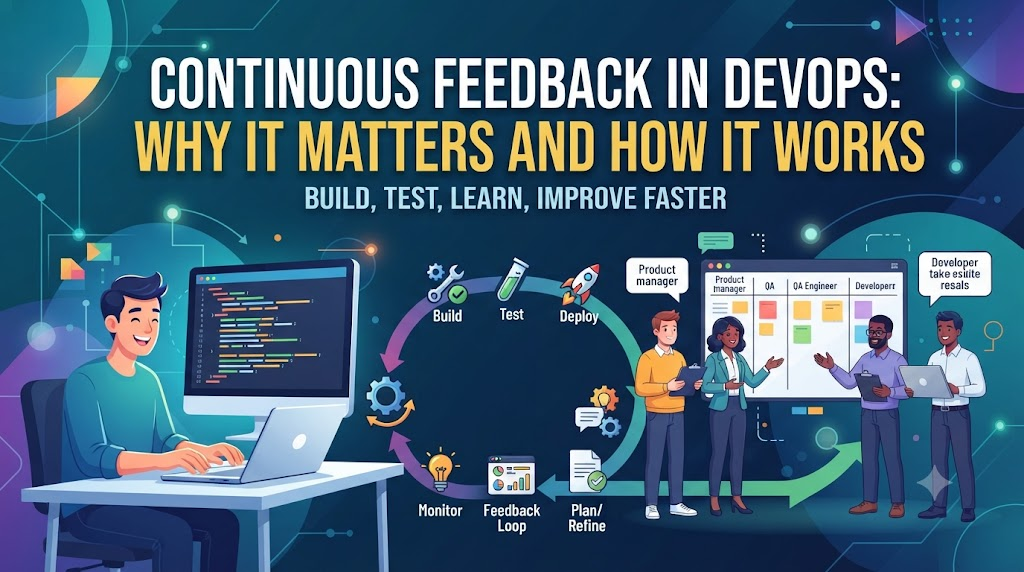
A typical DevOps feedback loop follows a continuous infinity cycle:
Plan→Code→Build→Test→Release→Deploy→Monitor→Learn→Improve
Information from each stage directly influences the next iteration. For example, production monitoring data informs the planning phase, ensuring that stability and performance metrics guide upcoming feature development.
Continuous Feedback Throughout the Software Development Lifecycle
Feedback is not a single event; it is an omnipresent stream across the SDLC:
- Planning: Feature requests and backlog adjustments based on user telemetry.
- Coding & Code Review: Immediate peer feedback via pull requests.
- Build & Testing: Rapid validation of syntax, dependencies, and functional correctness.
- Deployment & Production: Instant alerts on deployment health and resource usage.
- Customer Usage: Real-time analytics tracking feature adoption.
The Role of CI/CD in Continuous Feedback
DevOps CI/CD pipelines act as the central nervous system for feedback. Continuous Integration (CI) alerts developers within minutes if a new code commit breaks the build or fails automated tests. Continuous Delivery (CD) provides immediate signals regarding release readiness, ensuring that packages can be promoted to staging or production safely.
Automated Testing as a Feedback Mechanism
Automated testing replaces slow, manual QA cycles with rapid validation. By utilizing unit tests, integration tests, regression suites, API checks, and performance tests, engineering teams receive instantaneous feedback on code health long before changes reach production environments.
Monitoring and Observability for Continuous Feedback
Through DevOps monitoring and observability tools, operations teams gain granular visibility into application behavior. Logs, metrics, distributed traces, and intelligent dashboards help engineers diagnose anomalies, track error rates, and resolve bottlenecks before they impact end users.
Customer Feedback and DevOps
Technical metrics are only half the battle. True continuous improvement in DevOps requires listening to end users. Product analytics, customer support tickets, app store reviews, and session recordings translate human experience into actionable requirements for future development sprints.
Feedback From Incident Management
Failures are inevitable, but repeating them is a choice. Modern incident management utilizes blameless post-mortems, root-cause analysis (RCA), and corrective action items to turn outages into valuable system education.
Infrastructure and Operations Feedback
Infrastructure monitoring, cloud cost optimization, and capacity planning give system administrators continuous insights into hardware and cloud resource utilization, driving greater operational efficiency and cost control.
Security Feedback in DevSecOps
Integrating security early—often called DevSecOps—ensures continuous vulnerability scanning, static/dynamic code analysis (SAST/DAST), and compliance checks provide security feedback while code is still being written.
The Role of Collaboration in Continuous Feedback
A strong DevOps culture eliminates the classic “us versus them” mentality between developers and IT operators. Shared dashboards, collaborative war rooms, and transparent chatOps channels ensure that cross-functional teams troubleshoot and learn together.
DevOps Tools That Support Continuous Feedback
While tools do not create culture, they enable scale. Key tool categories include:
- Version Control: Git platforms for code review feedback.
- CI/CD Platforms: Jenkins, GitLab CI, GitHub Actions for pipeline status.
- Automated Testing: Selenium, JUnit, Postman for quality validation.
- Observability & Monitoring: Prometheus, Grafana, Datadog for system metrics.
- Incident Management: PagerDuty, Jira Service Management for operational alerts.
How Automation Makes Feedback Faster
Automation removes human latency. When code pushes automatically trigger builds, tests, security scans, and deployment smoke tests within minutes, developers can fix issues while the context is still fresh in their minds.
Continuous Feedback and Continuous Improvement
Feedback is useless without action. High-performing teams review metrics regularly, refactor technical debt, update automated test coverage, and continuously refine their engineering processes based on empirical data.
Key Benefits of Continuous Feedback in DevOps
- Faster Issue Detection: Catching bugs in development rather than production.
- Better Software Quality: Ensuring high code standards through rigorous automated checks.
- Reduced Deployment Risk: Making smaller, frequent releases safer.
- Enhanced Customer Satisfaction: Delivering stable, reliable features consistently.
- Continuous Learning: Building an engineering culture focused on growth.
Common Challenges in Building Continuous Feedback Loops
- Alert Fatigue: Too many false-positive alarms causing engineers to ignore notifications.
- Solution: Tune alert thresholds and focus on high-fidelity SLOs (Service Level Objectives).
- Siloed Teams: Resistance to sharing data across departments.
- Solution: Align incentives and establish shared cross-functional KPIs.
- Failure to Act: Collecting metrics without making operational changes.
- Solution: Assign clear ownership to review feedback during sprint retrospectives.
Best Practices for Creating Effective DevOps Feedback Loops
- Keep Feedback Fast: Aim for CI/CD build and test cycles under 10 minutes.
- Monitor Outcomes: Track both technical uptime and business conversion rates.
- Automate Ruthlessly: Eliminate manual sign-offs wherever possible.
- Encourage Blamelessness: Treat outages as learning opportunities, not blame games.
Real-World Example: Continuous Feedback in a DevOps Pipeline
Consider an e-commerce platform updating its checkout service:
- Commit & CI: A developer pushes code; the CI pipeline runs automated unit tests in 3 minutes, giving instant pass/fail feedback.
- Staging & Security: Automated DAST scans flag a minor dependency vulnerability, alerting the security team.
- Production & Monitoring: The feature deploys via a canary release. Prometheus metrics note a slight spike in latency.
- Feedback Action: The team rolls back automatically, reviews the trace logs, patches the bottleneck, and redeploys smoothly.
How DevOps Training Helps Professionals Build Feedback-Driven Practices
Mastering modern automation, observability, and pipeline design requires structured learning. DevOpsSchool provides comprehensive, hands-on training programs designed to help engineers, administrators, and tech leaders build practical expertise in CI/CD, automation, cloud infrastructure, and feedback-driven methodologies.
Future of Continuous Feedback in DevOps
The future of DevOps is increasingly intelligent. Emerging trends include AI-assisted anomaly detection, predictive analytics powered by AIOps, automated remediation scripts, and platform engineering initiatives that abstract complexity while accelerating feedback delivery.
Frequently Asked Questions
What is continuous feedback in DevOps?
It is the automated and systematic practice of collecting performance, quality, and user data across every stage of software delivery to guide improvements.
Why is continuous feedback important in DevOps?
It minimizes the blast radius of errors, accelerates delivery times, and aligns engineering output with real-world user needs.
How does CI/CD provide feedback?
CI/CD pipelines instantly report on code compilation success, automated test outcomes, and deployment health immediately after a commit is made.
How does customer feedback fit into DevOps?
Customer usage analytics, support tickets, and feature engagement metrics feed directly back into product backlogs for future iterations.
Conclusion: Building a Culture of Continuous Learning
DevOps is much more than a collection of tools or faster deployments; it is a philosophy rooted in continuous learning. By establishing robust feedback loops spanning development, testing, security, operations, and customer experience, organizations transform raw data into actionable wisdom—driving resilience, innovation, and long-term business success.