




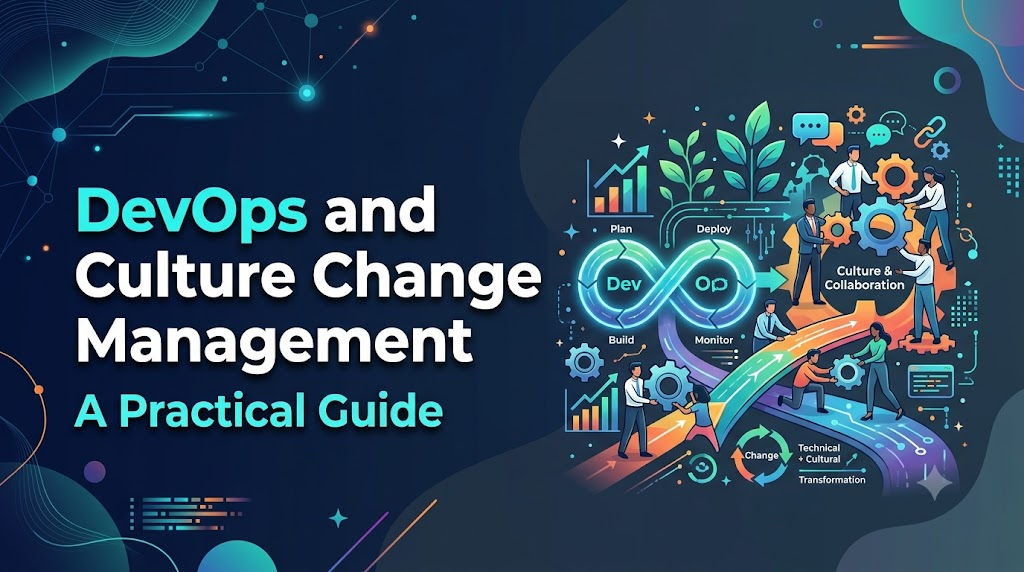
Introduction
Organizations routinely invest millions in CI/CD pipelines, cloud orchestration, and observability tools only to find that deployment failures persist, releases stall in bureaucratic review gates, and friction between teams remains high. The underlying issue is not technological capability, but the structural separation between development, operations, and security—groups traditionally rewarded on fundamentally opposing metrics of delivery speed versus production stability. True DevOps transformation is impossible through automation alone; it requires deliberate organizational culture change management that systematically shifts team incentives, dismantles operational silos, and establishes psychological safety and shared accountability across the entire software delivery lifecycle.
What Is DevOps Culture?
DevOps culture is a set of shared organizational values, working principles, and behavioral norms that unite software development, IT operations, quality assurance, and security teams throughout the entire software delivery lifecycle.
Rather than treating software delivery as a relay race—where code is passed over an organizational wall from one team to the next—a healthy DevOps culture treats delivery as a shared, continuous responsibility.
       Plan  <-------->  Build  <-------->  Test
        ^                                    |
        |          Continuous Feedback       |
        v                                    v
     Operate <-------->  Deploy <--------> Release
Core Characteristics of a Mature DevOps Culture
- Shared Responsibility for Delivery and Reliability: Developers write software with production maintainability, telemetry, and operability in mind. Operations engineers provide architectural guidance, infrastructure platforms, and operational guardrails early during application design.
- Collaboration Over Departmental Isolation: Success is evaluated based on end-to-end business outcomes and customer value, not individual or departmental output tickets.
- Open Communication and Fast Feedback: Information moves freely across disciplines. Telemetry from production monitoring, automated tests, and user behavior flows directly back to engineering teams to guide future work.
- Targeted Automation: Teams systematically automate repetitive, error-prone tasks—such as environment provisioning, regression testing, and deployment verification—freeing human effort for high-value problem solving.
- Continuous Learning and Improvement: Work systems explicitly accommodate retrospectives, technical debt reduction, system experimentation, and structured capability building.
- Blameless Incident Analysis: Production failures are treated as systemic learning opportunities rather than individual errors, focusing on improving systemic resilience rather than assigning personal fault.
- Customer-Centric Outcomes: Technology teams anchor their engineering priorities in business reliability, user satisfaction, and responsive delivery.
A common industry misconception is that adopting a DevOps culture eliminates specialized disciplines or demands that every engineer become an expert in everything. This is neither practical nor desirable.
DevOps culture does not erase specialization; it dismantles organizational walls. Core competencies—such as deep infrastructure architecture, database tuning, product engineering, and application security—remain essential. What fundamentally changes is the collaboration model: specialists build shared platforms, provide self-service tools, define guardrails, and collaborate openly rather than acting as restrictive gatekeepers.
What Is Culture Change Management?
Culture change management is the systematic approach to guiding an organization’s workforce through the behavioral, relational, and procedural shifts required to adopt new ways of working.
While technical change focuses on systems, configurations, architectures, and pipelines, culture change management focuses on people, social dynamics, and operational incentives.
+------------------------------------+------------------------------------+
| Technical Change                   | Cultural Change                    |
+------------------------------------+------------------------------------+
| • Implement CI/CD pipelines        | • Build trust to deploy frequently |
| • Deploy monitoring agents         | • Use metrics to learn, not blame  |
| • Automate infrastructure delivery | • Share ownership of reliability   |
+------------------------------------+------------------------------------+
Essential Elements of Culture Change Management
- Assessing the Baseline Organization: Diagnosing existing cultural norms, unwritten rules, historical grievances, team anxieties, and operational bottlenecks before prescribing solutions.
- Defining Desired Behaviors: Explicitly defining what effective collaboration looks like in daily routines (such as joint backlog refinement, peer reviews, and shared on-call rotations).
- Articulating the Context for Change: Transparently explaining the business pressures, engineering challenges, and customer requirements driving the transformation.
- Engaging Formal and Informal Leaders: Mobilizing line managers, respected senior engineers, and systems architects who directly influence team culture.
- Targeted Capability Building: Providing hands-on education, mentorship, and practical workspace so teams can master new workflows without fear of penalization.
- Constructively Resolving Resistance: Identifying the underlying operational, structural, or emotional root causes behind hesitation and addressing them directly.
- Reinforcing Target Behaviors: Aligning performance reviews, compensation models, engineering recognition, and promotion criteria with collaborative, shared-ownership outcomes.
- Iterative Measurement and Adjustment: Monitoring both operational delivery data and team sentiment to fine-tune the change approach over time.
Executive mandates do not transform organizational culture. Announcing that an engineering department is “now doing DevOps” via email or restructuring organizational charts produces little genuine impact. Real cultural change happens incrementally, through daily working interactions, transparent executive reinforcement, and systemic changes to incentives.
Why Culture Change Is Essential for DevOps Transformation
Technology operates within a human system. When cultural dimensions are neglected during a DevOps transformation, technical investments consistently underdeliver.
       +-------------------------------------------------------+
       |               Technical Capabilities                  |
       |         (CI/CD, Cloud Platforms, IaC, Telemetry)      |
       +-------------------------------------------------------+
                                  |
                               Fails If
                                  v
       +-------------------------------------------------------+
       |             Dysfunctional Cultural Baseline           |
       |   (Fear, Siloed Goals, Blame, Misaligned Incentives)  |
       +-------------------------------------------------------+
Breaking Down Development and Operations Silos
When departments focus solely on local optimizations, systemic delivery suffers. Development pushes unverified code downstream to meet sprint velocity commitments, while Operations introduces manual approvals, multi-day freeze windows, and rigid change advisory boards (CABs) to defend system uptime.
Culture change shifts these teams toward shared planning, joint architectural decisions, and collaborative troubleshooting. When both groups share delivery and reliability commitments, the incentive to throw unfinished work over the wall disappears.
Encouraging Shared Ownership
The principle of shared ownership—often framed as “you build it, you run it”—does not imply that developers arbitrarily execute ad-hoc commands in production environments without controls. Instead, it establishes operational health as a core engineering concern:
- Developers write actionable runbooks, integrate health endpoints, configure meaningful error logging, and participate in incident escalation rotations.
- Operations engineers focus on platform engineering: creating robust, self-service infrastructure, automated guardrails, and centralized monitoring frameworks.
Shared ownership bridges the divide between software construction and runtime operations, ensuring systems are built for long-term operability.
Improving Communication and Feedback
Modern software engineering requires rapid, low-friction information exchange. Long email threads and multi-day ticket handoffs introduce delay, dilute context, and breed misunderstandings.
A culture anchored in open communication replaces bureaucratic checkpoints with direct cross-functional interactions:
- Automated pipeline alerts deliver immediate test feedback directly to the engineer who authored the commit.
- Collaborative incident retrospectives bring cross-functional perspectives together within hours of an outage.
- Cross-functional backlog grooming ensures operational and security debt is prioritized alongside end-user features.
Building Trust Between Teams
Organizational silos thrive in environments dominated by suspicion. Developers suspect operations teams want to slow their releases down; operations teams suspect developers release unstable code without testing.
Culture change management builds trust through transparency, predictable working agreements, and shared visibility into system state. When teams work with unified telemetry dashboards and transparent backlogs, operational debates shift from emotional defenses to objective, data-informed decisions.
Supporting Continuous Improvement
A healthy engineering organization treats processes and systems as living mechanisms subject to continuous refinement.
Through structured retrospectives, automated deployment analysis, and deliberate experimentation, teams identify bottlenecks, adjust workflows, and remove waste. Continuous improvement prevents organizations from stagnating into rigid operational models that quickly grow obsolete.
Common Cultural Barriers to DevOps Adoption
Understanding why people resist change is critical. Resistance to DevOps is rarely driven by individual stubbornness; more often, it is a rational response to misaligned incentives, unmanaged risks, or previous negative transformation experiences.
| Common Cultural Barrier | Operational Impact | Practical Leadership Remedy |
| Resistance to New Tools & Workflows | Teams revert to manual routines, spreadsheet tracking, and shadow IT to complete daily work. | Involve teams in tool evaluations, provide protected training time, and automate existing pain points first. |
| Fear of Losing Control or Job Relevance | Specialists (e.g., manual testers, sysadmins) quietly block automated pipelines to protect their functional domain. | Clearly map career progression pathways; transition specialists into automation engineers, platform developers, and reliability specialists. |
| Blame-Based Incident Responses | Engineers conceal defects, delay outage escalations, and resist root-cause investigations to avoid disciplinary action. | Implement blameless post-mortems focused on system conditions, upstream pressures, and missing safety nets rather than human error. |
| Conflicting Team Goals & Metrics | Developers are evaluated on sprint feature velocity; operations are evaluated solely on zero-downtime availability. | Unify performance incentives around shared outcomes: lead time, service-level objectives (SLOs), and change failure rates. |
| Individual Over Team Recognition | Engineers hoard institutional knowledge and avoid peer reviews or mentorship to stand out as isolated “heroes.” | Reward collaboration, operational improvements, cross-team knowledge sharing, and platform enablement over isolated fire-fighting. |
| Disconnection from Business Context | Technical teams deliver features disconnected from real user needs, driving low customer satisfaction despite high velocity. | Include technical contributors in product discussions, user research reviews, and business impact readouts. |
| Training Deficits & Chronic Overload | Teams are expected to adopt cloud and automation tools while working at full capacity on existing backlogs. | Allocate protected working hours (e.g., 10–15% capacity) for skill development, automation refactoring, and sandbox practice. |
| Dependency on Manual Change Boards (CABs) | Releases sit queued for weeks awaiting approval from committees with minimal contextual understanding of the code. | Replace manual approvals with automated policy engines, linting, regression testing, and peer-reviewed pull requests. |
| Treating DevOps as a Tools-Only Initiative | Jenkins, Terraform, and Kubernetes are purchased, but siloed team dynamics and slow releases remain unchanged. | Center transformation roadmaps on communication cadences, ownership models, and cultural practices, using tools as enablers. |
| Ambiguous Ownership of Services | Production incidents trigger arguments between infrastructure and product teams regarding who owns remediation. | Establish service ownership matrices detailing runbook maintenance, alert handling, and escalation responsibilities. |
| Fading Executive Sponsorship | Leadership champions DevOps for two quarters, then abandons the initiative when immediate improvements do not manifest. | Establish long-term governance, report realistic qualitative and quantitative milestones, and reinforce consistent leadership expectations. |
The Role of Leadership in DevOps Culture Change
DevOps transformations inevitably stall without dedicated leadership support. However, leadership in a DevOps culture looks fundamentally different from traditional command-and-control management.
Command-and-control leaders demand arbitrary speed, dictate tools from top-down directives, and focus on compliance. Transformational leaders establish a clear organizational purpose, align incentives, remove bureaucratic bottlenecks, and cultivate psychological safety.
Traditional Management:
[Executive Directives] ---> [Strict Task Assignment] ---> [Siloed Performance Reviews]

DevOps Transformational Leadership:
[Shared Business Vision] ---> [Psychological Safety & Guardrails] ---> [Team Autonomy & Enablement]
Core Responsibilities of DevOps Leaders
- Articulating Clear Strategic Intent: Clearly convey why the organization is changing, how DevOps adoption connects to customer needs and business survival, and what success looks like.
- Aligning Systemic Incentives: Align engineering rewards with collective stability, delivery efficiency, and cross-functional collaboration, eliminating metrics that set teams against each other.
- Creating Psychological Safety: Explicitly support teams when well-reasoned experiments fail. When leaders respond to production incidents with curiosity rather than punishment, engineers focus their energy on system resilience rather than self-defense.
- Dismantling Bureaucracy: Continuously eliminate legacy processes that add delay without mitigating risk—such as multi-signature sign-off sheets, redundant approval chains, and outdated compliance rituals.
- Investing in Sustainable Learning: Provide teams with budget, resources, and time to build real technical depth in cloud architecture, test automation, and infrastructure as code.
- Modeling Collaborative Behaviors: Demonstrate cross-functional partnership at the executive level. If engineering directors, operations heads, and product executives run isolated fiefdoms, their teams will mirror those divisions.
- Maintaining Resilient Commitment: Understand that cultural transformations progress through phases of disruption and learning before producing consistent gains. Steady leadership support during initial challenges is critical.
Scenario: Realigning Engineering Incentives
Consider an engineering manager who inherited a development group focused entirely on story point velocity. Under this system, developers pushed code as quickly as possible, paying little attention to automated testing, code clarity, or operational logging. Downstream, the operations team faced high rates of deployment rollbacks and late-night incident pages.
The manager transformed the team’s working dynamics by revising their core success criteria:
- Discontinued the practice of ranking developers by individual velocity or lines of code delivered.
- Established shared team metrics: Lead Time for Changes, Change Failure Rate, and Mean Time to Recovery (MTTR).
- Integrated operations engineers into early sprint planning sessions to review non-functional requirements (telemetry, security, failover configurations).
- Established dedicated time during every development cycle to address technical debt, flaky integration tests, and platform stability.
By shifting incentives away from isolated output volume and toward collective service health, developers and operations engineers began collaborating on code quality, deployment reliability, and proactive observability.
Practical Strategies for Managing Culture Change in DevOps
Transforming organizational culture requires methodical, repeatable steps. Below are eight practical strategies for implementing and sustaining cultural change in DevOps.
+-------------------------------------------------------------------------------+
|  1. Assess Culture  -->  2. Define Clear Goals  -->  3. Communicate Purpose  |
+-------------------------------------------------------------------------------+
                                                                        |
                                                                        v
+-------------------------------------------------------------------------------+
|  6. Train & Mentor  <--  5. Cross-Functional    <--  4. Launch Pilot Team    |
+-------------------------------------------------------------------------------+
       |
       v
+-------------------------------------------------------------------------------+
|  7. Blameless Learning  ----------------------->  8. Reinforce & Sustain      |
+-------------------------------------------------------------------------------+
1. Assess the Existing Culture
Begin by mapping the current state of the organization across its technical, social, and procedural dimensions:
- How do development and operations teams interact during release windows?
- How are operational emergencies handled and reviewed?
- Where do work handoffs sit idle in queues waiting for human sign-offs?
- What are the primary frustrations surfaced in anonymous team satisfaction surveys?
A thorough cultural assessment identifies not only organizational dysfunctions but also existing strengths—such as high-performing informal working relationships or effective localized testing practices—that can serve as foundational building blocks.
2. Define Clear and Measurable Goals
Avoid vague, ungrounded aspirations like “becoming agile” or “embracing modern DevOps.” Instead, articulate concrete behavioral expectations paired with operational outcomes:
- Behavioral Expectation: Developers write automated unit, integration, and security tests for all new service functionality.
- Operational Goal: Reduce deployment-related regression defects by catching errors earlier in the continuous integration pipeline.
- Behavioral Expectation: Operations and development engineers jointly participate in post-incident retrospectives.
- Operational Goal: Identify and address underlying systemic vulnerabilities within two sprints of an incident.
3. Communicate the Purpose of Change
Transparent, frequent communication reduces fear of the unknown. Leaders should consistently outline:
- The business and competitive drivers necessitating change (e.g., market expectations for faster, more dependable product updates).
- What will change (e.g., automated deployments, collaborative planning, shared on-call responsibilities).
- What will remain stable (e.g., organizational values, dedication to system reliability, recognition of technical domain expertise).
- The direct support, tooling, and education provided to every employee throughout the transition.
Establish clear two-way communication channels—including open office hours, anonymous feedback portals, and open engineering forums—to discuss challenges early and openly.
4. Start With a Pilot Team
Avoid the temptation to roll out massive, department-wide reorganizations on day one. Instead, select a single, representative application team to pilot collaborative DevOps workflows.
The ideal pilot initiative possesses several key traits:
- A real, business-relevant application with measurable impact.
- Manageable architectural complexity (neither an untouchable monolithic core system nor an irrelevant utility project).
- Receptive engineers and product owners eager to adopt modern delivery methods.
A focused pilot team surfaces real organizational constraints—such as rigid change management policies, network access bottlenecks, or fragile deployment scripts—in a controlled setting. The insights gathered, documented, and refined by this team provide a practical, proven template for broader adoption across the organization.
5. Encourage Cross-Functional Collaboration
Dismantle organizational silos by bringing disparate roles together throughout the product lifecycle:
- Joint Backlog Grooming: Development, operations, and security specialists review user stories together to ensure operational readiness, observability, and compliance are built in early.
- Collaborative Incident Response: Shared rotations for initial triage and system recovery build mutual understanding of runtime pressures and architectural trade-offs.
- Combined Retrospectives: Regular meetings where developers, operations, and QA review sprint deliveries together to identify process bottlenecks and celebrate shared wins.
6. Invest in Training and Mentoring
Tooling rollouts without targeted skills education lead to employee anxiety, operational drift, and pipeline failure. Organizations must provide dedicated time and resources for structured learning:
- Practical, hands-on workshops covering containerization, infrastructure as code, automated testing frameworks, and observability systems.
- Internal mentorship initiatives pairing systems engineers with application developers for cross-discipline knowledge transfers.
- Pair programming, mob engineering sessions, and chaos engineering exercises simulating production incidents in safe staging environments.
Education must focus on real daily applications, giving engineers safe spaces to practice new methods on realistic enterprise architectures.
7. Introduce Blameless Learning
A cornerstone of psychological safety in DevOps is the blameless post-mortem, an approach pioneered by safety-critical industries and modern engineering organizations.
Blame-Centric Investigation:
Incident Occurs ---> "Who caused this error?" ---> Individual Reprimanded ---> Workers Hide Errors

Blameless System Investigation:
Incident Occurs ---> "What systemic factors enabled this?" ---> Safeguards Added ---> Resilience Grows
When an incident occurs:
- Focus investigations on the systemic factors that allowed the failure to occur: inadequate monitoring alerts, brittle deployment scripts, confusing configuration interfaces, or missing regression tests.
- Avoid asking “Who broke production?” Instead, ask: “What tools, safeguards, or information were missing that could have prevented or mitigated this failure?”
- Document post-incident findings transparently, distributing them across teams to prevent identical system vulnerabilities in other environments.
Note on Accountability: Blameless learning does not mean an absence of responsibility, nor does it excuse deliberate misconduct, policy defiance, or gross negligence. It recognizes that skilled professionals come to work intending to do good work, and that unexpected system failures point to weaknesses in architecture, processes, and tools rather than individual incompetence.
8. Reinforce and Sustain New Behaviors
Long-term cultural transformations require continuous reinforcement:
- Highlight and celebrate cross-functional collaborations and process improvements publicly in company town halls and engineering showcases.
- Align performance reviews and career progression tracks to explicitly reward enablement, knowledge-sharing, and reliability contributions.
- Review systemic metrics regularly, celebrating steady operational improvements while actively addressing emerging bottlenecks.
How to Build Collaboration Between Development, Operations, and Security
True DevOps collaboration reaches beyond developers and operations engineers to incorporate quality assurance, site reliability engineering (SRE), compliance, and information security (often referred to as DevSecOps).
                      +-------------------+
                      |      Security     |
                      | (Early Standards) |
                      +-------------------+
                                ^
                                |
                                v
+-------------------+                      +-------------------+
|    Development    | <==================> |    Operations     |
| (Operable Design) |   Cross-Functional   |  (Self-Service    |
+-------------------+     Collaboration    |    Platforms)     |
                                           +-------------------+
Key Practices for Multi-Discipline Integration
- Shift-Left Security & Early Architecture Reviews: Security and operations professionals collaborate with software architects during initial design phases rather than performing audit reviews hours before production release.
- Shared Definitions of Quality and Release Readiness: Clear, cross-functional agreements on code coverage standards, accessibility benchmarks, security vulnerability thresholds, and performance criteria.
- Self-Service Platforms and Guardrails: Operations and security engineers package compliance policies, infrastructure templates, and deployment scripts into self-service internal developer platforms (IDPs). Developers can provision approved, pre-hardened environments on demand without submitting manual tickets.
- Continuous Feedback Loops from Production: Runtime operational telemetry—such as CPU utilization, memory leaks, latency spikes, and error rates—flows directly to developers’ issue trackers and monitoring dashboards, ensuring production realities inform application roadmaps.
Collaborative Incident Triage: An Illustrative Example
A web application deployment triggered high database connection pooling timeouts, degrading transaction throughput for users.
- Traditional Response: The operations team immediately rolls back the deployment and closes the change ticket with a generic error note: “Application unstable.” The development team insists the code worked in the QA environment and blames the database infrastructure. Meanwhile, security steps in to investigate whether the connection spikes represent an unauthorized data extraction attempt. Three days pass in email exchanges before the underlying cause is understood.
- Collaborative DevOps Response: Telemetry flags the connection anomaly automatically via centralized observability dashboards. The on-call developer and an operations engineer jump into a shared incident bridge. The operations engineer provides visibility into database thread pool exhaustion, while the developer identifies an unindexed join query introduced in the latest release. The security engineer confirms no abnormal authorization access occurred. Together, they deploy a temporary connection limit configuration, prepare a hotfix with the correct index, verify the change in a staging environment, and complete the rollout within two hours.
The subsequent blameless post-mortem identifies that the local staging environment lacked realistic query data volumes, leading the teams to collaboratively build a sanitized, representative data-generation tool for earlier CI testing.
A Step-by-Step DevOps Culture Change Roadmap
Cultural transitions take deliberate effort and patience. The following phased roadmap outlines a sustainable, multi-stage path for managing organizational culture change in DevOps.
| Phase | Core Objective | Key Activities | Measurable Milestones |
| Phase 1: Assess | Diagnose baseline culture, workflows, and organizational pain points. | • Conduct anonymous engineering satisfaction surveys. • Map the deployment value stream to identify wait times. • Identify existing friction points and siloed workflows. | • Documented Value Stream Map detailing handoffs. • Baseline report on deployment frequency and lead time. • Identified organizational strengths and cultural risks. |
| Phase 2: Align | Establish strategic intent, shared objectives, and leadership support. | • Define business-grounded transformation goals. • Secure dedicated executive and line-management sponsorship. • Form an open cross-functional working group. | • Published transformation mission statement. • Unified engineering success criteria and shared SLOs. • Scheduled regular executive progress reviews. |
| Phase 3: Pilot | Test and refine collaborative practices in a focused, representative setting. | • Select a suitable, motivated application team. • Introduce automated CI/CD pipelines and shared on-call. • Establish weekly joint retrospectives and blameless reviews. | • Successfully completed pilot deployment workflows. • Documented lessons learned and process adjustments. • Positive qualitative feedback from pilot team members. |
| Phase 4: Enable | Build practical competencies, self-service tools, and knowledge bases. | • Provide hands-on training workshops and mentorship. • Develop foundational self-service platform capabilities. • Establish community of practice (CoP) knowledge forums. | • Measurable increase in engineers trained on modern tools. • Launch of first self-service infrastructure blueprints. • Regular, active cross-discipline lunch-and-learns. |
| Phase 5: Expand | Systematically roll out proven collaboration models to additional teams. | • Onboard secondary application groups via internal champions. • Break down legacy CAB approvals into automated pipelines. • Standardize blameless incident reviews across the org. | • Multiple business-line teams using shared pipelines. • Significant reduction in manual change approval delays. • Broad cross-functional participation in incident reviews. |
| Phase 6: Improve | Institutionalize a continuous learning and improvement culture. | • Regularly monitor delivery metrics and employee feedback. • Refactor legacy systems and pay down technical debt. • Encourage experimentation, innovation, and game-day sims. | • Sustained, predictable deployment cadence. • Low turnover and high psychological safety scores. • Continuous identification and elimination of waste. |
How to Measure DevOps Culture Change
Evaluating cultural change requires a balanced approach. Culture cannot be assessed through delivery speed alone, nor can it be captured entirely through subjective employee sentiment surveys.
Organizations should use a combined framework that pairs qualitative indicators of collaboration with quantitative delivery metrics.
                    +------------------------------------+
                    |   Holistic Culture Measurement     |
                    +------------------------------------+
                                      |
                 +--------------------+--------------------+
                 |                                         |
                 v                                         v
    [Qualitative Indicators]                  [Quantitative Delivery Metrics]
   • Psychological Safety                     • Deployment Frequency
   • Blameless Post-Mortem Actions            • Lead Time for Changes
   • Cross-Functional Participation           • Change Failure Rate
   • Open Escalation & Trust                  • Mean Time to Recovery (MTTR)
1. Qualitative & Behavioral Indicators
- Psychological Safety and Trust: Measured via anonymous, regular surveys evaluating whether engineers feel safe taking calculated risks, raising concerns, and admitting mistakes without fear of retribution.
- Effectiveness of Post-Incident Reviews: Assessed by the percentage of post-mortem action items implemented and whether discussions focus on systemic safeguards rather than human error.
- Cross-Team Interaction Cadence: The frequency with which development, operations, product, and security professionals meet for proactive planning, threat modeling, and shared architecture sessions.
- Knowledge Sharing and Mentorship: Tracking voluntary participation in internal engineering demos, open documentation contributions, and cross-team pairing initiatives.
2. Quantitative Delivery Metrics (The DORA Framework)
The DevOps Research and Assessment (DORA) research program, supported by Google Cloud, has identified four key operational metrics that indicate software delivery throughput and system stability. While these are delivery metrics rather than direct measures of culture, improvements in them often reflect growing trust, healthy automation, and cross-functional collaboration.
| DORA Metric | What It Measures | What Improvement Suggests Culturally |
| Deployment Frequency | How often code is successfully deployed to production or an app store. | Smaller batch sizes, reduced release anxiety, high trust, and automated deployment verification. |
| Lead Time for Changes | Time elapsed from a commit being merged to running in production. | Elimination of bureaucratic ticket queues, manual approvals, and long wait states between functional silos. |
| Change Failure Rate | Percentage of deployments causing production degradation or requiring rollbacks. | Effective collaborative testing, shared architectural ownership, and robust automated guardrails. |
| Failed Deployment Recovery Time (MTTR) | Time taken to restore service when an unmanaged production failure occurs. | High psychological safety, cross-functional incident collaboration, robust observability, and blameless analysis. |
Important: Avoid treating delivery metrics as productivity targets or individual performance scorecards. When metric targets become rigid quotas, engineers find ways to game them (such as dividing trivial changes to artificially inflate deployment frequency). Use metrics as system-level indicators to highlight bottlenecks and guide continuous improvement discussions.
Common Mistakes in DevOps Culture Change Management
Transformations often run into predictable pitfalls. Being aware of these missteps helps organizations steer clear of common setbacks.
       +-------------------------------------------------------+
       |             Common Transformation Traps               |
       +-------------------------------------------------------+
        [ Tools-Only Focus ]    [ Imposed Mandates ]
        [ Premature Rollout]    [ Punishment Culture ]
        [ Isolated DevOps  ]    [ Over-Measuring Velocity ]
1. The Tools-Only Fallacy
- Mistake: Investing heavily in Kubernetes, Terraform, and modern CI platforms while leaving legacy approval hierarchies, siloed teams, and divided incentives untouched.
- Correction: Ensure every technology investment is paired with clear operating agreements, cross-functional training, and streamlined workflows.
2. Top-Down Mandates Without Strategic Context
- Mistake: Issuing corporate directives that all teams must “do DevOps immediately” without explaining the underlying business reasons or supporting engineers through the transition.
- Correction: Communicate the clear purpose behind the change, invite teams to share their perspectives, and involve engineers directly in designing their new workflows.
3. Creating a New “DevOps Silo”
- Mistake: Establishing a separate “DevOps Team” that simply sits between Development and Operations, introducing yet another ticket queue and handoff layer.
- Correction: Frame DevOps as a cultural practice across all teams, or build a dedicated Platform Engineering team whose explicit mission is to provide self-service tools for product developers.
4. Expecting Immediate Results
- Mistake: Expecting delivery speed to double within weeks of transformation kickoff, leading to abandoned efforts when initial changes cause temporary disruption.
- Correction: Plan for a natural learning curve. Account for a temporary dip in delivery velocity as teams learn new tools, build test suites, and adapt to unfamiliar workflows.
5. Blaming Individuals for System Failures
- Mistake: Claiming to embrace DevOps while reprimanding individual engineers whenever an unanticipated bug slips into production.
- Correction: Direct leadership attention toward analyzing system safeguards, improving automated test coverage, and refining staging environments through blameless retrospectives.
6. Measuring Only Speed While Sacrificing Stability
- Mistake: Celebrating rapid deployment frequency while ignoring growing change failure rates, customer error reports, and team burnout.
- Correction: Balance throughput metrics (deployment frequency, lead time) with operational health metrics (change failure rate, MTTR, team satisfaction).
7. Premature Scaling Before Validating the Pilot
- Mistake: Expanding pilot workflows across dozens of engineering groups before identifying tool incompatibilities and operational bottlenecks.
- Correction: Run pilot programs until the team establishes stable workflows, gathers practical operational insights, and can serve as internal mentors for other teams.
8. Treating Cultural Change as a Project with a Fixed End Date
- Mistake: Concluding the transformation initiative once pipelines are deployed and team trainings finish, allowing old habits to gradually resurface.
- Correction: Embed continuous improvement rituals—such as retrospectives, platform reviews, and regular survey check-ins—into normal daily operations.
Realistic Example of DevOps Culture Transformation
The following scenario illustrates typical cultural and operational dynamics observed in enterprise software environments.
Initial Challenges in a Traditional Architecture
An enterprise organization delivering an online transaction processing application experienced frequent delivery delays and operational friction.
The software development team operated on two-week sprint cycles, committing code to a central branch and evaluating their output by story point velocity. Once a month, the team bundled their changes into a large release candidate and submitted an infrastructure deployment ticket to the operations group.
Initial State:
[Dev: Fast Code Batching] --(Monthly Ticket)--> [CAB Review: 7-Day Delay] --(Ops Hand-off)--> [Outages & Finger-pointing]
The handoff process suffered from persistent issues:
- The change documentation was often missing configuration details, environment variables, and dependencies.
- The formal Change Advisory Board (CAB) took five to seven business days to review and approve the release ticket.
- Deployments regularly triggered late-night production failures, leading to rolled-back releases, database connection pool timeouts, and finger-pointing meetings regarding whether the root issue lay in the application code or the runtime infrastructure.
- Post-incident reviews were contentious: developers defended their code, operations pointed to incomplete deployment instructions, and security teams raised concerns over untracked libraries.
The Transformation Strategy
Rather than buying new tools or undertaking a disruptive reorganization, engineering leaders tackled the cultural handoff between development and operations directly:
- Shared Ownership and Integrated Planning: Operations and security engineers joined development teams during sprint planning, reviewing feature designs to address telemetry, database migration approaches, and security boundaries early on.
- Developing Self-Service CI/CD Guardrails: The operations team shifted from manually running deployments to building a secure, automated delivery pipeline with integrated linters, regression test suites, and compliance checks.
- Establishing Shared Service Health Objectives: The teams established unified Service Level Objectives (SLOs) focused on user transaction latency and system availability, shifting performance incentives from isolated velocity to shared application reliability.
- Adopting Blameless Post-Mortems: Incident investigations moved from accusatory email exchanges to structured, blameless reviews focused on missing automated checks, telemetry gaps, and system resilience.
Transformed Collaborative State:
[Cross-Functional Planning] ---> [Self-Service CI/CD Platform] ---> [Frequent, Small Releases]
             ^                                                                 |
             +------------------- (Shared SLOs & Feedback) <-------------------+
The Observed Outcome
Over nine months of iterative practice, working dynamics shifted:
- Communication between developers and operations evolved from transactional, ticket-based handoffs to collaborative architecture reviews.
- Deployments became smaller, frequent daytime activities rather than stressful, high-risk weekend events.
- When unexpected production issues emerged, developers and operations worked from the same centralized logging dashboards, resolving incidents collaboratively without assigning personal fault.
- By shifting focus toward shared accountability, automated guardrails, and psychological safety, the organization built a sustainable, collaborative delivery culture.
How DevOpsSchool Can Support DevOps Learning
Building a strong DevOps culture requires both organizational empathy and practical technical capabilities. Teams need to understand the human side of collaboration while mastering the automation tools, container systems, and observability platforms that enable modern delivery.
For professionals and organizations seeking structured technical learning, DevOpsSchool provides resources to help engineers and leaders build practical capabilities across the software delivery lifecycle.
When planning educational initiatives for your teams, explore relevant areas on the platform:
- Core Technical Topics: Fundamentals of modern CI/CD architectures, cloud infrastructure orchestration, container ecosystems, and observability frameworks.
- Curriculum and Prerequisites: Outlines covering fundamental prerequisites, helping engineers with diverse backgrounds—from operations, QA, or development—enter at the right level.
- Hands-on Labs and Practical Projects: Learning modules designed around real-world implementation exercises rather than purely abstract theory.
- Mentorship and Interactive Formats: Structured learning environments that give teams opportunities to practice automation, refine workflows, and ask complex architectural questions.
Investing in relevant, practical education builds the technical confidence teams need to leave legacy routines behind and embrace a modern, collaborative DevOps culture.
Frequently Asked Questions About DevOps and Culture Change Management
1. What is DevOps culture?
DevOps culture is an organizational approach defined by shared responsibility, active cross-functional collaboration, transparency, blameless learning, and continuous improvement across development, operations, QA, and security teams.
2. Why is culture change important in DevOps?
Without cultural change, automated tools are simply layered on top of disconnected teams with conflicting incentives. Culture change aligns individual behaviors, performance metrics, and operational processes to ensure automation investments deliver real business value.
3. What is culture change management?
Culture change management is the structured process of helping individuals and organizations transition from legacy habits and siloed routines to collaborative, open, and iterative ways of working.
4. How can organizations overcome resistance to DevOps adoption?
Address the real root causes of resistance: misaligned incentives, inadequate training, and fear of making mistakes. Involve teams in tool evaluations, provide protected time for skill building, eliminate blame-focused incident responses, and reward cross-team collaboration.
5. What role does leadership play in DevOps transformation?
Leaders establish psychological safety, communicate the strategic context for change, align team performance metrics, remove bureaucratic bottlenecks, and model cross-functional collaboration.
6. How can development and operations teams collaborate more effectively?
By establishing shared delivery and reliability goals, participating in joint backlog grooming, conducting blameless retrospectives, sharing on-call rotations, and using unified telemetry dashboards.
7. What is a blameless culture in DevOps?
A blameless culture treats unexpected system failures as operational learning opportunities. Instead of punishing individuals for human error, investigations focus on identifying the missing system safeguards, process gaps, and environmental factors that allowed the failure to occur.
8. How long does DevOps culture change take?
Cultural change is an ongoing evolution rather than a project with a fixed endpoint. Most organizations notice meaningful improvements in collaboration and deployment stability within six to twelve months of deliberate, iterative practice, but continuous improvement remains an ongoing effort.
9. How can organizations measure cultural improvement?
By pairing qualitative assessments (team psychological safety surveys, post-mortem action follow-through, cross-functional collaboration frequency) with system delivery metrics (deployment frequency, lead time for changes, change failure rate, and mean time to restore service).
10. What are the most common barriers to DevOps adoption?
Misaligned performance incentives, fear of job loss, blame-centric incident management, heavy reliance on manual change advisory boards, chronic lack of time for training, and treating DevOps as an isolated tooling rollout.
11. How can small teams begin building a DevOps culture?
Small teams can start immediately by picking one clear operational bottleneck: invite an operations engineer to sprint planning, write automated tests for a frequent bug, replace an email handoff with a shared dashboard, or conduct a blameless post-mortem after an outage.
12. Why is communication important in DevOps?
Effective software delivery relies on fast, unambiguous feedback. Open communication ensures that application bugs, security vulnerabilities, and deployment risks are surfaced and addressed early, avoiding costly late-stage surprises.
13. How does training support DevOps culture change?
Targeted training reduces the anxiety associated with new technologies. Giving engineers protected time to learn automation, cloud platforms, and testing frameworks builds the confidence required to transition away from familiar, manual routines.
14. Can DevOps succeed without organizational culture change?
No. An organization can automate code builds and buy cloud infrastructure, but if teams maintain conflicting priorities, hide mistakes, and work in isolation, deployments will remain slow, contentious, and error-prone.
15. How can organizations sustain DevOps improvements over time?
By embedding continuous improvement into standard operations through regular retrospectives, aligning career progression with collaborative behaviors, maintaining continuous leadership support, and using metrics to learn and adapt rather than punish.
Conclusion
Sustainable DevOps adoption ultimately succeeds or fails on the strength of its human system, using automation and modern tooling only as enablers for shared trust, open communication, and blameless continuous learning. Instead of attempting an overwhelming department-wide reorganization overnight, engineering leaders should identify a single high-friction handoff between development, operations, and security, establish joint reliability and delivery goals, and use iterative retrospectives to measure and refine systemic outcomes. To deepen your team’s technical capabilities and build the collaborative habits essential for long-term engineering excellence, explore the structured training roadmaps and practical learning resources available at DevOpsSchool.