




Introduction
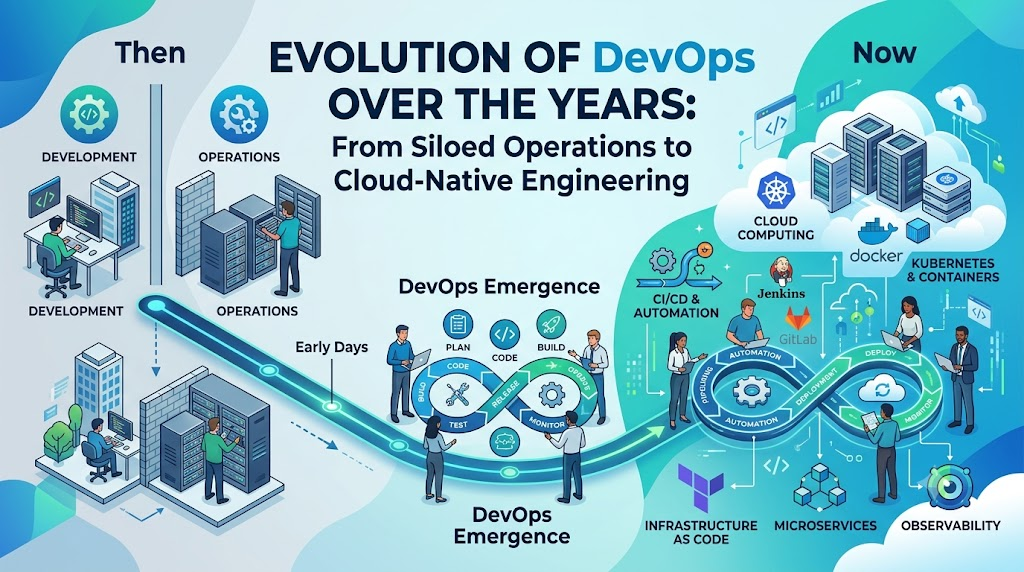
The way organizations create, test, and run software has changed fundamentally over the past few decades. In early computing environments, software delivery was a slow, rigid, and fragile undertaking. Development and operations teams functioned in isolated worlds, separated by distinct goals, incompatible tools, and rigid departmental boundaries.
Today, high-performing software teams release updates multiple times a day with high confidence, automated governance, and near-zero downtime. This transformation did not happen overnight, nor did it emerge as a pre-packaged methodology in a single breakthrough year. Instead, modern software delivery practices took shape through the convergence of multiple disciplines: early software configuration management, Agile methodologies, continuous integration, infrastructure automation, cloud computing, and shared organizational responsibility.
Understanding the evolution of DevOps over the years provides crucial context for engineering teams. It reveals why modern delivery pipelines look the way they do, why specific architectural choices were made, and how past operational friction led to current solutions like platform engineering and DevSecOps. This guide examines the history, defining milestones, core technology shifts, and emerging directions that continue to shape how software is built and sustained.
What Is DevOps?
At its core, DevOps is a combination of cultural philosophies, collaborative practices, and technical automation designed to shorten the software development lifecycle while maintaining high system stability and reliability. The word itself blends Development (software engineering) and Operations (system administration and infrastructure support).
Historically, these two departments had fundamentally conflicting incentives:
- Development teams were judged on delivery speed, feature output, and responsive change.
- Operations teams were judged on availability, uptime, and system stability—which meant resisting risky changes.
DevOps addresses this structural contradiction by turning software delivery into a shared lifecycle rather than a sequential relay race:
- Shared Responsibility: Developers take ownership of how code behaves in production, while operations engineers participate early in architecture and pipeline design.
- End-to-End Automation: Repetitive tasks—building code, executing unit tests, provisioning environments, running regression suites, and managing deployments—are automated to eliminate manual error.
- Continuous Integration and Continuous Delivery (CI/CD): Code changes are frequently merged into a shared repository, validated with automated testing, and prepared for predictable release.
- Observability and Feedback Loops: Real-time telemetry, structured logging, and proactive monitoring feed production runtime data back to engineering teams to guide code improvements and architecture fixes.
DevOps is neither a standalone job title nor a software product you can purchase off the shelf. It represents both an organizational approach and a set of rigorous technical practices. When implemented thoughtfully, it transforms software delivery from an unpredictable event into a continuous, reliable business process.
What Came Before DevOps?
To appreciate why DevOps emerged, one must understand the operational friction that preceded it. Throughout the 1990s and early 2000s, software development was dominated by sequential models, most notably Waterfall-style project planning.
+-----------------------------------------------------------------------------------+
|                           TRADITIONAL SEQUENTIAL MODEL                            |
|                                                                                   |
|  [ Requirements ] -> [ Architecture ] -> [ Coding ] -> [ QA Testing ]            |
|                                                                 |                 |
|                                      "Over the Wall" Handoff    v                 |
|                                                        [ IT Operations ]          |
|                                                                 |                 |
|                                                                 v                 |
|                                                      (Production Incidents)       |
+-----------------------------------------------------------------------------------+
In these environments:
- Long, Sequential Release Cycles: Projects spent months in discovery, months in architecture, months in development, and months in dedicated quality assurance (QA). Deliveries occurred quarterly, semi-annually, or annually.
- Siloed Handoffs: Engineering tossed completed code “over the wall” to QA. QA spent weeks manually running test matrices before handing the resulting binaries over to IT operations for deployment.
- Manual Provisioning and Scripting: Operations teams racked physical servers by hand, installed operating systems from installation disks, and applied configurations using ad-hoc shell scripts or manual text-editor adjustments.
- Environment Drift (“It Worked on My Machine”): Because development, staging, and production machines were configured by hand at different times, subtle differences in library versions, environment variables, or kernel parameters caused deployments to fail unexpectedly in production.
- Painful Troubleshooting: When production broke, developers blamed operations for misconfiguring the server, while operations blamed developers for writing buggy code. Root-cause analysis was slow, stressful, and heavily politicized.
Waterfall was not the only model used during this era, and many teams applied progressive automation, early version control, and pragmatic collaboration before the term “DevOps” existed. However, the structural divide between builders and operators remained an industry-wide bottleneck as the internet accelerated business expectations.
The Historical Roots of DevOps
DevOps did not appear out of a vacuum. It was the direct evolutionary descendant of several foundational software engineering and organizational movements.
5.1. Software Configuration Management (SCM)
Long before automated pipelines, version control systems (such as RCS, CVS, Subversion, and later Git) established the practice of tracking code changes systematically. Configuration management expanded this discipline to system configuration, proving that software environments—not just application source code—should be tracked, audited, and repeatable.
5.2. Agile Software Development
The publication of the Agile Manifesto in 2001 challenged rigid Waterfall planning. Agile introduced iterative sprints, cross-functional project teams, and frequent software increments. However, early Agile often stopped at the boundary of the development department. Teams could produce working software iterations every two weeks, but operations still deployed code only every six months. Agile made the downstream operational bottleneck painfully visible.
5.3. Continuous Integration (CI)
Pioneered within Extreme Programming (XP) and popularized by early automation tools like CruiseControl and Hudson (later Jenkins), Continuous Integration encouraged developers to merge code changes into a shared trunk several times a day. Automated builds and unit tests ran on every check-in, identifying defects early before they compounded into catastrophic integration bugs.
5.4. Continuous Delivery and Deployment (CD)
Building on CI, Jez Humble and David Farley formalized Continuous Delivery in 2010. They established that software should be kept in a deployable state throughout its lifecycle, moving changes through automated deployment pipelines that validate configuration, functional behavior, and performance at every stage.
5.5. Lean and Systems Thinking
DevOps borrowed heavily from Lean manufacturing, the Toyota Production System, and Goldratt’s Theory of Constraints. Principles such as eliminating waste (unnecessary handoffs, waiting times, manual approvals), limiting work-in-progress (WIP), amplifying immediate feedback, and optimizing the entire value stream directly informed modern DevOps culture.
DevOps Evolution Timeline
The history of DevOps reflects a continuous transition from custom, manual operations toward standardized, declarative, and automated systems.
| Period / Year | Important Development | What Changed | Why It Mattered to DevOps |
| Before 2000s: Foundations | SCM, Unix Philosophy, and Early Automation | Version control systems, shell automation, and structured system administration took hold; Agile Manifesto formulated (2001). | Laid the technical and conceptual baseline for reproducible computing and iterative engineering. |
| Early to Mid-2000s: The Agile Bottleneck | Rise of Web Applications & Scaled Online Services | Software releases accelerated to two-week sprints, but production deployments remained manual and infrequent. | Created severe operational friction, highlighting that rapid development cannot succeed without modern operations. |
| 2007–2009: Emergence of DevOps Thinking | “Agile Infrastructure” and the First DevOpsDays | Patrick Debois, Andrew Shafer, and others discussed operational agility. John Allspaw and Paul Hammond gave their landmark 2009 presentation: “10+ Deploys Per Day: Dev and Ops Cooperation at Flickr.” Debois organized the inaugural DevOpsDays in Ghent, Belgium (2009). | Defined the term “DevOps,” galvanized a passionate community, and proved that high release velocity and high availability can coexist. |
| 2010–2013: Tooling Growth & Automation | Code-Driven Configuration Management & Jenkins | Tools like Puppet, Chef, and Ansible gained widespread traction; Jenkins became the standard for CI automation; Jez Humble and David Farley published Continuous Delivery (2010). | Shifted infrastructure management from manual sysadmin runbooks to automated, repeatable, version-controlled scripts. |
| 2014–2017: Containers & Cloud-Native Adoption | The Rise of Docker and Kubernetes | Docker popularized lightweight application containerization (2013–2014); Google open-sourced Kubernetes (2014); microservices architecture gained wide enterprise adoption. | Solved the environment parity problem (“works on my machine”) and established declarative, immutable infrastructure as the industry standard. |
| 2018–2020: Security, GitOps & Measurement | DevSecOps, GitOps, and DORA Metrics | Security shifted left into automated delivery pipelines; GitOps emerged as a Git-based operating model for Kubernetes; DORA research codified the four key delivery metrics. | Moved DevOps from experimental setups to disciplined, measurable engineering backed by automated compliance and operational telemetry. |
| 2021–2023: Platform Engineering & Developer Experience | Internal Developer Platforms (IDPs) & Cognitive Load Reduction | Organizations built dedicated platform teams to provide self-service infrastructure and deployment templates to feature teams. | Solved tool sprawl and reduced developer burnout by providing curated golden paths rather than forcing every developer to be a Kubernetes expert. |
| 2024 Onward: AI-Assisted Engineering & Intelligent Ops | AI-Integrated Workflows and Predictive Systems | Engineering teams began exploring AI-assisted coding, automated pipeline troubleshooting, telemetry log analysis, and automated remediation. | Represents the next frontier: augmenting human engineering judgment with automated pattern recognition and predictive operational assistance. |
How DevOps Has Changed at Each Stage
As technical capabilities expanded, core delivery activities evolved across several dimensions. Older approaches did not disappear entirely—many organizations still maintain legacy components—but the center of gravity has shifted dramatically toward automation and self-service.
EARLIER PARADIGMS                            MODERN PARADIGMS
Manual deployments                 ----->    Declarative CI/CD pipelines
Physical servers & manual VMs      ----->    Cloud-native elastic infrastructure
Ad-hoc configuration scripts       ----->    Declarative Infrastructure as Code (IaC)
Monolithic application code        ----->    Microservices & containerized workloads
Perimeter, late-stage security     ----->    Automated DevSecOps throughout the pipeline
Reactive alert monitoring          ----->    Proactive observability & distributed tracing
Centralized ticket queues          ----->    Self-service internal developer platforms
1. Manual Deployments to Automated Pipelines
- Earlier Approach: Releases required detailed runbooks, weekend maintenance windows, manual file transfers via FTP/SSH, and nervous sanity checks by on-call engineers.
- Modern Approach: Code merges trigger automated pipelines that build container images, run comprehensive test suites, and execute blue-green or canary deployments without downtime.
- Benefits and Trade-offs: Drastically reduces human error and deployment stress; requires ongoing investment in automated test reliability to prevent bad code from moving through the pipeline.
2. Traditional Servers to Virtualized and Cloud Infrastructure
- Earlier Approach: Procuring a new server meant raising hardware requisitions, waiting weeks for delivery, and manually racking, cabling, and configuring the box.
- Modern Approach: Elastic cloud APIs spin up compute instances, managed database clusters, and serverless runtimes in seconds on demand.
- Benefits and Trade-offs: Delivers near-infinite elasticity and rapid experimentation; introduces risks of cloud sprawl, unexpected billing, and vendor lock-in.
3. Configuration Scripts to Infrastructure as Code (IaC)
- Earlier Approach: Sysadmins ran manual bash or PowerShell scripts directly on live servers, leading to configuration drift between instances.
- Modern Approach: Declarative files specify the desired state of infrastructure (e.g., using Terraform, OpenTofu, or CloudFormation). Changes are committed to Git, reviewed via pull requests, and applied deterministically.
- Benefits and Trade-offs: Auditable, versioned, and reproducible infrastructure; misconfigured code can inadvertently alter or destroy resources if change plans are not properly validated.
4. Monolithic Applications to Microservices and Cloud-Native Architectures
- Earlier Approach: Large, unified codebases where any minor change required compiling, testing, and deploying the entire application.
- Modern Approach: Decentralized services encapsulated in containers, communicating via lightweight APIs or event buses, managed by orchestrators like Kubernetes.
- Benefits and Trade-offs: Enables independent scaling and deployment velocity across teams; dramatically increases networking, distributed state, and architectural complexity.
5. Separate Security Reviews to Integrated DevSecOps
- Earlier Approach: Security performed audits right before production launch, often discovering architectural flaws that delayed deployment by months.
- Modern Approach: Static application security testing (SAST), software composition analysis (SCA), secret scanning, and container vulnerability scans run automatically on every code commit.
- Benefits and Trade-offs: Catches security vulnerabilities when they are cheapest and easiest to fix; risk of developer fatigue from excessive false-positive scan alerts.
6. Reactive Monitoring to Observability and SRE
- Earlier Approach: Simple ping/SNMP checks and CPU/memory threshold alerts notified on-call staff only after a server crashed or an endpoint went down.
- Modern Approach: Distributed tracing, structured application logs, high-cardinality metrics, and Service Level Objectives (SLOs) provide visibility into unpredictable system states.
- Benefits and Trade-offs: Pinpoints complex distributed issues across microservices; requires deep domain expertise and generates substantial log storage and query costs.
7. Ticket-Based Provisioning to Self-Service Platforms
- Earlier Approach: Developers opened service tickets requesting database access, test environments, or firewall updates, waiting days for manual fulfillment.
- Modern Approach: Internal developer platforms offer pre-approved, self-service portals and APIs that provision compliant infrastructure automatically.
- Benefits and Trade-offs: Eliminates operational handoff delays and maintains organizational compliance; demands a dedicated platform engineering discipline to build and maintain the internal platform.
8. Basic Automation to AI-Assisted Workflows
- Earlier Approach: Rigid, rule-based scripts and static pipeline declarations that required manual updates whenever environments changed.
- Modern Approach: Emerging use of AI-assisted code reviews, automated log summarization, anomaly detection, and natural-language pipeline generators.
- Benefits and Trade-offs: Accelerates routine tasks and provides fast initial triage; models can hallucinate incorrect configurations and lack true contextual understanding of business safety.
Major Technologies That Shaped DevOps
DevOps is driven by culture, but tooling has consistently expanded what teams can practically achieve. Different categories of technology matured over the years to solve specific delivery bottlenecks:
- Version Control Systems (Git): Distributed version control replaced centralized systems, standardizing branching strategies, pull request workflows, and collaborative peer reviews.
- Continuous Integration and Delivery (Jenkins, GitLab CI/CD, GitHub Actions, Argo CD): Provided the automation engines that compile code, execute tests, package artifacts, and reconcile production state.
- Configuration Management (Puppet, Chef, Ansible, SaltStack): Introduced idempotent, automated configuration, allowing administrators to bring thousands of target machines to a defined state reliably.
- Containers and Orchestration (Docker, Kubernetes): Container packaging decoupled the runtime environment from the underlying host OS, while Kubernetes provided the industry standard for scheduling, scaling, and managing container lifecycles.
- Infrastructure as Code (Terraform, Pulumi, OpenTofu): Replaced manual cloud console configuration with version-controlled, declarative files that represent computing networks, storage, and access policies.
- Cloud Computing Platforms (AWS, Microsoft Azure, Google Cloud): Made physical hardware invisible, offering self-healing infrastructure, managed data systems, and global content networks via software APIs.
- Observability and Telemetry (Prometheus, Grafana, OpenTelemetry, ELK Stack): Unified the collection and visualization of metrics, distributed traces, and log data across complex multi-cloud ecosystems.
- Automated Security Tools (Trivy, Snyk, SonarQube): Embedded automated policy enforcement, static analysis, and vulnerability checks directly into developer IDEs and pipeline execution runners.
- Internal Developer Platforms and GitOps (Backstage, Argo CD, Flux): Standardized how developers discover infrastructure templates, trigger deployments through Git repository state, and observe runtime behavior without manual operations intervention.
No individual team needs every tool in this ecosystem. Mature organizations choose tools based on their architecture, regulatory environment, and delivery scale rather than chasing every new framework.
How Cloud Computing Accelerated DevOps
While DevOps practices can be applied in on-premises datacenters, the rise of public cloud computing accelerated DevOps adoption across the industry.
Before the cloud, automating a deployment pipeline was constrained by physical boundaries. If an automated test suite required twenty new servers, operations had to purchase, rack, and cable hardware. Cloud computing transformed infrastructure into an API-driven software abstraction.
Cloud computing reinforced DevOps in several ways:
- On-Demand Infrastructure: Pipelines can programmatically spin up isolated, production-identical testing environments, run thousands of tests, and destroy the environment immediately after completion.
- Elastic Resource Management: Applications scale computing power dynamically based on user traffic metrics, eliminating the need to over-provision static servers for peak yearly loads.
- Managed Platform Services: Cloud providers absorbed the routine maintenance of relational databases, message queues, and Kubernetes control planes, freeing internal teams to focus on application logic and delivery flow.
- Built-in Automation Hooks: Native cloud APIs allowed Infrastructure as Code tools to manage networking, IAM permissions, serverless functions, and storage buckets using the same software engineering practices applied to application code.
However, cloud computing and DevOps remain distinct disciplines. Cloud computing provides elastic, hosted resources; DevOps provides the organizational culture, automation methods, and collaborative practices used to build and operate software reliably on any infrastructure—whether public cloud, on-premises datacenters, or hybrid environments.
The Evolution from DevOps to DevSecOps, SRE, GitOps, and Platform Engineering
As DevOps matured, organizations discovered that simply telling “devs and ops to talk” did not solve every specialized challenge. Rather than replacing DevOps, several complementary disciplines emerged to extend its principles to specific domains.
                    +-----------------------------+
                    |           DevOps            |
                    |   (Core Philosophy and      |
                    |   Collaborative Delivery)   |
                    +--------------+--------------+
                                   |
         +-----------------+-------+---------+-----------------+
         |                 |                 |                 |
         v                 v                 v                 v
   [ DevSecOps ]         [ SRE ]         [ GitOps ]   [ Platform Eng. ]
   Security as code    Reliability as   Declarative    Self-service
   & automated scans   an engineering   Git workflows  internal platforms
   in the pipeline     discipline       for systems    for developers
DevSecOps
Traditional security models relied on compliance audits at the very end of development. As deployment speed increased from months to hours, late-stage security reviews became an unsustainable bottleneck. DevSecOps embeds automated security checks—dependency scanning, static code analysis, and infrastructure compliance tests—directly into continuous delivery pipelines, making security a shared responsibility from day one.
Site Reliability Engineering (SRE)
Pioneered at Google, SRE applies software engineering techniques to solve infrastructure and operations challenges. SRE provides concrete operational mechanics that complement DevOps philosophies: defining Service Level Objectives (SLOs), managing error budgets, eliminating repetitive operational toil through automation, and running blameless postmortems after incidents.
GitOps
GitOps emerged as a specialized operating model for cloud-native applications and Kubernetes. In a GitOps workflow, Git serves as the single source of truth for declared system state. Automated software agents (such as Argo CD or Flux) run inside the target environment, continuously comparing actual runtime state with the desired state committed in Git, automatically reconciling any drift.
Platform Engineering
As toolchains expanded—requiring developers to understand Docker, Kubernetes, Terraform, Helm, IAM roles, and observability agents—many software engineers suffered severe cognitive overload. Platform engineering addresses this by treating the internal developer platform as a dedicated product. Platform teams build self-service “golden paths” that allow product developers to deploy and run applications reliably without having to manage raw infrastructure complexity.
AIOps and Intelligent Automation
AIOps applies machine learning and statistical models to the massive volumes of logs, metrics, and network traces generated by distributed systems. Rather than replacing human operators, it filters out noisy alerts, spots anomalous performance trends, and correlates related telemetry events during live system incidents.
These paradigms are not mutually exclusive alternatives; they are specialized expressions of the same underlying goal: delivering resilient, secure, and useful software continuously.
How DevOps Has Changed Software Delivery
The following comparison illustrates how software delivery has shifted from traditional IT operations models to mature DevOps practices:
| Delivery Aspect | Traditional IT Operations Approach | Mature DevOps Approach |
| Release Frequency | Quarterly, semi-annually, or annually in large batches. | On-demand, daily, or multiple times per day in small increments. |
| Deployment Process | Manual executions using written runbooks during maintenance windows. | Fully automated continuous delivery pipelines with canary or blue-green rollouts. |
| Testing Approach | Manual verification by dedicated QA teams late in the delivery cycle. | Automated unit, integration, security, and performance test suites run continuously. |
| Infrastructure Management | Manually configured physical servers and static virtual machines. | Declarative, version-controlled Infrastructure as Code (IaC) with elastic scaling. |
| Team Collaboration | Disconnected functional silos with formal ticket-based handoffs. | Cross-functional alignment, shared production ownership, and joint accountability. |
| Security Integration | Late-stage audits and manual sign-offs shortly before release. | DevSecOps practices with automated security and compliance scanning in CI/CD. |
| Monitoring & Feedback | Reactive alert thresholds on infrastructure (CPU, memory, uptime pings). | Proactive observability using distributed tracing, structured logs, metrics, and SLOs. |
| Incident Handling | High-pressure bridge calls, finger-pointing, and punitive incident reviews. | Blameless postmortems, automated remediation, and continuous reliability engineering. |
| Change Traceability | Disconnected documentation, change advisory board (CAB) logs, manual forms. | Comprehensive commit-to-production audit trails tracked directly in version control. |
Actual operational outcomes depend on engineering rigor, architectural simplicity, and supportive company culture rather than tool adoption alone.
Real-World Example of DevOps Evolution
To see how these practices evolve in practice, consider the journey of an illustrative enterprise software company named ExampleTech.
PHASE 1 (Traditional)          PHASE 2 (Early Automation)     PHASE 3 (Mature Cloud-Native)
- Manual FTP releases          - Centralized Git + Jenkins    - Microservices & Kubernetes
- Unversioned servers          - Basic automated unit tests   - Terraform Infrastructure as Code
- Staging != Production        - Semi-automated staging push  - Integrated security scanning
- Multi-day weekend outages    - Still manual production gate - Self-service developer platform
Stage 1: The Monolithic, Manual Baseline
In its early days, ExampleTech ran a monolithic web application hosted on four virtual machines. Releases happened once a quarter on Saturday nights. Developers committed code to fragmented local branches. On release day, an operations engineer followed an eighty-step document: running database migration scripts by hand, copying compiled binaries via SSH, and manually editing application configuration files on each machine.
Deployments regularly failed due to subtle environmental differences. The team spent weekends rolling back changes, debugging in high-stress war rooms, and blaming each other for failed releases.
Stage 2: Introducing Version Control and Automated CI
Frustrated by constant deployment failures, ExampleTech consolidated its code into a single Git repository. They introduced an automated CI server that ran unit tests on every pull request. Developers could no longer merge code that broke basic compilation or core business logic.
Lesson Learned: Automated testing immediately caught integration bugs, but deployments remained slow because packaging and environment setup were still manual.
Stage 3: Establishing Delivery Pipelines and Infrastructure as Code
Next, the team replaced manual server configuration with Infrastructure as Code templates. They automated deployment to staging environments via continuous delivery pipelines. Staging and production were now configured identically.
Lesson Learned: Deployment failures dropped significantly. However, production releases still required long manual approvals because security and operations teams lacked visibility into changes.
Stage 4: DevSecOps and Modern Platform Capabilities
To address the remaining bottlenecks, ExampleTech integrated automated dependency and secret scanning into their pipeline, satisfying compliance teams. They shifted microservices workloads onto a managed Kubernetes cluster and established a small internal platform engineering team.
Instead of writing custom deployment scripts, developers now use a standardized internal portal to spin up preview environments and deploy services through pre-approved pipelines. When incidents occur, telemetry traces isolate the issue quickly, and fixes roll out through the same automated pipeline in minutes.
By treating the transformation as an iterative learning process, ExampleTech replaced high-risk, infrequent releases with predictable, routine software delivery.
Benefits and Challenges Across the Evolution of DevOps
While the advantages of modern DevOps practices are clear, the journey also introduces distinct engineering trade-offs.
Key Benefits
- Faster Time to Value: Small, automated updates allow organizations to deliver features and bug fixes to users in hours rather than months.
- Improved Deployment Reliability: Automated pipelines, standardized environments, and comprehensive testing reduce deployment failures and unexpected regressions.
- Enhanced Team Productivity: Eliminating manual provisioning, handoffs, and repetitive testing allows engineers to focus on building features rather than wrestling with operational friction.
- Early Vulnerability Detection: Shifting security testing left helps teams identify and remediate security issues when code is fresh in mind and inexpensive to fix.
- Deeper Operational Visibility: Modern telemetry provides real-time insights into system health and user behavior, allowing teams to resolve issues before users are impacted.
Ongoing Challenges
- Toolchain Complexity: Managing a modern toolchain—encompassing Git, CI/CD runners, container registries, Kubernetes, IaC, security scanners, and monitoring dashboards—can be daunting.
- Cultural and Organizational Friction: Moving away from traditional silos requires trust, changes in incentive structures, and strong engineering leadership. Many initiatives fail because organizations adopt new tools without changing their underlying culture.
- Skills and Knowledge Gaps: Modern delivery requires engineers to understand distributed systems, networking fundamentals, containerization, and security best practices.
- Managing Legacy Applications: Decoupling decades-old legacy monoliths is expensive, risky, and rarely straightforward.
- Cloud Cost Control (FinOps): Elastic infrastructure makes resource provisioning effortless, which can lead to runaway cloud bills without automated budget policies and governance.
- Pipeline and Automation Maintenance: CI/CD pipelines are software systems in their own right. Poorly maintained pipelines suffer from flaky tests, slow build times, and configuration drift, creating new operational bottlenecks.
Adopting DevOps is not a one-time project with an end date; it is an ongoing organizational commitment to measuring friction, improving delivery workflows, and simplifying architectures.
How DevOpsSchool Relates to DevOps Learning
Mastering modern software delivery requires navigating a vast ecosystem of concepts, frameworks, and tools. This is where structured learning platforms like DevOpsSchool fit into the technical landscape.
DevOpsSchool serves as a specialized education provider focused on DevOps, cloud computing, containerization, automation, and related software engineering practices. For individuals and engineering teams seeking to build practical competencies, structured educational programs help bridge the gap between theoretical concepts and hands-on implementation.
A key benefit of a structured learning approach is understanding foundational principles before picking up specific tools. Rather than simply learning syntax for tools like Docker, Kubernetes, Ansible, or Terraform, engineers benefit most from learning:
- The operational problems these tools were built to solve.
- How version control, CI/CD pipelines, and configuration management fit together into an end-to-end delivery lifecycle.
- How to design reliable automation that aligns with organizational security, observability, and compliance requirements.
By focusing on foundational practices alongside hands-on technical training, educational providers help aspiring engineers, operations professionals, and IT leaders build sustainable skills that remain relevant even as tools evolve.
Future of DevOps
DevOps continues to evolve alongside advances in computing architectures, developer tooling, and systems design. Several emerging directions are actively shaping the next generation of software delivery:
+-----------------------------------------------------------------------------------+
|                            THE FUTURE OF DEVOPS                                   |
|                                                                                   |
|  [ AI-Augmented Pipelines ] ---> Automated triage, test generation, and log analysis|
|  [ Platform Engineering   ] ---> Curated golden paths and reduced cognitive load  |
|  [ Supply Chain Security  ] ---> Cryptographic provenance, SBOMs, and signing     |
|  [ FinOps Integration     ] ---> Automated cost governance inside IaC pipelines   |
|  [ Green Computing        ] ---> Energy-efficient workload scheduling and sizing   |
+-----------------------------------------------------------------------------------+
- AI-Augmented Engineering: Artificial intelligence is increasingly integrated into delivery workflows to generate boilerplate code, analyze test results, summarize incident logs, and identify misconfigurations. While AI accelerates routine tasks, human engineering judgment remains essential for validating output, ensuring architectural integrity, and maintaining accountability.
- Expansion of Platform Engineering: As system complexity grows, more organizations are investing in internal developer platforms (IDPs). These platforms provide clear “golden paths” that make it easy for developers to deliver software safely without needing to master every layer of the infrastructure stack.
- Software Supply Chain Security: High-profile supply-chain attacks have elevated the importance of security across every delivery artifact. Future delivery pipelines will routinely enforce cryptographic provenance verification, automated Software Bills of Materials (SBOMs), signed commits, and strict dependency verification.
- FinOps and Cost-Aware Pipelines: Infrastructure costs are increasingly managed as an engineering metric. Modern pipelines are integrating automated cost-estimation steps that flag expensive infrastructure changes before code is applied to production.
- Policy as Code and Automated Governance: Instead of relying on manual security committees, organizations are using policy engines (such as Open Policy Agent) to validate compliance, network policies, and security guardrails automatically during pipeline execution.
- Sustainable and Energy-Aware Computing: With cloud data centers consuming significant power, teams are beginning to track and optimize the carbon intensity and energy efficiency of build pipelines and production workloads.
Emerging technologies do not eliminate the need for sound engineering principles. Clear communication, automated testing, solid architecture, and a focus on reliability will remain the foundation of successful software delivery.
Frequently Asked Questions (FAQs)
What is the history of DevOps?
The history of DevOps began in the late 2000s as a response to the growing operational friction between Agile development teams and traditional IT operations. Frustrated by siloed handoffs, environment inconsistencies, and painful production deployments, early practitioners combined Agile values, configuration management, continuous integration, and infrastructure automation into a unified approach to software delivery.
When did DevOps emerge?
DevOps gained formal identity between 2008 and 2009. A pivotal moment was John Allspaw and Paul Hammond’s 2009 presentation at the O’Reilly Velocity Conference on cross-functional cooperation at Flickr. Later that year, Patrick Debois organized the first DevOpsDays conference in Ghent, Belgium, coining the term “DevOps.”
Who helped popularize the DevOps movement?
Key figures who helped define and popularize DevOps include Patrick Debois (widely regarded as the father of DevOps), Andrew Shafer, John Allspaw, Paul Hammond, Jez Humble, David Farley, and Gene Kim (co-author of The Phoenix Project and The DevOps Handbook).
How did Agile influence DevOps?
Agile proved that working in small, iterative batches improved development speed and software quality. However, because early Agile focused primarily on development teams, completed code frequently stalled at operations handoffs. DevOps extended Agile principles downstream across testing, infrastructure provisioning, deployment, and ongoing production operations.
What technologies shaped the evolution of DevOps?
The evolution of DevOps was driven by several core technologies: distributed version control (Git), continuous integration engines (Jenkins, GitLab CI/CD), configuration management tools (Puppet, Chef, Ansible), containers and orchestrators (Docker, Kubernetes), Infrastructure as Code (Terraform), cloud platforms (AWS, Azure, Google Cloud), and modern observability platforms (Prometheus, Grafana).
How did cloud computing change DevOps?
Cloud computing transformed infrastructure from physical, slow-to-provision hardware into software-defined, API-driven resources. This enabled engineering teams to automate environment provisioning on demand, run comprehensive test suites in ephemeral environments, scale applications elastically, and manage infrastructure using the same version-controlled workflows used for code.
What is the difference between DevOps and DevSecOps?
DevOps focuses on breaking down silos between development and operations to improve delivery speed and reliability. DevSecOps builds upon this by embedding security practices, compliance checks, and vulnerability scanning directly into every stage of the automated delivery pipeline, ensuring that security is a continuous shared responsibility rather than an afterthought.
How is platform engineering related to DevOps?
Platform engineering is an evolution of DevOps practices designed to reduce developer cognitive load. Instead of requiring every product developer to configure complex infrastructure, container orchestrators, and deployment scripts, a dedicated platform team builds an internal developer platform with curated “golden paths” for self-service deployments.
Why should professionals understand the history of DevOps?
Understanding the history of DevOps helps engineers appreciate why specific architectural patterns, pipeline designs, and cultural practices exist. It helps professionals evaluate new tools objectively based on the operational problems they solve, rather than treating DevOps as a superficial collection of disconnected software products.
Final Thoughts
The evolution of DevOps over the years reflects a shift from siloed, manual IT operations toward automated, cross-functional engineering, cloud-native architectures, proactive DevSecOps, and developer-centric internal platforms. DevOps is not a static methodology or an off-the-shelf toolkit; it continues to adapt as system architectures evolve, cloud technologies mature, and intelligent automation transforms engineering workflows. For teams building their skills through educational platforms like DevOpsSchool, the lasting takeaway is clear: while specific tools and frameworks will inevitably change, the core principles of shared ownership, deliberate automation, fast feedback loops, and continuous improvement remain the true foundation of sustainable, high-performing software delivery.