




Introduction
In the modern engineering landscape, the most successful organizations are not those that finish a project the fastest, but those that learn the fastest. Software development is no longer a static milestone; it is a living process. This is where the concept of continuous improvement becomes the lifeblood of a healthy engineering organization. How DevOps facilitates continuous improvement is a question that goes beyond simple tooling. It is about restructuring how teams think, work, and respond to failures. When we integrate DevOps practices, we stop viewing operations as a final hurdle and start viewing it as a core component of the development lifecycle. Organizations that prioritize this cycle of constant optimization remain competitive, adaptable, and resilient, while those that resist find themselves struggling with technical debt and stagnant delivery cycles. For those looking to deepen their expertise or train their teams in these methodologies, platforms like DevOpsSchool provide structured learning paths that bridge the gap between theoretical knowledge and real-world execution. Through proper automation, deep collaboration, and rigorous feedback loops, DevOps transforms the way we build, ship, and maintain software, ensuring that every deployment is better than the last.
What Is Continuous Improvement in DevOps?
At its core, continuous improvement in DevOps is the practice of incrementally refining processes, codebases, and team dynamics to eliminate waste and deliver higher value. It is the application of the Lean manufacturing concept of “Kaizen”—change for the better—adapted for the digital age.
Continuous improvement is not a project with a start and end date; it is a permanent state of mind. It involves:
- Continuous Learning: A team culture where mistakes are treated as data points rather than reasons for punishment.
- Incremental Optimization: Instead of attempting massive, risky overhauls, teams make small, frequent, and measurable changes.
- Feedback-Driven Development: Every line of code, infrastructure change, and deployment is monitored, measured, and fed back into the planning phase to inform the next iteration.
- Shared Responsibility: Developers, operations, and security teams move from silos to a shared ownership model where everyone is responsible for the health of the system.
Why Continuous Improvement Matters
Without a focus on continuous improvement, technical debt accumulates silently. It starts with minor workarounds and ends with brittle, unmaintainable systems that slow down innovation to a crawl.
- Faster Software Delivery: By identifying and removing bottlenecks in the CI/CD pipeline, teams shorten the time it takes to move code from a developer’s machine to production.
- Better Software Quality: Automated testing and continuous feedback allow teams to catch bugs when they are cheap to fix, rather than after they reach the user.
- Reduced Operational Risks: Smaller, more frequent updates are inherently less risky than massive, infrequent “big bang” releases.
- Increased Customer Satisfaction: When you can release features and patches faster, you respond to customer needs in real-time, building trust and loyalty.
- Long-Term Business Growth: Efficient teams are sustainable. They avoid burnout and maintain the velocity required to scale.
How DevOps Enables Continuous Improvement
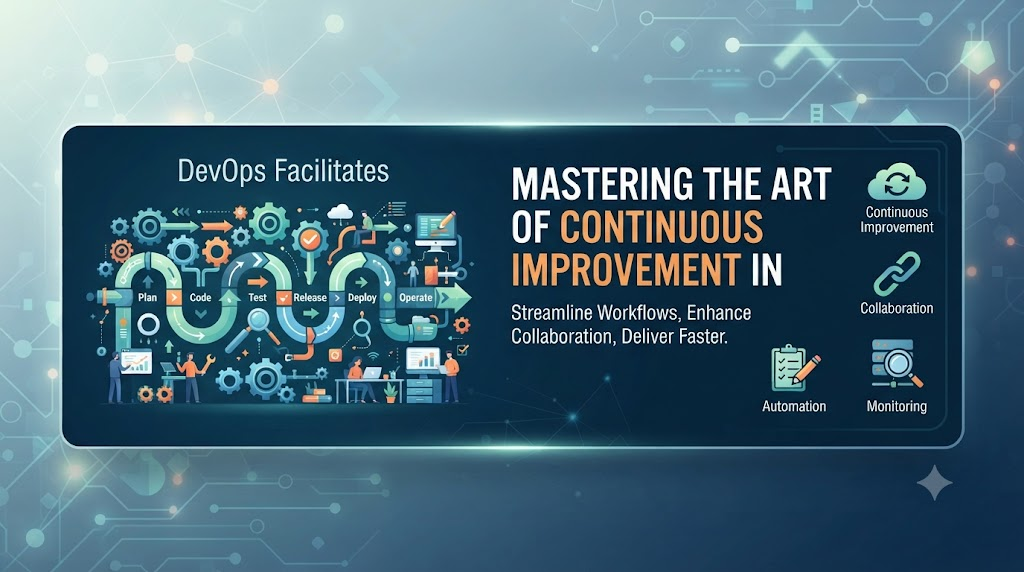
The DevOps lifecycle is often visualized as an infinity loop. This loop is the engine of continuous improvement.
- Planning: We identify what to build based on user data and business goals.
- Development: Engineers write code with testing and observability in mind.
- Continuous Integration: Code is merged frequently to a shared repository, triggering automated builds.
- Automated Testing: Tests run automatically to ensure quality.
- Deployment: Software is pushed to environments using automated release pipelines.
- Monitoring: We track application performance, infrastructure health, and user behavior.
- Customer Feedback: We listen to the users, gathering data on what is working and what is not.
- Retrospectives: Teams review the process, discussing successes and failures openly.
- Optimization: We take insights from the previous steps to refine the planning phase.
This cycle repeats endlessly. Each time through the loop, the team creates a more efficient and stable environment than the one before.
Core DevOps Practices That Support Continuous Improvement
| Practice | Business Benefit | Operational Benefit |
| Continuous Integration (CI) | Faster time to market | Immediate feedback on code quality |
| Continuous Delivery (CD) | Reliable feature releases | Reduced manual deployment effort |
| Infrastructure as Code (IaC) | Consistent, repeatable environments | Reduced configuration drift |
| Automated Testing | Higher product quality | Faster validation of changes |
| Monitoring & Observability | Improved customer experience | Faster incident detection and resolution |
| DevSecOps | Secure, compliant software | Security integrated early, not bolted on |
The Role of Automation
Automation is the multiplier for continuous improvement. If you have to do a task manually, you are constrained by human bandwidth. When you automate, you create a baseline of consistency.
- CI/CD Pipelines: These are the highways for your software. A well-built pipeline automates the journey from source code to production, removing human error.
- Infrastructure Automation: By treating infrastructure as code, you eliminate the “it works on my machine” problem. You can spin up, tear down, and update entire environments in seconds.
- Testing Automation: Manual testing is a bottleneck. Automated unit, integration, and regression tests allow for rapid iterations without breaking existing functionality.
- Deployment Automation: Automating releases means the process is standardized, auditable, and repeatable.
Feedback Loops and Observability
Feedback is the steering mechanism of your engineering organization. Without it, you are driving blind.
- Metrics: Tracking DORA metrics (Deployment Frequency, Lead Time for Changes, Change Failure Rate, Mean Time to Recovery) provides an objective view of performance.
- Logs and Traces: These tell you what happened inside your system. They are the breadcrumbs that lead to the root cause of an issue.
- Customer Feedback: This is the ultimate truth. If users are struggling, your metrics will eventually show it, but direct feedback provides the “why.”
- Incident Reviews: After an issue occurs, the post-mortem process allows the team to understand the failure. The key here is to keep it “blameless.” Focus on how the system failed, not who failed.
Continuous Learning and Team Collaboration
DevOps is 80% culture and 20% tools. The most sophisticated automation will fail if the team culture is toxic or siloed.
- Knowledge Sharing: Encourage documentation and internal brown-bag sessions. If one person holds all the knowledge about a subsystem, you have a single point of failure.
- Pair Programming: This is one of the most effective ways to transfer knowledge and improve code quality simultaneously.
- Agile Retrospectives: Hold these regularly. Ask three questions: What went well? What did not go well? What can we do better next time?
- Blameless Postmortems: This is the cornerstone of DevOps improvement. If you punish failure, people will hide it. If you treat failure as a learning opportunity, people will expose it, fix it, and improve the system.
Measuring Continuous Improvement
You cannot improve what you cannot measure.
| Metric | Why It Matters | Business Value |
| Deployment Frequency | Measures velocity and throughput | Faster delivery to customers |
| Lead Time for Changes | Measures efficiency of the pipeline | Reduced time to market for new features |
| Change Failure Rate | Measures the stability of changes | Fewer disruptions to the end user |
| Mean Time to Recovery (MTTR) | Measures resilience and process design | Minimized impact of outages |
| Automation Coverage | Measures reduction of manual toil | Lower operational costs and human error |
Common Challenges
| Challenge | Impact | Recommended Solution |
| Resistance to Change | Stagnation and low morale | Start small, show wins, and lead by example |
| Manual Processes | Slow velocity and high error rates | Prioritize automation of the most frequent tasks |
| Weak Feedback Loops | Blind spots in system health | Implement comprehensive logging and monitoring |
| Tool Complexity | Cognitive overload | Simplify the stack; don’t add tools for the sake of it |
| Skill Shortages | Inconsistent implementation | Invest in team training and mentorship programs |
Best Practices
- Encourage Experimentation: Create a “sandbox” where teams can try new technologies without risking production.
- Automate Repetitive Tasks: If you do it more than twice, automate it.
- Review Metrics Regularly: Do not look at metrics only when things break. Review them during weekly syncs.
- Share Knowledge Openly: Use shared wikis and documentation platforms.
- Conduct Retrospectives: Never skip these, even if the sprint went well.
- Invest in Continuous Learning: Make time for professional development.
Real-World Example: FinTech Streamline Corp
FinTech Streamline Corp was struggling with a 6-week release cycle. They had manual testing teams, developers who threw code “over the wall” to operations, and constant outages on patch days.
The Transformation:
- Pilot Team: They selected one product team to adopt DevOps practices first.
- Automation: They implemented CI/CD pipelines to run automated unit tests on every commit.
- Observability: They moved from server-based monitoring to application-level observability, allowing them to trace requests across their microservices.
- Cultural Shift: They instituted a “You build it, you run it” policy, forcing developers to own their code in production.
The Outcome:
After 12 months, the release cycle dropped from 6 weeks to 3 days. Change failure rate dropped by 60%, and the team morale improved significantly because they were no longer spending weekends fixing broken deployments.
Common Beginner Mistakes
- Focusing Only on Tools: Buying the latest DevOps tool without changing the culture will only give you “automated chaos.”
- Ignoring Feedback: Collecting metrics but never acting on them is a waste of time.
- Weak Documentation: Relying on tribal knowledge will slow down onboarding and scaling.
- Avoiding Retrospectives: Assuming everything is fine leads to complacency.
- Measuring the Wrong Metrics: Tracking lines of code written is a vanity metric. Track value delivered instead.
Future of Continuous Improvement in DevOps
The future of DevOps is moving toward intelligence and self-management.
- AI-Assisted DevOps: AI tools will help in writing unit tests, optimizing infrastructure configurations, and predicting outages before they happen.
- Platform Engineering: This is the evolution of DevOps, where dedicated teams build “Internal Developer Platforms” (IDPs) to provide self-service capabilities to developers, reducing cognitive load.
- GitOps: Managing infrastructure and application deployments through Git repositories as the single source of truth.
- Self-Healing Systems: Using automated monitoring to trigger corrective actions automatically (e.g., auto-scaling, restarting services) without human intervention.
Certifications & Learning Paths
Continuous improvement applies to your personal career growth as well.
| Certification | Best For | Skill Level | Focus Area |
| Kubernetes (CKA) | Infrastructure Engineers | Advanced | Container Orchestration |
| AWS/Azure DevOps | Cloud Engineers | Intermediate | Cloud-Native Delivery |
| Terraform/IaC | Platform Engineers | Intermediate | Infrastructure Provisioning |
| DevSecOps | Security Professionals | Intermediate | Integrated Security |
| SRE Fundamentals | SRE Professionals | Advanced | Reliability Engineering |
Practical Continuous Improvement Checklist
- Define Measurable Goals: What are you trying to improve (e.g., reduce MTTR by 20%)?
- Automate Testing: Are you running tests on every build?
- Improve Pipelines: Are your CI/CD pipelines fast and reliable?
- Monitor Continuously: Do you have visibility into your production environment?
- Review Incidents: Are you conducting blameless postmortems?
- Learn from Feedback: Is customer feedback informing your roadmap?
- Optimize Regularly: Are you reviewing and refining your processes every sprint?
FAQs
- What is continuous improvement in DevOps?It is the practice of consistently evaluating and refining processes, tools, and culture to improve efficiency, quality, and velocity in software delivery.
- Why is continuous improvement important?It prevents technical debt, reduces operational risk, accelerates feature delivery, and ensures the system remains scalable and maintainable.
- How does CI/CD support improvement?CI/CD provides the automated infrastructure to test and deploy code frequently, enabling rapid feedback and reducing the size and risk of changes.
- Which KPIs should teams monitor?Focus on DORA metrics: Deployment Frequency, Lead Time for Changes, Change Failure Rate, and Mean Time to Recovery (MTTR).
- What role does automation play?Automation removes manual, error-prone tasks, standardizes processes, and allows engineers to focus on high-value work rather than “keeping the lights on.”
- How do retrospectives help?They provide a safe space to analyze the development cycle, celebrate what went right, and identify specific actions to address what went wrong.
- Can small teams adopt continuous improvement?Yes. In fact, small teams often find it easier to adopt these practices due to less bureaucracy and higher agility.
- How should beginners get started?Start by automating your testing, then your deployments, and always foster a culture where asking questions is encouraged.
- What is the difference between monitoring and observability?Monitoring tells you if the system is healthy; observability tells you why the system is behaving the way it is.
- How do I handle team resistance?Focus on “wins.” Show the team how a specific DevOps practice saves them time or reduces the stress of deployment days.
- Is DevOps only for Cloud environments?While it is most effective in the cloud, DevOps principles can be applied to any infrastructure, including on-premises, through automation.
- What are blameless postmortems?They are incident reviews that focus on systemic causes of failure rather than assigning blame to individuals.
- Why is culture so critical?Tools are useless if the team is siloed, fearful of failure, or uncooperative. DevOps is fundamentally a collaboration strategy.
- What is Infrastructure as Code (IaC)?It is the practice of managing and provisioning infrastructure through machine-readable definition files, rather than manual configuration.
- How does DevSecOps improve software?It integrates security checks into the CI/CD pipeline, ensuring vulnerabilities are identified and mitigated early in the development lifecycle.
Final Thoughts
Continuous improvement is not an event; it is a discipline. As an architect or an engineering leader, your goal is not to reach a “perfect” state—because that state does not exist. Your goal is to build an organization that is inherently curious, technically capable, and operationally rigorous.
Do not try to overhaul your entire enterprise overnight. Start with one pipeline, one team, and one process. Automate the most painful part of your day, measure the impact, and then look for the next bottleneck. Build a culture that values learning over blame and optimization over maintenance. By focusing on these incremental steps, you will eventually find that your delivery velocity, software quality, and team satisfaction are operating at a level you previously thought impossible.