




Introduction
In the modern technology landscape, the ability to release software quickly and reliably is no longer a luxury—it is a survival skill. Many organizations struggle with long release cycles, buggy deployments, and the constant friction between development and operations teams. This is where the shift toward DevOps becomes critical.
Software delivery is the process of moving code from a developer’s laptop to a production environment where users can access it. In traditional setups, this journey is often fraught with delays, manual handoffs, and communication breakdowns. DevOps changes this dynamic by breaking down silos and fostering a culture of shared responsibility.
By integrating development and operations, teams can achieve faster release cycles, higher software quality, and improved reliability. For those looking to master these skills, organizations like DevOpsSchool offer hands-on resources to bridge the gap between theory and real-world application. Understanding how DevOps improves software delivery is the first step toward building more robust and efficient engineering teams.
What Is Software Delivery?
Software delivery is the end-to-end process of developing, testing, and releasing software to end users. It encompasses everything from the initial requirement gathering and coding to testing, packaging, and finally deploying the application to a server or cloud environment.
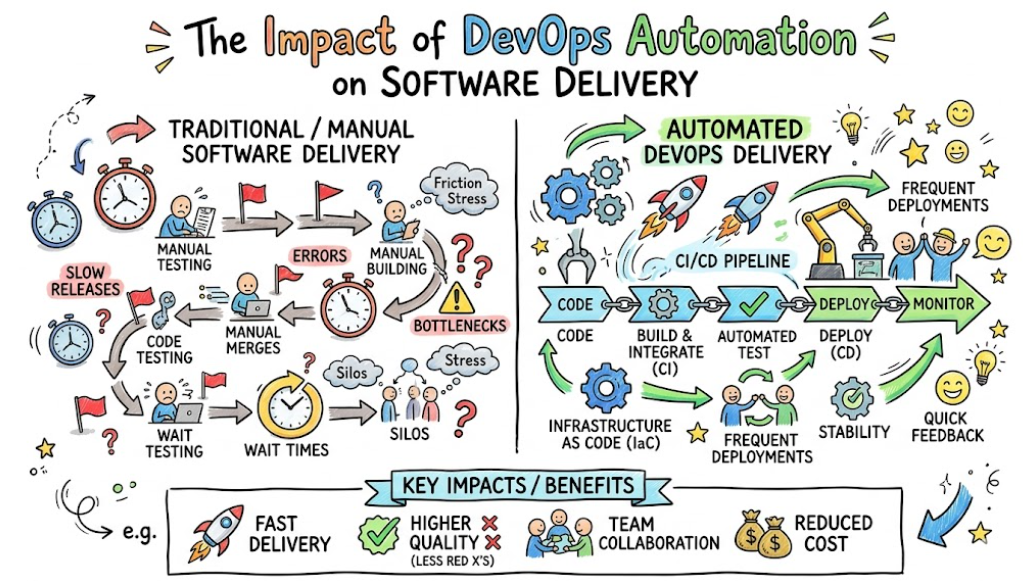
In a traditional lifecycle, this process is often linear and disjointed. Developers write code, hand it over to a QA team for testing, and eventually pass it to an Operations team for deployment. This “over-the-wall” mentality often results in delays because each stage acts as a bottleneck. If a problem is discovered during deployment, the team must trace the issue back to the developer, leading to long feedback loops and frustration.
What Is DevOps?
DevOps is a set of practices, tools, and a cultural philosophy that automates and integrates the processes between software development and IT teams. It emphasizes team empowerment, cross-team communication, and technology automation.
At its core, DevOps is not just about installing tools like Jenkins or Kubernetes; it is about mindset. It is the practice of treating infrastructure like software, automating repetitive tasks, and ensuring that the teams responsible for building the software are also involved in running it. This shift reduces the “us versus them” mentality and aligns the entire organization around a single goal: delivering value to the customer reliably and quickly.
Why Traditional Software Delivery Struggles
Traditional software delivery models are often characterized by rigid structures and slow communication. Here are the primary reasons why these models struggle:
- Siloed Teams: Development, QA, and Operations work in isolation. They have different priorities and often lack visibility into each other’s work.
- Manual Deployments: Deployments are performed manually by human operators. This is prone to human error, inconsistent configurations, and long downtime windows.
- Slow Feedback Loops: If a bug is found in production, it can take days or weeks to diagnose, fix, and release a patch because of the disconnected nature of the teams.
- High Deployment Risk: Because releases happen infrequently (often as “big bang” updates), the risk of failure is significantly higher. A large release is harder to troubleshoot than a small, incremental update.
How DevOps Improves Software Delivery
DevOps bridges the gap between development and operations, transforming the delivery lifecycle into a continuous flow.
| DevOps Practice | Software Delivery Benefit |
| CI/CD | Enables frequent, automated code releases. |
| Automation | Removes human error from testing and deployment. |
| Infrastructure as Code | Ensures consistent environments across stages. |
| Monitoring | Provides real-time visibility into application health. |
| Collaboration | Aligns teams on common goals and shared ownership. |
| Feedback Loops | Allows for rapid iteration and bug fixing. |
By implementing these practices, organizations move away from infrequent, high-risk releases toward frequent, low-risk deployments.
Continuous Integration and Continuous Delivery (CI/CD)
CI/CD is the backbone of modern software delivery. It is a method to frequently deliver apps to customers by introducing automation into the stages of app development.
- Continuous Integration (CI): Developers frequently merge their code changes into a central repository. Automated builds and tests are run to detect integration errors early.
- Continuous Delivery (CD): Once the code passes automated tests, it is automatically prepared for a release to production.
This process ensures that the software is always in a deployable state. If a developer breaks the build, they get immediate feedback. They do not have to wait until the end of a sprint to find out that their changes caused a system-wide failure.
Automation in DevOps
Automation is the engine that drives DevOps speed. Manual tasks are the primary cause of delays and configuration drift in software delivery.
- Test Automation: Unit tests, integration tests, and security scans run automatically with every code commit, ensuring quality before the code reaches a user.
- Deployment Automation: Scripts or orchestration tools automatically move code from development to testing to production, eliminating manual command-line interventions.
- Infrastructure Automation: Provisioning servers, databases, and network configurations is done through code rather than manual clicks in a cloud console.
- Monitoring Automation: Alerts are triggered automatically based on performance thresholds, allowing teams to resolve issues before they impact users.
Better Collaboration Through DevOps
The cultural aspect of DevOps is just as important as the tooling. In a DevOps environment, developers, QA, and operations engineers operate as a unified unit.
When a developer knows they are responsible for how their code performs in production, they write cleaner, more resilient code. When operations engineers are involved early in the design phase, they can provide feedback on infrastructure needs, avoiding bottlenecks during the release phase. Shared ownership fosters a culture of helpfulness, where teams solve problems together rather than blaming each other for downtime.
Infrastructure as Code (IaC) Improves Delivery
Infrastructure as Code (IaC) is the practice of managing and provisioning infrastructure through machine-readable definition files, rather than physical hardware configuration or interactive configuration tools.
Tools like Terraform or Ansible allow engineers to version control their infrastructure. If a server environment needs to be replicated for testing, an engineer can simply run the code to create an exact clone of the production environment. This eliminates the “it works on my machine” problem, as the infrastructure environment is identical for development, staging, and production.
Faster Feedback Loops in DevOps
In software development, the time between making a change and learning the result of that change is the feedback loop. DevOps aims to shorten this loop as much as possible.
Monitoring and observability tools are critical here. By using platforms to track application performance, CPU usage, memory leaks, and error rates, teams can detect an issue seconds after a deployment. If a new release causes a spike in error rates, the team knows immediately. This rapid feedback allows for quick rollbacks or hotfixes, keeping the system stable and reliable.
Real-World Example: Traditional Delivery vs. DevOps Delivery
| Area | Traditional IT | DevOps |
| Release Speed | Months or weeks | Hours or days |
| Testing | Manual/Delayed | Automated/Continuous |
| Deployment | High-risk, Manual | Low-risk, Automated |
| Recovery | Hours of troubleshooting | Instant rollback |
| Collaboration | Siloed teams (Us vs Them) | Shared ownership/Cross-functional |
Real-World Example of DevOps Software Delivery Workflow
Consider a common workflow for an e-commerce platform:
- Code Commit: A developer writes a feature for the checkout page and pushes the code to Git.
- CI Pipeline: The CI server detects the change, triggers a build, and runs unit tests.
- Artifact Creation: If tests pass, the system packages the code into a container (e.g., Docker image).
- Automated Testing: The container is deployed to a temporary staging environment where automated integration and acceptance tests run.
- CD Pipeline: Once acceptance tests pass, the pipeline pushes the container to the production cluster.
- Monitoring: Once live, the monitoring tool (e.g., Prometheus) tracks the checkout page performance.
- Feedback: If the new checkout feature slows down the site, the system alerts the team, who can instantly rollback to the previous version.
DevOps and Cloud-Native Software Delivery
Cloud-native practices take DevOps to the next level by utilizing the scalability of the cloud. Concepts like containers (Docker) and orchestration (Kubernetes) allow applications to be broken down into microservices.
Each microservice can be developed, tested, and deployed independently. If the “User Profile” service needs an update, the team can release it without redeploying the entire “Checkout” or “Inventory” services. This granular approach to delivery significantly reduces the blast radius of any deployment failure.
Role of Monitoring in Software Delivery
Monitoring is the “eyes and ears” of a DevOps team. You cannot improve what you do not measure.
Tools like Prometheus for metrics collection and Grafana for visualization allow teams to observe system health in real-time. Without these tools, a team is “flying blind” during a release. Effective monitoring ensures that performance tracking and error detection happen continuously, turning incident response from a reactive scramble into a proactive, data-driven process.
Benefits of DevOps for Software Delivery
- Faster Time-to-Market: Automating the pipeline means features get to customers faster.
- Better Reliability: Automated tests catch bugs before they reach the user.
- Reduced Deployment Failures: Small, frequent, and automated updates are safer than large, manual releases.
- Better Product Quality: Continuous feedback allows developers to improve the product based on real user behavior.
- Improved Customer Experience: Fewer outages and faster updates lead to higher customer satisfaction.
Common Challenges in DevOps Adoption
Adopting DevOps is not always easy. Teams often face:
- Cultural Resistance: Moving from siloed teams to shared ownership is a significant shift that requires management support.
- Tool Complexity: The DevOps landscape is vast. Choosing the right tools (CI/CD, Monitoring, IaC) can be overwhelming.
- Skill Gaps: DevOps requires a mix of development and operations skills. Regular training is necessary.
- Weak Automation: Trying to automate a broken process will only make the problem worse. Fix the process first, then automate.
Common Beginner Misunderstandings
- DevOps is only tools: No, DevOps is a culture supported by tools.
- DevOps removes developers: It actually brings developers closer to operations.
- Automation solves everything: Automation speeds up processes; it does not replace the need for quality architectural design.
- DevOps is only for large companies: DevOps is even more important for startups that need to move fast and iterate.
Best Practices for Improving Software Delivery with DevOps
- Invest in Automation: If you do a task more than twice, automate it.
- Build CI/CD Pipelines: Every project needs a pipeline from day one.
- Improve Collaboration: Hold regular blameless post-mortems to discuss failures without assigning blame.
- Monitor Continuously: Never deploy code that you cannot monitor.
- Practice Incremental Releases: Break large features into small, manageable pieces.
Role of DevOpsSchool in Learning DevOps Practices
Organizations like DevOpsSchool play a vital role in navigating the complexities of modern engineering. Because DevOps is a combination of many different tools and methodologies, it can be difficult to know where to start.
Hands-on learning, such as working through CI/CD pipelines, containerizing applications, and managing cloud-native infrastructure in a lab setting, is essential. Mentoring programs and structured curriculum help professionals gain the practical exposure needed to handle real-world challenges, such as scaling production systems or troubleshooting automated deployments.
Career Importance of DevOps Skills
The demand for DevOps engineers, Platform engineers, and SRE (Site Reliability Engineering) professionals is rising because companies need people who can build these efficient delivery systems.
- DevOps Engineer: Focuses on the pipeline and automation.
- Platform Engineer: Focuses on building internal tools for developers to self-serve.
- Cloud Engineer: Focuses on managing infrastructure at scale.
- Automation Engineer: Focuses on scripting and reducing manual toil.
Skills like CI/CD, Kubernetes, Cloud (AWS/Azure/GCP), and IaC are the most sought-after in the industry today.
Industries Benefiting from DevOps Software Delivery
- Banking & Finance: Needs high security and compliance but also high speed.
- Healthcare: Needs reliable, always-on applications with strict audit trails.
- SaaS Platforms: Requires continuous updates to keep up with competitive feature requests.
- E-Commerce: Requires the ability to scale infrastructure during peak traffic (like sale seasons).
- Telecom: Needs to manage massive, complex, and distributed networks.
Future of Software Delivery with DevOps
The future of DevOps is moving toward AI-assisted automation and Self-healing systems. Imagine a system that automatically detects a performance degradation and restarts a service, or an AI that helps write the initial unit tests for a feature. GitOps is also becoming the standard, where the desired state of the system is entirely defined in Git, and the system automatically reconciles itself to match that state.
FAQs
- How does DevOps improve software delivery?DevOps improves delivery by removing manual bottlenecks, automating testing and deployment, and fostering collaboration. This leads to faster, more reliable, and higher-quality releases.
- What is CI/CD in DevOps?CI/CD stands for Continuous Integration and Continuous Delivery/Deployment. It is a set of practices that automates the building, testing, and delivery of code.
- Is DevOps only for large companies?No. Startups and small businesses benefit significantly from DevOps because it allows them to compete with larger companies by releasing features faster and with fewer resources.
- Why is automation important in DevOps?Automation eliminates manual errors, speeds up the delivery process, and ensures consistency across different environments.
- Does DevOps improve release speed?Yes. By automating the pipeline and reducing the time spent on manual testing and configuration, teams can release updates daily or even multiple times a day.
- What tools are commonly used in DevOps?Common tools include Jenkins, GitLab CI, GitHub Actions, Docker, Kubernetes, Terraform, Ansible, Prometheus, and Grafana.
- Can beginners learn DevOps?Yes. Beginners can start by learning the basics of Linux, version control (Git), and scripting, then move into CI/CD pipelines and containerization.
- Is DevOps a good career?Yes. DevOps skills are highly sought after, and professionals in this field are often well-compensated due to the critical nature of these roles in modern business.
- What is Infrastructure as Code (IaC)?IaC is managing and provisioning computing infrastructure through definition files rather than physical hardware or manual configuration.
- Does DevOps replace QA?No. DevOps integrates QA into the development process. Testing becomes a shared responsibility that is automated early in the pipeline.
- What is a “silo” in software development?A silo is when teams (like Dev and Ops) work independently without sharing information or goals, which often causes communication breakdowns.
- What is the difference between CI and CD?CI focuses on merging code and automated testing. CD focuses on automatically preparing and deploying that code to production environments.
- How does monitoring help with software delivery?Monitoring provides real-time data on how the application performs, allowing teams to detect and fix issues instantly after a release.
- Is DevOps a set of tools or a culture?It is a culture supported by tools. Having the tools without the cultural change of collaboration rarely leads to success.
- What is GitOps?GitOps is an operational framework that takes DevOps best practices used for software development and applies them to infrastructure automation, where Git is the “source of truth.”
Final Thoughts
Improving software delivery is a journey, not a destination. DevOps provides the framework, the tools, and the cultural shifts necessary to move faster without sacrificing quality. By focusing on automation, collaboration, and continuous feedback, any team can transform how they deliver software.
Remember that you do not need to change everything overnight. Start by automating one manual task, then build a simple CI/CD pipeline, and slowly expand your practices. Consistency and a commitment to learning are the keys to long-term success in the DevOps world.