




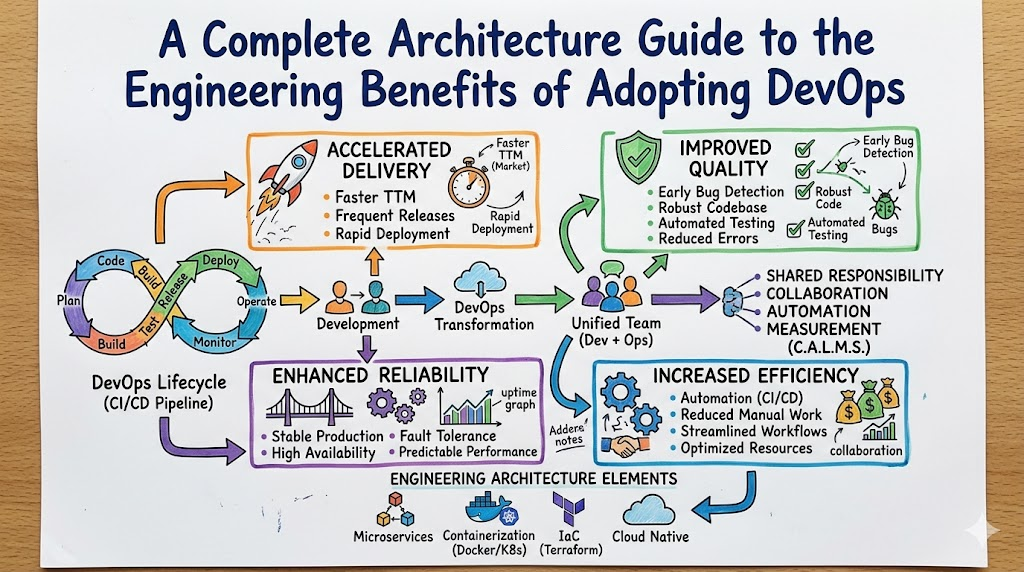
Introduction
Modern industries are undergoing rapid digital transformation. Companies that used to rely on physical storefronts now operate entirely through digital infrastructure. Software is no longer just a tool to support business operations. Today, software is the core engine that drives customer acquisition, data collection, and financial transactions across the globe.
This shifting landscape creates an unprecedented demand for faster software delivery. Customers expect web applications and mobile apps to update seamlessly without service interruptions. In a hyper-competitive market, a delay of days or weeks in shipping a software feature can result in lost revenue and diminishing market share.
Traditional IT delivery models struggle to keep pace with these modern operational requirements. Historically, engineering teams operated within rigid silos. Software developers focused exclusively on writing new code and features. Systems administrators and operations engineers focused entirely on maintaining infrastructure stability and keeping systems running.
This separation created conflicting incentives. Developers wanted to push changes into production as quickly as possible to meet feature targets. Operations teams wanted to limit changes because modifications often introduce stability risks, unexpected downtime, and resource conflicts. This operational gap created slow release cycles, high deployment failure rates, and long delivery friction.
To bridge this operational gap and build a unified delivery model, modern enterprises are shifting away from legacy workflows. Organizations are actively pursuing comprehensive DevOps adoption to unify their development systems, infrastructure practices, and quality assurance processes under a single operational framework.
[Legacy Model]  Dev Team ---> (Wall of Confusion) ---> Ops Team ---> Slow Manual Deployments
[DevOps Model]  Dev + Ops Team 🔄 Shared Automation 🔄 CI/CD Pipelines 🔄 Rapid Releases
By transitioning to an integrated culture of shared engineering responsibility, businesses can replace manual processes with reliable automated workflows. For teams seeking structured educational resources and implementation blueprints to successfully navigate this transition, organizations like DevOpsSchool provide specialized training frameworks designed to build the collaborative workflows and automation systems necessary for modern enterprise engineering.
What Is DevOps?
DevOps is a operational philosophy that combines software development and operations teams into a unified engineering group. It eliminates the traditional handoff phases where code is completed by one team and thrown over a wall to another for deployment and maintenance.
   [Plan]      ->      [Code]      ->     [Build]     ->    [Test]
     ^                                                           |
     |                                                           v
  [Monitor]    <-     [Operate]    <-    [Deploy]     <-   [Release]
At its core, DevOps focuses on continuous collaboration throughout the entire software development lifecycle. This starts at the initial planning stages and carries through code creation, testing, deployment, live operations, and ongoing infrastructure monitoring.
The foundation of DevOps relies heavily on an automation mindset. Instead of configuring servers manually or executing test scripts by hand, DevOps teams treat infrastructure and software configurations as code. This allows every stage of the delivery pipeline to be automated, version-controlled, and verified through repeatable processes.
Continuous improvement forms the final pillar of this engineering approach. Teams use real-world production metrics and user feedback loops to constantly refine their applications, optimize code performance, and improve the underlying delivery pipeline itself.
Why Organizations Are Adopting DevOps
Organizations are adopting DevOps primarily to satisfy accelerating market demands for faster feature delivery. In legacy frameworks, releasing a new software capability took months due to long manual testing and complex staging verifications. Today, companies must ship features in days or hours to keep pace with user expectations.
Modern consumers expect continuous value from their digital services. If a banking application or an e-commerce platform experiences slow performance, bugs, or lacks essential modern features, users can quickly migrate to a competitor. DevOps allows organizations to react to user issues and deliver product enhancements almost instantly.
The widespread shift toward cloud-native environments has also accelerated DevOps adoption. Traditional infrastructure relied on physical hardware racks that required manual management by specialized server administrators. Cloud systems rely on virtual assets, containerized clusters, and API-driven scaling that demand software-defined automation to be managed efficiently.
Competitive business pressures mean that companies using slow, manual processes risk falling behind automated competitors. Organizations adopt DevOps to protect market share, maximize engineering productivity, and ensure their technical infrastructure can rapidly adapt to sudden shifts in market demand.
Key Benefits of Adopting DevOps
Implementing a DevOps framework yields tangible advantages across engineering operations and high-level corporate performance. The following table highlights the direct relationship between specific DevOps engineering outcomes and their corresponding business impacts.
| DevOps Benefit | Business Impact |
| Faster Software Delivery | Shorter time-to-market, allowing faster feature monetization and competitive validation. |
| Improved Team Collaboration | Reduced organizational friction, higher employee retention, and clear cross-team alignment. |
| Better Quality and Reliability | Lower production defect rates, preserving brand reputation and reducing customer churn. |
| Faster Incident Recovery | Minimized operational downtime, preventing financial losses during infrastructure outages. |
| Increased Automation | Reduced engineering overhead, freeing high-skilled developers from manual, repetitive tasks. |
| Better Cloud Scalability | Efficient resource consumption, optimizing cloud infrastructure expenditures automatically. |
| Enhanced Security Integration | Reduced risk of data breaches, ensuring compliance with strict global data privacy laws. |
Faster Software Delivery
A central pillar of DevOps is the establishment of continuous integration and continuous delivery networks, universally known as CI/CD pipelines. These automation systems validate code updates the moment an engineer pushes changes to a central repository, preventing human errors and integration delays.
Continuous Integration automatically compiles new code submissions, runs comprehensive test suites, and flags syntax errors or regressions immediately. This prevents broken code from pooling in a development branch, allowing engineers to address flaws while the logic is fresh in their minds.
Developer Push ──> [ Jenkins / GitLab CI ] ──> Automated Build ──> Automated Test ──> Staging Artifact
Continuous Delivery extends this automated pipeline by packaging validated builds and preparing them for production environments. By automating the packaging, configuration matching, and artifact tracking phases, deployment becomes a predictable, low-risk event.
These combined automation frameworks allow software release cycles to accelerate significantly. Rather than organizing massive quarterly deployments that carry high failure risks, companies can issue micro-updates multiple times a day safely.
Consider a practical workplace example involving a subscription-based media streaming company. Under old frameworks, shipping a new personalized content recommendation module required manual code assembly, tedious database synchronization, and overnight maintenance windows.
With an active CI/CD pipeline, the new module moves through automated regression testing, passes staging security checks, and deploys to production during regular working hours without interrupting users.
Improved Collaboration Between Teams
Traditional software engineering models often suffer from deep organizational silos. Development teams operate inside an isolated bubble focused strictly on feature velocity, while operations engineers manage production servers without clear visibility into upcoming code architectures.
DevOps systematically breaks down these structural barriers by establishing a culture of shared engineering ownership. When developers share responsibility for production stability, and operations engineers contribute to early application architecture, goals align naturally across the entire technical department.
[Legacy Silos]:     [Dev Team] ──(No Visibility)──> [Ops Team]
[DevOps Culture]:   [Dev + Ops Unified Engineering] ──> Shared Tools, Goals, and Metrics
Communication improves because both groups utilize unified toolsets, shared dashboards, and common vocabularies. Instead of using separate tracking tools and filing blame-heavy tickets when errors arise, teams collaborate within a shared dashboard to resolve the underlying systemic issue.
Take an enterprise engineering team launching an updated payment API as an example. Instead of developers writing code blindly and passing it to operations for deployment, both teams collaborate from day one.
Operations engineers provide automated infrastructure templates tailored to the API’s memory footprint, while developers build native health check endpoints into their code. This shared ownership minimizes integration errors and deployment friction.
Better Software Quality and Reliability
DevOps improves overall software quality by shifting testing workflows earlier into the development process, an engineering practice known as shifting left. Rather than running quality assurance checks right before a major production release, automated tests execute continuously throughout the entire lifecycle.
These automated regression suites, unit tests, and integration checks analyze every code revision, identifying architectural flaws and memory leaks before they reach staging environments. This continuous verification ensures that production builds are structurally sound and free of basic logic failures.
System visibility and operational telemetry protect production reliability after code deployments. Engineers use advanced monitoring frameworks to gather continuous data on application behavior, server resources, and network traffic.
System Metrics ──> [ Prometheus Collection ] ──> Data Storage ──> [ Grafana Dashboard ] ──> Live Alerts
Tools like Prometheus act as data scrapers, pulling performance time-series data from microservices at regular intervals. This raw operational data feeds directly into visualization platforms like Grafana, converting infrastructure logs into readable dashboards.
These dashboards track core metrics such as application error rates, response latencies, and server memory consumption. If an update causes system latency to spike, the engineering team can pinpoint the exact service causing the slowdown and address it before it affects the broader user base.
Faster Incident Detection and Recovery
No software platform can maintain continuous uptime without occasional infrastructure or application incidents. The true differentiator for a high-performing engineering organization is how quickly they can identify, isolate, and recover from these live production errors.
DevOps addresses this challenge by pairing monitoring tools with automated alerting systems. When application errors exceed a predefined threshold, the alerting mechanism bypasses manual notification chains and pings the on-call engineering team directly with comprehensive debugging logs.
This continuous visibility reduces the Mean Time to Detection (MTTD) from hours down to seconds. Instead of waiting for angry customers to report a broken checkout button to support agents, engineers receive system notifications the moment error rates cross acceptable limits.
[Error Spikes] ──> Prometheus Alerts ──> On-Call Engineer Paged ──> Automated Git Revert ──> System Restored
Mean Time to Recovery (MTTR) improves significantly through standardized, automated rollbacks and reproducible environments. Because deployments operate through automated pipelines, reversing a problematic update is as simple as reverting a code commit and allowing the CI/CD pipeline to redeploy the last stable version.
Consider a real-world enterprise scenario where a global retail site experiences an unexpected database connection pool exhaustion during a high-traffic sales event.
The monitoring infrastructure detects the traffic anomaly and alerts the SRE team instantly. Because the environment was built using automated scripts, the engineer scales out temporary database read-replicas with a single command, restoring normal checkout functionality within minutes.
Increased Automation and Efficiency
Manual infrastructure configuration is slow, prone to human error, and difficult to scale consistently. DevOps replaces these manual tasks with comprehensive infrastructure automation, treating servers, networks, and storage components as software code.
Infrastructure as Code (IaC) allows engineers to define complex cloud environments using declarative configuration files. These files are stored in version control systems alongside application code, providing a clear historical record of all infrastructure modifications.
Declarative Code (.tf / .yml) ──> [ IaC Engine ] ──> Automated Cloud Provisioning (VMs, Networks, Disks)
Engineers use specialized automation tools to execute these infrastructure tasks reliably:
- Terraform: Orchestrates cloud topology, provisioning virtual networks, compute clusters, and storage volumes across diverse cloud providers using uniform configuration files.
- Ansible: Automates application configuration and system patch management, ensuring hundreds of remote servers maintain consistent software versions without manual SSH logins.
- Jenkins: Coordinates the continuous integration pipeline, orchestrating code pulls, triggering automated test runs, and executing downstream deployment playbooks.
[Code Commit] ──> Jenkins (Build/Test) ──> Terraform (Infrastructure) ──> Ansible (App Config)
Automating these workflows eliminates repetitive human tasks, reducing configuration drift across testing, staging, and production environments. Engineers can spend less time manually fixing server settings and focus more energy on developing high-value software features.
Improved Scalability and Cloud Readiness
Legacy applications were traditionally built as large, monolithic blocks of code deployed on fixed, single-server systems. When system traffic spiked, the only way to scale the application was to upgrade to a larger, more expensive server, a process known as vertical scaling.
DevOps practices are built for modern, cloud-native environments that leverage microservices architectures. By breaking a large system down into small, isolated services that run inside independent software containers, applications become highly resilient and easier to scale horizontally.
[Monolith Model]:    [ Single Large Server ] ──> Scales vertically by buying larger hardware.
[Cloud-Native]:      [ Pod 1 ] [ Pod 2 ] [ Pod 3 ] ──> Scales horizontally via Kubernetes HPA.
Kubernetes serves as the orchestration engine for these containerized workloads. It monitors live compute traffic and scales application instances up or down based on real-world system resource demands.
When application traffic spikes unexpectedly, Kubernetes automatically provisions additional container replicas across the underlying cloud cluster to distribute the incoming load.
Once traffic drops back to normal levels, the orchestration engine safely terminates the unneeded instances. This elastic scaling maintains application performance during high-demand events while preventing unnecessary infrastructure spending during low-traffic periods.
Better Security Through DevSecOps
In older software development models, security assessments were performed as an isolated review phase at the very end of the engineering lifecycle. This approach caused significant friction; finding a critical structural flaw right before launch meant delaying the release or shipping risky code.
DevSecOps remedies this by embedding security protocols directly into the existing DevOps pipeline, a philosophy known as shifting security left. Security validations operate as automated checks within the continuous integration engine, testing code adjustments at every step.
[Developer Code] ──> SAST Scan ──> Dependency Scan ──> Container Scan ──> Secure Staging Deploy
This automated security model leverages specialized scanning frameworks embedded within the deployment pipeline:
- Static Application Security Testing (SAST): Scans source code during compilation to flag vulnerable code patterns, injection risks, and exposed secrets before the build finishes.
- Software Composition Analysis (SCA): Evaluates open-source libraries and dependencies against active vulnerability databases to block insecure packages from entering production.
- Container Scanning: Examines container images for known system flaws and outdated packages, ensuring only secure, verified artifacts move down the delivery line.
Automating these compliance and vulnerability checks protects enterprise networks without slowing down delivery speeds. Security transforms from a manual gatekeeping step into an integrated, automated component of the engineering pipeline.
Real-World Example: Traditional IT Team
To understand the practical impact of DevOps, let us look at the operational workflow of a traditional software delivery team using manual engineering methods.
[Write Code] ──> [Manual Hand-off File] ──> [Manual QA Testing] ──> [Manual Server Config] ──> Production Error
- Step 1: Developers spend four weeks building an update on their local machines. They package the finished code into a zip archive and email it to the operations team with a long text file of manual installation instructions.
- Step 2: The operations engineer reads the text guide and manually logs into a staging server via SSH. They install dependencies by hand, adjust environment variables, and uncover a version conflict that stalls testing for two days.
- Step 3: After resolving the dependency conflict manually, the code moves to the testing team. Quality assurance testers run manual scripts over three days, documenting application bugs inside an isolated spreadsheet.
- Step 4: The bugs are sent back to the developers, who fix the issues locally and generate a new zip archive, restarting the manual installation process from scratch.
- Step 5: During production deployment night, the team takes the system offline for a four-hour maintenance window. An unrecorded configuration difference between staging and production causes the system to crash, forcing the team to spend hours manually troubleshooting the server or scrambling to roll back the changes.
Limitations of This Approach
This manual approach carries significant operational risks. Handoff delays extend feature time-to-market, manual configurations introduce human error, and a lack of system visibility makes resolving production issues slow and stressful.
Real-World Example: DevOps Team
Now, let us examine the same update moving through a modern engineering team utilizing a fully automated DevOps pipeline.
[Push Code] ──> [GitLab CI Runs Tests] ──> [Terraform Validates IaC] ──> [Blue-Green Zero-Downtime Deploy]
- Step 1: A developer finishes a feature update and pushes the code changes directly to a central GitLab repository.
- Step 2: The code push automatically triggers the CI/CD pipeline. The build runner compiles the code, executes hundreds of automated unit tests, runs a security vulnerability scan, and generates a standardized container image within five minutes.
- Step 3: The automated pipeline uses Terraform to build an identical clone of the production environment in a staging zone, ensuring there are no configuration differences between the two environments.
- Step 4: Automated integration tests run against the staging clone. Once all tests pass, the pipeline orchestrates a blue-green deployment to production. The new version (green) spins up alongside the active version (blue).
- Step 5: Production traffic routes smoothly to the green environment. Continuous monitoring tools monitor system health metrics; when error rates remain flat, the old blue environment spins down with zero application downtime.
Benefits of This Approach
This automated workflow removes manual friction from the delivery process. Code updates move from development to production predictably and safely, human error is eliminated, and engineers can deploy changes with confidence during regular business hours.
Business Benefits of DevOps Adoption
Beyond technical metrics like deployment frequency and test coverage, DevOps adoption provides direct business value that helps organizations succeed in competitive global markets.
Accelerated Delivery ──> Faster Time-to-Market ──> Captured Revenue ──> Enhanced Innovation Capital
Accelerated time-to-market is a significant commercial advantage. Launching features ahead of competitors allows businesses to capture market opportunities early, secure intellectual property, and build brand loyalty with an evolving user base.
Customer satisfaction increases when software updates roll out smoothly without service disruptions. Regular, bug-free feature updates show users that an organization listens to feedback, which helps reduce customer churn and increases long-term subscription revenue.
DevOps lowers operational costs by eliminating repetitive manual processes through automation. Replacing manual server setup and troubleshooting tasks with automated scripts reduces infrastructure management overhead and minimizes costly downtime.
Finally, DevOps drives business innovation. When engineers spend less time managing broken builds or manually configuring servers, they can focus more energy on researching new technologies, refining application architectures, and building features that create true business value.
Challenges in DevOps Adoption
While the advantages of DevOps are clear, transitioning to this operational model involves overcoming significant enterprise challenges. The table below lists common adoption obstacles along with practical solutions.
| Adoption Challenge | Root Operational Cause | Recommended Strategic Solution |
| Cultural Resistance | Teams fear changing established workflows and worry about shifting job responsibilities. | Start with a small pilot project to demonstrate success before scaling changes across the enterprise. |
| Tool Complexity | Managing many disconnected automation tools leads to fragmented workflows and tool fatigue. | Standardize on a unified platform framework that integrates your CI/CD, testing, and monitoring tools. |
| Technical Skill Gaps | Legacy teams may lack experience with advanced cloud architectures, IaC programming, and automation. | Invest in structured team training programs and provide dedicated learning paths for modern tools. |
| Legacy System Technical Debt | Monolithic architectures and old physical infrastructure can be difficult to automate. | Break down old monolithic systems step-by-step into modular, containerized microservices over time. |
Common Beginner Misunderstandings
When starting a DevOps transformation, beginners often run into common misconceptions that can misalign expectations and stall team progress.
- DevOps means only using tools: Many believe that simply installing tools like Jenkins, Terraform, or Kubernetes means they have adopted DevOps. In reality, tools are only useful if backed by a collaborative team culture and structured engineering processes.
- Automation solves every organizational problem: Automating a broken, disorganized process simply causes errors to propagate faster. Teams must clean up and optimize their workflows manually before writing automation scripts.
- DevOps removes the need for Operations teams: DevOps does not eliminate operations engineers. Instead, it evolves their role away from manual server administration and toward building automated platforms and scaling infrastructure alongside developers.
- DevOps transformation works instantly: Changing enterprise culture and rewriting legacy delivery pipelines takes time. It is a long-term commitment to continuous improvement, not a quick adjustment you can complete in a weekend.
Best Practices for Successful DevOps Adoption
Achieving a sustainable DevOps transformation requires a practical, step-by-step approach that balances cultural change with technical automation.
[Form Culture] ──> [Identify Small Project] ──> [Automate Core CI/CD] ──> [Measure DORA] ──> [Scale Enterprise]
First, focus on building a collaborative engineering culture. Encourage developers and operations engineers to share responsibility for system stability, and establish post-incident reviews that focus on improving systems rather than assigning blame.
Next, invest heavily in automating your delivery pipeline. Start by setting up a centralized source control repository and building a foundational continuous integration pipeline to automate your compilation and basic testing workflows.
Avoid trying to transform your entire enterprise infrastructure overnight. Start small by migrating a single low-risk internal tool or microservice to the new DevOps pipeline, allowing your team to refine their automation processes without risking customer-facing applications.
Track your progress using real-world performance data. Focus on standard DORA metrics to evaluate your delivery pipeline’s efficiency and stability over time:
- Deployment Frequency: How often your team successfully releases code to production.
- Lead Time for Changes: The time it takes for a commit to move from development to production.
- Change Failure Rate: The percentage of production deployments that result in service degradation.
- Time to Restore Service: How long it takes to recover from a production failure or outage.
Finally, prioritize continuous team education. Provide engineers with the training resources, technical sandboxes, and dedicated learning time needed to master infrastructure automation, cloud-native design, and modern monitoring frameworks.
Role of DevOpsSchool in Learning DevOps
Navigating a DevOps transformation requires deep technical expertise across a wide variety of automation tools, architectural styles, and operational methodologies. For both individual engineers and enterprise engineering teams, keeping pace with these evolving technologies requires structured guidance and practical hands-on experience.
Organizations like DevOpsSchool provide comprehensive training frameworks designed to help teams bridge technical skill gaps and master modern delivery systems. Their educational programs focus on practical, real-world application, helping students move past theoretical concepts to build functioning deployment pipelines.
The training programs offer deep exposure to continuous integration and continuous delivery configurations, allowing students to build robust pipelines using tools like Jenkins and GitLab CI. Participants gain practical experience managing cloud-native architectures, containerizing legacy software with Docker, and orchestrating large application deployments using Kubernetes.
By focusing on an automation mindset, these programs teach engineers how to manage complex cloud environments using Infrastructure as Code tools like Terraform and Ansible. This educational foundation helps teams eliminate manual configuration processes, break down organizational silos, and build the collaborative engineering practices required for a successful enterprise DevOps transformation.
Career Importance of DevOps Skills
The widespread adoption of DevOps across industries has created strong global demand for engineering professionals who combine software development skills with operational expertise.
                    ┌──> DevOps Engineer (CI/CD / Pipeline Architecture)
                    ├──> SRE Specialist (Reliability / Telemetry / Uptime)
[DevOps Mastery] ───┼──> Cloud Platform Architect (Infra-as-Code / Security)
                    └──> Platform Engineer (Developer Tooling & Self-Service)
Engineers can pursue several specialized roles within this automated ecosystem:
- DevOps Engineer: Designs and manages automated CI/CD pipelines, configures release management frameworks, and maintains core code repositories.
- Site Reliability Engineer (SRE): Focuses on system availability, optimization, and scaling, using monitoring tools to protect production reliability and manage error budgets.
- Cloud Engineer: Builds and secures cloud infrastructure, utilizing infrastructure automation tools to provision virtual networks and cluster assets across cloud providers.
- Platform Engineer: Creates internal developer platforms and self-service portals, giving development teams the automated tools they need to deploy code independently.
To succeed in these modern engineering roles, professionals must build a well-rounded technical skill set:
[CI/CD Engine Mastery] ──> [Cloud Infra Automation] ──> [Telemetry & Monitoring] ──> [Scripting & Core OS]
- CI/CD Pipeline Management: Building and managing automated build, test, and deployment workflows using tools like Jenkins, GitHub Actions, or GitLab CI.
- Cloud and Container Orchestration: Architecting resilient, scalable container networks using Docker and Kubernetes across major cloud platforms.
- Monitoring and Operational Telemetry: Configuring time-series data collections and log visualization tools like Prometheus, Grafana, and ELK stacks to monitor system health.
- Infrastructure Automation: Writing clean, reusable declarative configuration scripts with tools like Terraform and Ansible to manage infrastructure as code.
Industries Benefiting from DevOps
DevOps is no longer limited to forward-thinking consumer internet companies. It has become a core operational model across a wide variety of global industries.
[Banking & Finance] ──> Fast updates balanced with automated compliance checks.
[Healthcare Tech]   ──> Secure data handling paired with continuous infrastructure auditing.
[E-Commerce Tech]   ──> Elastic cloud auto-scaling during unpredictable holiday traffic spikes.
In the banking and financial sectors, companies use DevOps to launch digital banking features quickly while maintaining strict regulatory compliance. Automated security scanning and immutable deployment records ensure financial platforms stay secure and fully auditable by regulators.
The healthcare industry leverages DevOps to accelerate the distribution of patient care portals, medical imaging systems, and telemedicine applications. Shifting security left allows healthcare organizations to protect sensitive patient data while modernizing old legacy infrastructure.
For software-as-a-service (SaaS) providers, DevOps is foundational to their business model. Continuous delivery pipelines allow SaaS companies to ship feature updates and bug fixes directly to users multiple times a day without requiring manual software downloads.
E-commerce platforms rely on DevOps to survive major holiday shopping spikes. Automated infrastructure scaling allows online retailers to handle sudden surges in web traffic seamlessly, preventing performance drops and keeping checkout systems available during critical revenue windows.
Future of DevOps Adoption
The field of DevOps continues to evolve, incorporating new technological advancements to optimize software delivery and infrastructure management.
[GitOps Repositories] ──> [AI Automation Engines] ──> [Self-Healing Production Nodes]
Artificial intelligence is becoming deeply integrated into automation pipelines, an evolution known as AIOps. Teams use machine learning models to analyze system logs, predict potential hardware failures before they occur, and optimize cloud resource allocations automatically.
Platform engineering is transforming how enterprises manage internal developer workflows. Specialized platform teams build internal developer portals that provide product teams with self-service templates, automated access keys, and pre-configured deployment pipelines, allowing developers to manage workloads safely without manually configuring underlying servers.
The growth of GitOps has standardized infrastructure management around developer workflows. In a GitOps model, Git repositories serve as the single source of truth for an entire system’s state. Automated operators monitor the repository; if the live environment drifts from the stored code configuration, the system automatically corrects itself to match the repository.
Finally, production environments are shifting toward self-healing architectures. Modern monitoring systems can detect application memory leaks early and automatically restart affected container clusters or adjust routing pathways without requiring manual engineering intervention, driving system availability closer to absolute uptime.
FAQs (15 Questions)
What are the benefits of adopting DevOps?
Adopting DevOps accelerates software delivery speeds, enhances cross-team collaboration, reduces deployment failures, and lowers operational overhead. It replaces slow manual processes with automated pipelines, allowing organizations to release features reliably while maintaining high infrastructure uptime.
Why do companies adopt DevOps?
Companies adopt DevOps to keep pace with accelerating market demands and changing user expectations. Moving away from slow, siloed engineering models allows businesses to shorten time-to-market, respond quickly to competitor features, and manage modern cloud infrastructure efficiently.
Does DevOps improve software quality?
Yes. DevOps improves software quality by moving automated testing workflows earlier into the development lifecycle. Automated unit, integration, and security tests evaluate every code change, identifying bugs and architectural defects before they can reach production environments.
Is DevOps only about automation tools?
No. Tools are necessary to execute automation, but DevOps is fundamentally a combination of culture, processes, and people. It relies on breaking down organizational silos, establishing a culture of shared engineering responsibility, and committing to continuous system improvement.
How does DevOps improve collaboration?
DevOps improves collaboration by combining development and operations teams into a single engineering unit with shared metrics, unified dashboards, and common business goals. This shared ownership removes the traditional handoff friction and reduces blame when technical issues arise.
Can beginners learn DevOps?
Yes, beginners can learn DevOps by focusing on core foundational concepts first. Start by mastering version control with Git, learning basic Linux administration, understanding fundamental networking concepts, and gradually building simple automated CI/CD pipelines.
Why is monitoring important in DevOps?
Monitoring provides engineers with clear visibility into the real-world health and performance of production applications. Tools like Prometheus and Grafana track error rates, response latencies, and server usage, allowing teams to identify and resolve performance regressions early.
How does DevOps improve deployment speed?
DevOps increases deployment speed by replacing manual code configurations with automated CI/CD pipelines. These automation systems package application artifacts, run comprehensive testing suites, and handle production rollouts automatically, reducing release times from months down to minutes.
What is the role of CI/CD in DevOps?
CI/CD forms the central automation engine of a DevOps pipeline. Continuous Integration validates and tests new code changes automatically, while Continuous Delivery ensures packaged software artifacts are verified and ready for deployment to staging or production environments.
How does DevSecOps protect application security?
DevSecOps embeds security checks directly into the existing automation pipeline rather than leaving reviews for the final stage of development. Automated tools scan source code, evaluate open-source dependencies, and verify container images, catching security vulnerabilities early.
What is Infrastructure as Code (IaC)?
Infrastructure as Code is the practice of managing and provisioning computing assets, virtual networks, and storage volumes using declarative configuration files. This allows infrastructure to be version-controlled, tested, and reproduced reliably without manual server setups.
What are DORA metrics?
DORA metrics are four core industry standards used to measure the efficiency and stability of a software delivery team. They track deployment frequency, lead time for changes, change failure rate, and mean time to restore service.
How does Kubernetes fit into DevOps?
Kubernetes acts as the container orchestration engine for modern cloud-native applications. It automatically scales container workloads up or down based on real-world system traffic, manages network routing, and ensures application instances remain highly available.
What is the difference between DevOps and SRE?
DevOps is a broad operational philosophy focused on breaking down team silos and automating the software lifecycle. Site Reliability Engineering (SRE) is a specific implementation of DevOps that applies software engineering principles directly to infrastructure operations and production reliability.
How long does it take to see the benefits of DevOps?
Initial improvements, such as faster automated testing and reduced build errors, are often visible within weeks of setting up a basic CI/CD pipeline. However, full enterprise-wide transformation and deep cultural shifts typically progress over several months as teams scale their automation frameworks.
Final Thoughts
DevOps is not a temporary industry trend or a collection of software tools. It is a fundamental shift in how modern organizations build, deliver, and maintain software platforms. By combining people, processes, and technology into a single engineering framework, DevOps replaces organizational silos with a culture of shared responsibility and continuous improvement.
True DevOps success balances cultural transformation with automated engineering practices. While infrastructure automation provides consistency and eliminates manual human errors, it is the underlying culture of open collaboration and psychological safety that allows teams to innovate and respond quickly to changing market conditions.
Ultimately, DevOps is a long-term commitment to operational excellence. By focusing on small, iterative changes, automating repetitive tasks, and using real-world production metrics to guide development, companies can build the resilient infrastructure and agile engineering teams needed to thrive in a digital economy.